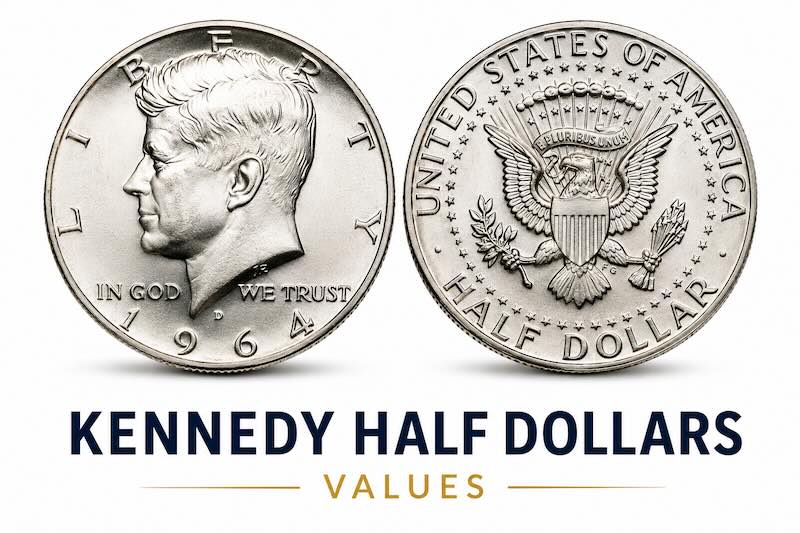
Kennedy half dollars have been struck every year since 1964, but what each coin is worth depends almost entirely on its date. A 1964 Kennedy contains 0.3617 troy ounces of 90% silver. A 1972 Kennedy contains none at all. That single variable — silver content — separates coins worth well over $10 from coins worth fifty cents.
This guide covers every Kennedy half dollar from 1964 to the present: the three composition eras, how to identify silver content by date and edge color, values by year and grade, key dates and error varieties that carry premiums above melt, live melt value calculations, and how Kennedy halves compare to other silver half dollar series for bullion buyers.
History and Design of the Kennedy Half Dollar
Congress authorized the Kennedy half dollar in December 1963, less than a month after President John F. Kennedy’s assassination on November 22. The legislation moved through both chambers faster than any other coinage bill in modern history. Jacqueline Kennedy personally approved the design and requested that the half dollar — rather than the quarter — bear her husband’s portrait, so that George Washington would not be displaced from everyday commerce.
Chief Engraver Gilroy Roberts designed the obverse portrait of President Kennedy, adapting it from the inaugural medal he had created in 1961. The reverse features a heraldic eagle based on the Presidential Seal, designed by Assistant Engraver Frank Gasparro. Both designs have remained largely unchanged for over 60 years, with only minor modifications to the hair detail and mint mark placement along the way.
Production began in January 1964 at the Philadelphia and Denver Mints. Public demand was overwhelming. Banks limited purchases. Bags of the new half dollars were hoarded almost immediately, with many going straight into dresser drawers rather than cash registers. That hoarding impulse, combined with the coin’s silver content, explains why so many 1964 Kennedy halves survive in above-average condition today.
Three Composition Eras: Silver Content by Year
The U.S. Mint changed the Kennedy half dollar’s composition twice, creating three distinct groups. Which group your coin falls into determines whether it has any silver value at all.
1964: 90% Silver (0.3617 Troy Oz)
The first Kennedy halves were struck in 90% silver and 10% copper, the same alloy used for U.S. half dollars since the late 1830s. Each coin weighs 12.50 grams and contains 0.3617 troy ounces of pure silver. These are the most valuable Kennedy halves for bullion buyers and remain the most traded date in the series.
1965-1970: 40% Silver Clad (0.1479 Troy Oz)
The Coinage Act of 1965 eliminated silver from dimes and quarters entirely but kept a reduced silver content in half dollars. These coins use a silver-clad sandwich construction: an outer layer of 80% silver bonded to an inner core of 20.9% silver. Each coin weighs 11.50 grams and contains 0.1479 troy ounces of pure silver — roughly 41% of a 1964 coin’s silver weight. The 40% silver melt value calculator tracks what these coins are worth in real time.
1971-Present: Copper-Nickel Clad (No Silver)
Starting in 1971, the Mint removed all silver from circulation-strike half dollars. These coins use the same copper-nickel clad composition as modern quarters and dimes: a pure copper core sandwiched between layers of 75% copper and 25% nickel. They contain no precious metal and are worth face value in circulated condition.
There is one ongoing exception. Silver proof Kennedy halves have been struck at the San Francisco Mint every year from 1992 to the present. From 1992 through 2018, these collector coins used the original 90% silver composition (0.3617 oz silver). Starting in 2019, the Mint switched to .999 fine silver for proof sets. Either way, silver proofs are sold through collector products, not released into circulation.
Kennedy Half Dollar Silver Content Quick Reference
| Years | Composition | Weight | Silver Content (Troy Oz) | Today’s Melt Value |
|---|---|---|---|---|
| 1964 | 90% silver, 10% copper | 12.50 g | 0.3617 oz | $22.90 |
| 1965-1970 | 40% silver clad | 11.50 g | 0.1479 oz | $9.36 |
| 1971-present (circulation) | Copper-nickel clad | 11.34 g | 0 oz | $0.50 (face value) |
| 1992-2018 (S-proof) | 90% silver | 12.50 g | 0.3617 oz | $22.90 |
| 2019-present (S-proof) | .999 fine silver | 12.50 g | 0.4019 oz | $25.44 |
Melt values in the table above update automatically with the current silver spot price. For a full breakdown across all silver coin denominations, see our half dollar melt value calculator.
How to Tell If Your Kennedy Half Dollar Is Silver
Before looking up values, determine which composition era your coin falls into. Three methods will confirm it.
Check the date. If the coin reads 1964, it is 90% silver. If it reads 1965 through 1970, it is 40% silver. If it reads 1971 or later, it is clad — unless it is an S-mint proof from 1992 onward.
Check the edge. This is the fastest confirmation when the date is worn or hard to read. A 1964 half dollar has a solid silver-white edge with no visible color change. A 1965-1970 half dollar shows a thin line of copper visible at the rim where the silver-clad layer meets the copper core. A clad coin from 1971 onward has a thick copper-orange stripe on the edge.
Weigh the coin. A 1964 Kennedy weighs 12.50 grams. A 40% silver Kennedy weighs 11.50 grams. A clad Kennedy weighs 11.34 grams. A basic kitchen scale accurate to 0.1 grams is enough to distinguish the 90% silver coins from the others. The difference between 40% silver and clad is only 0.16 grams, so weight alone may not be definitive for those two — check the edge instead.
For a broader guide to identifying silver coins across all U.S. denominations, see our article on collecting 90% silver half dollar coins.
1964 Kennedy Half Dollar Value
The 1964 Kennedy half dollar is the coin that started the series and the one most people ask about. Two mints produced them: Philadelphia (no mint mark) and Denver (D mint mark on the reverse, below the eagle’s tail feathers).
Mintage: Approximately 277 million from Philadelphia and 156 million from Denver, for a combined total exceeding 430 million coins. Despite those production numbers, the coins were hoarded almost immediately after release. Public demand following President Kennedy’s assassination meant most 1964 halves went straight into private hands rather than cash registers.
Silver content: 0.3617 troy ounces of .900 fine silver per coin. At today’s silver spot price, each 1964 Kennedy half dollar’s silver melt value is $22.90. You can check the live 1964 Kennedy half dollar melt value on our calculator, which updates with spot.

| Condition | 1964 (P) Value | 1964-D Value |
|---|---|---|
| Circulated (AG-VF) | Silver melt value | Silver melt value |
| AU (About Uncirculated) | Melt + $1-3 | Melt + $1-3 |
| MS63 (Uncirculated) | $20-$30 | $20-$30 |
| MS65 | $30-$80 | $30-$80 |
| MS66 | $80-$200 | $80-$200 |
| MS67+ | $200-$500+ | $200-$500+ |
The vast majority of 1964 Kennedy halves in circulation are worth their silver melt value, nothing more. The mintage was too large for common examples to carry a numismatic premium. Only coins grading MS66 or higher begin to separate from melt. Several rare 1964 varieties — the Accented Hair Proof and the 1964-D Doubled Die Obverse (DDO FS-101) — carry premiums of hundreds to thousands of dollars and are covered in the key dates section below.
1965-1970 Kennedy Half Dollar Values (40% Silver)
The 40% silver Kennedy halves from 1965-1970 are the most overlooked coins in the series. They contain real silver — 0.1479 troy ounces per coin, worth $9.36 at today’s spot — but trade at lower premiums than their 1964 counterparts. For bullion buyers focused on accumulating ounces at the lowest cost over spot, these are often the best value among Kennedy halves. Our 40% silver melt value calculator tracks what they are worth in real time.
No mint marks were used on any 1965-1967 coins. The Mint temporarily suspended mint mark usage as part of the Coinage Act of 1965 reforms, making Philadelphia and Denver coins from those years indistinguishable. Mint marks returned in 1968.
| Year | Mint Mark | Mintage | Circulated | MS63 | MS65 | MS66+ |
|---|---|---|---|---|---|---|
| 1965 | None | 65.9M | Silver melt | $4-$8 | $15-$30 | $50-$200 |
| 1966 | None | 108.9M | Silver melt | $4-$8 | $15-$30 | $75-$250 |
| 1967 | None | 295.0M | Silver melt | $4-$6 | $12-$25 | $50-$150 |
| 1968-D | D | 246.9M | Silver melt | $4-$6 | $12-$25 | $50-$150 |
| 1969-D | D | 129.9M | Silver melt | $4-$8 | $15-$30 | $75-$200 |
| 1970-D | D | 2.15M | $15-$20 | $20-$30 | $30-$60 | $75-$300+ |
A few notes on individual dates:
- 1965-1967 SMS specimens: Special Mint Sets from 1965-1967 have a slightly different finish than regular business strikes. SMS coins with deep cameo contrast can bring $50-$100+ in top grades.
- 1967: The highest-mintage 40% silver Kennedy at 295 million. These are among the most common 40% silver coins in existence and are readily available in rolls and bags from bullion dealers.
- 1968-S and 1969-S proofs: The San Francisco Mint produced 40% silver proof halves in 1968 and 1969. These sell for $8-$15 in typical proof condition, with deep cameo examples bringing $20-$50.
- 1970-D: The sleeper of the 40% silver era. Produced only for mint sets and never released into general circulation. At just 2.15 million struck, it is the lowest-mintage Kennedy half dollar from the silver era by a wide margin. If you find one in a junk silver bag or a collection, set it aside — it carries a meaningful premium above melt even in lower uncirculated grades.
The 40% silver halves fall into the broader category of junk silver, which trades based on silver content rather than face value. They often carry lower premiums than 90% silver coins, making them a cost-effective entry point for new silver stackers.
1971-1974 Kennedy Half Dollar Values (Copper-Nickel Clad)
Starting in 1971, all circulation-strike Kennedy halves switched to copper-nickel clad. These coins contain no silver and are worth face value in circulated condition.
| Year | Mintage (P+D combined) | Circulated | MS65 | MS66+ |
|---|---|---|---|---|
| 1971 / 1971-D | 457.3M | $0.50 | $3-$5 | $15-$50 |
| 1972 / 1972-D | 295.1M | $0.50 | $3-$5 | $15-$50 |
| 1973 / 1973-D | 148.1M | $0.50 | $3-$5 | $20-$60 |
| 1974 / 1974-D | 266.2M | $0.50 | $3-$5 | $15-$50 |
The only coins from this era worth more than a few dollars are uncirculated examples in original mint sets or rolls, and two notable error varieties: the 1972 (no mint mark) Doubled Die Obverse (DDO FS-101) and the 1974-D Doubled Die Obverse. Both are covered in the key dates section below.
1776-1976 Bicentennial Kennedy Half Dollar Value
The Bicentennial Kennedy half dollar features a special reverse design by Seth Huntington showing Independence Hall. These coins carry a dual date “1776-1976” and were produced during both 1975 and 1976. No 1975-dated Kennedy halves exist.
Two versions were made:
- Copper-nickel clad (Philadelphia and Denver): Mintage exceeded 521 million. These are worth face value in circulated condition and $2-$5 in uncirculated grades.
- 40% silver clad (San Francisco): Approximately 11 million struck for collector sets. These contain 0.1479 troy ounces of silver and are worth their silver melt value of $9.36 plus a modest collector premium of $3-$10.
| Version | Circulated | MS/PR 65 | MS/PR 67+ |
|---|---|---|---|
| Clad (P or D) | $0.50 | $3-$5 | $15-$50 |
| Silver (S) | Silver melt + $3 | $10-$15 | $25-$75 |
Despite being popular with non-collectors who assume they are rare, the half-billion-plus clad mintage makes Bicentennial halves one of the most common Kennedy varieties in existence.
1977-Present: Modern Clad Kennedy Half Dollars
From 1977 to 2001, the Mint continued producing Kennedy halves for general circulation, though they became increasingly uncommon in everyday commerce. From 2002 to 2020, Kennedy halves were produced only for collector products — mint sets, proof sets, rolls, and bags ordered directly from the U.S. Mint. In 2021, the Mint resumed shipping half dollars to the Federal Reserve for general circulation.
Most modern clad Kennedy halves are worth face value. The exceptions are limited:
- Clad proof coins from annual proof sets: $3-$10 in typical condition.
- Silver proofs (1992-present, S-mint): worth their silver melt value plus a $3-$10 collector premium. The 90% silver proofs (1992-2018) contain 0.3617 oz silver; the .999 fine silver proofs (2019-present) contain 0.4019 oz.
- High-grade business strikes (MS67+): $10-$50 for common dates, more for scarcer issues.
- The 1998-S Matte Finish: The key modern rarity, worth $150-$3,000+ depending on grade. Covered in detail in the key dates section below.
Kennedy Half Dollar Key Dates and Error Coins
While most Kennedy halves are worth melt value or face value, several varieties across the series carry real numismatic premiums. These are the coins worth examining carefully before selling for silver weight.
1964 Accented Hair Proof
Early 1964 proof strikes used a die with extra detail in Kennedy’s hair, particularly above the ear. The U.S. Mint modified the dies shortly after production began, making these “Accented Hair” proofs scarcer than the standard proof variety. The difference is subtle but visible under magnification — look for stronger, more defined hair strands above Kennedy’s ear compared to the standard proof.
| Grade | Approximate Value |
|---|---|
| PR63-PR64 | $75-$150 |
| PR65 | $150-$200 |
| PR66 DCAM | $300-$500 |
| PR67 DCAM | $500-$1,000 |
| PR68 DCAM | $3,000-$6,000 |
PR68 Deep Cameo examples have sold at auction for $6,000 through PCGS-verified sales. These are legitimate four-figure coins in top grades.
1964-D Doubled Die Obverse (DDO FS-101)
The most significant business-strike error in the Kennedy series. This Denver Mint variety shows clear doubling on “IN GOD WE TRUST” and on the date. It is cataloged as FS-101 (First Strike 101) in the Cherrypickers’ Guide. The doubling is visible to the naked eye on strong examples, making it one of the more accessible DDO varieties to identify without specialized equipment.
| Grade | Approximate Value |
|---|---|
| VF-XF (circulated) | $50-$100 |
| MS60 | $150 |
| MS63 | $250 |
| MS65 | $500 |
| MS67+ | $1,000-$2,000 |
Because these are 90% silver coins, even a misidentified example still holds its full silver melt value of $22.90 as a floor.
1970-D Kennedy Half Dollar
Not an error coin, but the key date of the 40% silver era. With a mintage of just 2.15 million — produced exclusively for inclusion in 1970 Mint Sets — the 1970-D is the scarcest regular-issue silver Kennedy by a wide margin. In MS67, examples have sold for $300 or more. Even in MS63, the 1970-D trades at $20-$30, well above its silver melt value of $9.36.
1972 Doubled Die Obverse (DDO FS-101)
A well-known error on a clad (non-silver) coin. The doubling is visible on “TRUST” and “LIBERTY” and can be seen with the naked eye on strong examples. This is a Philadelphia coin with no mint mark.
| Grade | Approximate Value |
|---|---|
| VF-XF (circulated) | $50-$100 |
| MS63 | $100-$200 |
| MS65 | $350-$850 |
| MS66+ | $1,000+ |
1974-D Doubled Die Obverse
A less well-known DDO variety, also on a clad coin. The doubling appears on “LIBERTY” and “IN GOD WE TRUST.” Numismatic value in MS65 runs $100-$300 depending on the strength of the doubling. This coin has no silver content, so its value is entirely numismatic.
1998-S Matte Finish Kennedy
The key modern rarity in the Kennedy series. The 1998-S Matte Finish half dollar was included exclusively in the Robert F. Kennedy commemorative coin set. It has a distinctive satin-like surface that differs from both business strikes and standard proofs. Only 62,000 sets were produced, and many were broken up or damaged over the years. PCGS and NGC grade these with an “SP” (Specimen) designation.
| Grade | Approximate Value |
|---|---|
| SP65 | $150-$200 |
| SP67 | $300-$500 |
| SP68 | $1,000-$2,000 |
| SP69 | $3,000+ |
The 1998-S Matte Finish is a copper-nickel clad coin with no silver content. Its value is entirely numismatic. For more on rare half dollar varieties across all series, see our guide to rare numismatic half dollar coins and values.
2014-W Gold Kennedy Half Dollar
For the 50th anniversary of the Kennedy half dollar, the U.S. Mint struck a special gold version at the West Point Mint: 3/4 troy oz of .9999 fine gold in a proof finish. The original issue price was $1,240, and the coin sold out quickly. Its current market value tracks gold spot price plus a collector premium. At today’s gold prices, the melt value alone places this coin well above its original issue price.
Key Kennedy Half Dollar Value Summary
| Coin | Silver? | Circulated | MS/SP 65 | MS/SP 67+ |
|---|---|---|---|---|
| 1964 (regular) | Yes, 90% | Melt ($22.90) | $30-$80 | $200-$500+ |
| 1964 Accented Hair Proof | Yes, 90% | N/A (proof only) | $150-$200 (PR65) | $500-$6,000 |
| 1964-D DDO FS-101 | Yes, 90% | $50-$100 | $500 | $1,000-$2,000 |
| 1965-1969 (regular) | Yes, 40% | Melt ($9.36) | $12-$30 | $50-$250 |
| 1970-D | Yes, 40% | $15-$20 | $30-$60 | $300+ |
| 1971-present (regular) | No | $0.50 | $3-$5 | $10-$50 |
| 1972 DDO FS-101 | No | $50-$100 | $350-$850 | $1,000+ |
| 1974-D DDO | No | $20-$50 | $100-$300 | $500+ |
| 1998-S Matte Finish | No | N/A | $150-$200 (SP65) | $300-$3,000+ |
| 2014-W Gold | Gold (.9999) | N/A | Gold melt + premium | Gold melt + premium |
How to Calculate Your Kennedy Half Dollar’s Melt Value
If your Kennedy half dollar is from 1964 or 1965-1970, its floor value is tied to the price of silver. Here is the math behind the numbers.
1964 (90% silver): Weight (12.50 grams) x 0.900 purity / 31.1035 (grams per troy ounce) = 0.3617 troy oz of silver. Multiply by today’s silver spot price. At current spot, each 1964 Kennedy half dollar is worth $22.90 in silver alone.
1965-1970 (40% silver): Total silver content = 0.1479 troy oz per coin. Multiply by today’s silver spot price. At current spot, each 40% silver Kennedy half dollar is worth $9.36 in silver.
You do not need to do this math yourself. Our half dollar melt value calculator runs these calculations live for both 90% and 40% silver Kennedy halves, and our 40% silver melt value calculator covers the 1965-1970 dates specifically. Both update automatically with the current silver spot price.
Melt value per roll and bag: Bullion Kennedy halves trade in standard face-value quantities. Here is what each lot size contains in silver:
| Quantity | Coins | 90% Silver (1964) | 40% Silver (1965-1970) |
|---|---|---|---|
| $1 face value | 2 | 0.7234 oz silver | 0.2958 oz silver |
| $10 face roll | 20 | 7.234 oz silver | 2.958 oz silver |
| $100 face bag | 200 | 72.34 oz silver | 29.58 oz silver |
Where the Mint Mark Is Located
The mint mark location on Kennedy half dollars changed over the years:
- 1964: Reverse, just below the eagle’s tail feathers. Philadelphia coins have no mint mark; Denver coins carry a “D.”
- 1965-1967: No mint mark on any coin. The Mint suspended mint mark usage during this period.
- 1968-present: Obverse, just below the date on Kennedy’s neck truncation. D = Denver, S = San Francisco (proofs and silver issues), W = West Point (special issues like the 2014 Gold Kennedy).
Buying Silver Kennedy Half Dollars
Kennedy halves are one of the most liquid silver coins on the secondary bullion market. High mintages, a familiar design, and standardized face-value packaging make them easy to buy and easy to sell. Here is what to know when shopping.
90% Silver (1964)
These are the most traded Kennedy halves. Bullion premiums on 1964 halves typically run 3-10% over melt when purchased in roll ($10 face) or bag ($100 face) quantities. At the single-coin level, premiums are higher. FBP tracks live bullion pricing on 1964 Kennedy half dollars across dealers so you can sort by lowest premium and buy at the best available price. You can find deals across all silver products on our closest to spot silver page.
40% Silver (1965-1970)
The 40% halves carry lower premiums than 90% coins and are often sold in $100 face value bags. They are a viable option for accumulating silver at a lower per-transaction cost, though you need significantly more coins to match the silver weight of a 1964 lot. A $100 face value bag of 40% halves contains 29.58 oz of silver, compared to 72.34 oz in a $100 bag of 1964 coins. For a full buying strategy on budget silver, see our junk silver buying guide.
Graded vs. Raw
For regular-date Kennedy halves, professional grading rarely makes economic sense unless the coin grades MS66 or higher. The cost of grading ($20-$40 per coin) often exceeds the premium that a slab adds to a common-date coin. For error coins and key dates — the 1964-D DDO, 1964 Accented Hair, 1998-S Matte Finish — grading is worth the cost because it authenticates the variety and protects the coin’s value. Raw coins claimed as DDO varieties sell at steep discounts because buyers factor in the risk of misattribution.
Authentication on Errors
If you believe you have a 1964-D DDO FS-101 or 1964 Accented Hair proof, get it authenticated by PCGS or NGC before selling. The premium difference between a certified and uncertified error coin is substantial. A certified MS65 1964-D DDO sells for around $500; an uncertified one might bring $150-$250.
Kennedy Half Dollars vs. Other Silver Half Dollar Series
The Kennedy half is the youngest of four 20th-century silver half dollar series. If you are deciding which silver halves to buy for bullion or collecting purposes, here is how they compare.
| Series | Years | Silver | Typical Circulated Premium |
|---|---|---|---|
| Barber Half Dollar | 1892-1915 | 90% | Melt + 20-50% |
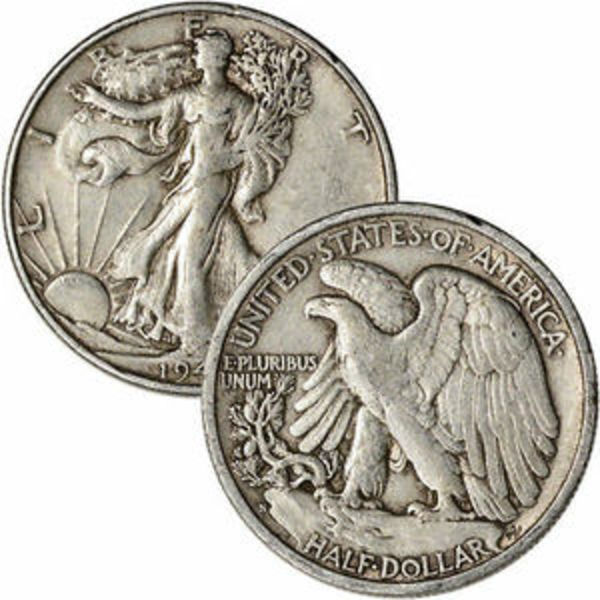
| Walking Liberty Half Dollar | 1916-1947 | 90% | Melt + 10-30% |
| Franklin Half Dollar | 1948-1963 | 90% | Melt + 5-15% |
| Kennedy Half Dollar | 1964 | 90% | Melt + 3-10% |
| Kennedy Half Dollar | 1965-1970 | 40% | Melt + 0-5% |
Kennedy halves consistently trade at the lowest premiums among 90% silver half dollars because of their massive mintage and modern appearance. For silver stackers focused purely on accumulating ounces at the lowest cost over spot, Kennedy halves are often the best deal in the half dollar category. Barber halves carry the highest premiums due to age and lower survival rates. Walking Liberty halves split the difference — they trade above Kennedy premiums but below Barber premiums, with the added appeal of what many collectors consider the most beautiful U.S. coin design.
For a broader look at where Kennedy halves fit into a diversified precious metals portfolio, see our guide on the best precious metal to invest in.
Selling Kennedy Half Dollars
What you get for your Kennedy halves depends on what you have and who you sell to.
Common-date 1964 halves in circulated condition are worth their silver melt value. Online bullion dealers typically buy at 90-97% of melt for 90% silver coins purchased in bulk. Local coin shops offer similar or slightly lower percentages. Do not accept less than 85% of melt for common silver Kennedys — the market is liquid enough that you should be able to do better.
40% silver halves (1965-1970) sell at a slight discount to 90% coins on a percentage basis. Dealers prefer 90% silver because it packs more silver per coin and is easier to process. Expect buy-back offers of 85-95% of melt for 40% halves.
Key dates and error varieties — 1970-D, 1964-D DDO, 1964 Accented Hair, 1998-S Matte Finish — should be evaluated for numismatic value before selling for melt. Even the most common of these, the 1970-D, is worth $15-$20 or more in any grade, well above its 40% silver melt of $9.36. Selling a 1998-S Matte Finish for melt would be a serious financial mistake.
Clad Kennedy halves (1971-present) with no error varieties are worth face value. Coin shops and dealers generally will not buy them unless they are part of a larger lot.
Should You Clean Your Kennedy Half Dollars?
No. Cleaning coins reduces their numismatic value. Professional grading services will designate cleaned coins as “details” grades, which sell for significantly less than problem-free examples at the same technical grade. If you are selling for silver melt value only, cleaning is irrelevant to the price you receive — but it is still not recommended, because you may not realize a coin has numismatic value until after you have damaged it.
Frequently Asked Questions
How much is a 1964 Kennedy half dollar worth?
In circulated condition, a 1964 Kennedy half dollar is worth its silver melt value. Each coin contains 0.3617 troy ounces of 90% silver, giving it a current melt value of $22.90. Check the live value on our half dollar melt value calculator. Uncirculated examples in MS65 or higher can sell for $30-$500+ depending on grade.
What makes a 1964 Kennedy half dollar rare?
Standard 1964 Kennedy halves are not rare — over 430 million were produced. Certain 1964 varieties are valuable: the Accented Hair Proof (PR68 DCAM: $3,000-$6,000) and the 1964-D Doubled Die Obverse FS-101 (MS67+: $1,000-$2,000). Condition also matters — coins grading MS67 or higher are scarce regardless of variety.
How much is a 1967 Kennedy half dollar worth?
A 1967 Kennedy half dollar contains 40% silver (0.1479 troy oz) and is worth its silver melt value of $9.36 in circulated condition. The 1967 had the highest mintage (295 million) of any 40% silver Kennedy, so it carries no numismatic premium in typical grades. In MS65, expect $12-$25.
How much silver is in a Kennedy half dollar?
It depends on the year. A 1964 Kennedy contains 0.3617 troy ounces of .900 fine silver (12.50 grams total, 11.25 grams pure silver). A 1965-1970 Kennedy contains 0.1479 troy ounces (40% silver clad). A 1971 or later Kennedy contains no silver unless it is an S-mint proof from 1992 onward.
What is a 1776-1976 Kennedy half dollar worth?
Clad Bicentennial Kennedy halves (P or D mint) are worth face value — fifty cents. Over 521 million were struck. The 40% silver San Francisco versions (S mint) are worth their silver melt value of $9.36 plus a small collector premium.
What is the most valuable Kennedy half dollar?
The highest auction prices have gone to 1964 Accented Hair proofs in PR68 Deep Cameo, which have sold for $6,000 or more. Among business strikes, the 1964-D DDO FS-101 in MS67 can reach $2,000. The 1998-S Matte Finish in SP69 has also sold for over $3,000. The 2014-W Gold Kennedy tracks gold spot price and is currently worth well over its $1,240 issue price.
Are Kennedy half dollars still being made?
Yes. The U.S. Mint still produces Kennedy half dollars for mint sets, proof sets, and direct orders, though they are no longer a fixture in everyday circulation. All circulation strikes from 1971 onward are copper-nickel clad with no silver content. Silver proof versions continue to be produced for annual silver proof sets.
Where is the mint mark on a Kennedy half dollar?
On 1964 coins, the mint mark is on the reverse below the eagle’s tail feathers. From 1965 to 1967, no mint marks were used. Starting in 1968, the mint mark moved to the obverse, just below the date on Kennedy’s neck truncation.
Should I sell my Kennedy half dollars for silver or keep them?
If your coins are common-date 1964 halves in circulated condition, they are worth more as bullion silver than as collectibles. If you have coins dated 1970-D, 1998-S Matte Finish, or any recognized error variety (1964-D DDO, 1972 DDO, 1974-D DDO), have them evaluated for numismatic value before selling for melt. Clad halves from 1971 onward with no errors are worth face value and can be spent or deposited.
Disclaimer
The values and estimates in this article are based on recent market data and are intended for informational purposes only. Actual prices may vary based on condition, market demand, dealer markup, and other factors. Coin values can fluctuate with changes in the silver spot price and collector demand. This article does not constitute financial or investment advice. Always do your own research and consult with a qualified professional before making purchasing or selling decisions.