Junk silver refers to circulated U.S. coins whose value comes from their silver content, not from collector demand. The term covers pre-1965 dimes, quarters, half dollars, and silver dollars minted in 90% silver, plus 40% silver Kennedy halves (1965-1970) and 35% silver War Nickels (1942-1945). Despite the name, there is nothing “junk” about the metal — the label means only that these coins carry no significant numismatic premium above their melt value.
Junk silver has been a staple of physical silver investing for decades: the coins are fractional by nature, widely recognized, hard to counterfeit at scale, and frequently available at some of the lowest premiums in the silver market. Below: what qualifies as junk silver, how to calculate what each coin is worth, current premiums and market conditions, and how to buy at the best prices.
What Counts as Junk Silver
Three categories of U.S. coins fall under the junk silver umbrella, distinguished by their silver content.
90% Silver Coins (Pre-1965)
The core of the junk silver market. From the founding of the U.S. Mint through 1964, dimes, quarters, half dollars, and silver dollars were minted in an alloy of 90% silver and 10% copper. The Coinage Act of 1965 ended silver coinage for circulation, making every surviving pre-1965 coin a silver coin by default.
The most commonly traded 90% silver coins are:
Roosevelt Dimes (1946-1964) — the most common junk silver dime. Each contains 0.0715 troy oz of silver. Current melt value: ~$4.63
Mercury Dimes (1916-1945) — same silver content as Roosevelt dimes (0.0715 ozt) but older and sometimes carrying modest collector premiums for early dates and mint marks
Washington Quarters (1932-1964) — the workhorse of the junk silver market. Each contains 0.1808 troy oz of silver. Current melt value: ~$11.70. Silver quarters guide has the full breakdown.
Standing Liberty Quarters (1916-1930) — same silver content as Washington quarters. Older and less common, so they can carry a slight premium depending on condition and date.
Franklin Half Dollars (1948-1963) — each contains 0.3617 troy oz of silver. Current melt value: ~$23.40
1964 Kennedy Half Dollars — the last 90% silver half dollar. Same 0.3617 ozt silver content as Franklins. The 1964 Kennedy is the most common 90% silver half dollar.
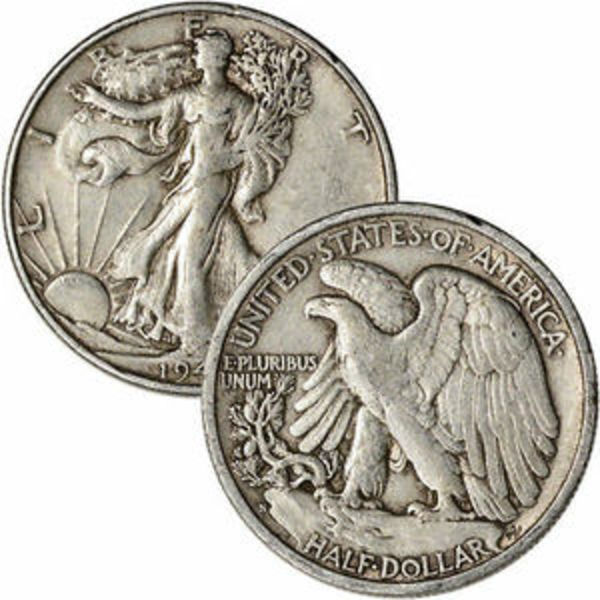
Walking Liberty Half Dollars (1916-1947) — same silver content as other halves. Collectors prize the design, so these sometimes trade above pure melt.
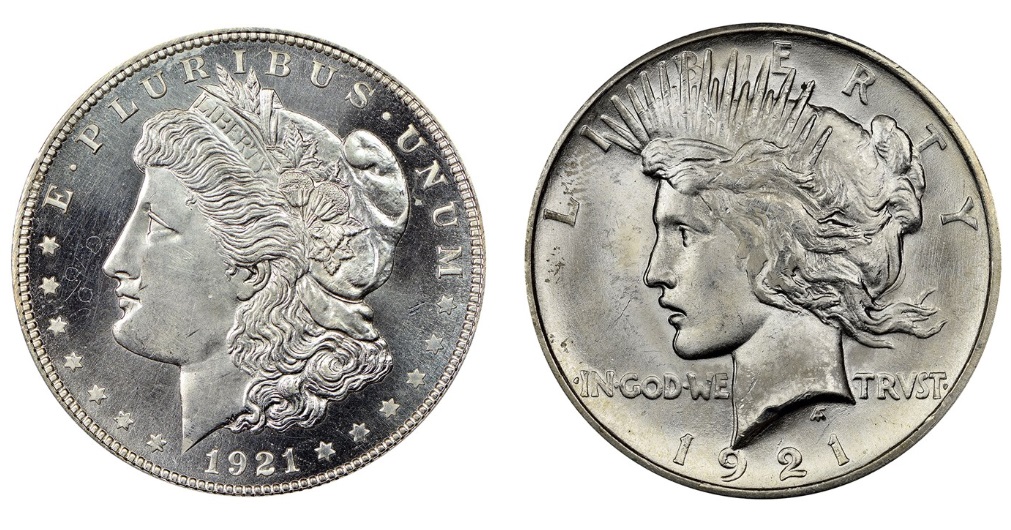
Morgan Dollars (1878-1921) and Peace Dollars (1921-1935) — each contains 0.7734 troy oz of silver. Melt value: ~$50.03. These usually trade above melt due to collector demand, especially in better condition.
40% Silver Coins (1965-1970)
After the 1965 switch to clad coinage, Kennedy half dollars continued to contain silver — but only 40% instead of 90%. Kennedy halves minted from 1965 through 1970 each contain 0.1479 troy oz of silver. At ~$64.70/oz, the melt value is about $9.57 per coin.
The 40% Kennedy halves trade at lower premiums than 90% coins but also contain significantly less silver per dollar of face value. Some Eisenhower dollars (1971-1976) and Bicentennial issues from the San Francisco Mint (marked with an “S” mint mark) were also minted in 40% silver, though these are less commonly found in junk silver lots.
35% Silver War Nickels (1942-1945)
During World War II, nickel was needed for military armor plating, so the U.S. Mint replaced the standard nickel alloy with a composition of 56% copper, 35% silver, and 9% manganese. War nickels are identifiable by the large mint mark (P, D, or S) above the dome of Monticello on the reverse.
Each War Nickel contains 0.0563 troy oz of silver — the lowest of any junk silver coin. At ~$64.70/oz, melt value is about $3.64. War Nickel melt values fluctuate with silver prices. These coins typically trade near melt and are the cheapest entry point into junk silver.
How to Calculate Junk Silver Melt Value
The junk silver market uses face value as its standard unit of trade. A “$10 face value bag of 90% silver quarters” means $10 worth of quarters at their original denomination — 40 quarters — regardless of what the silver in them is actually worth today.
The key number for 90% silver is: $1.00 face value of 90% silver coins contains approximately 0.715 troy ounces of silver. This accounts for the 10% copper alloy and average circulated wear. (The precise figure for uncirculated coins is 0.7234 ozt per dollar face, but circulated junk silver has lost some weight through decades of handling.)
From that, the math is simple:
Melt value of 90% junk silver = face value x 0.715 x current silver spot price
For 40% silver Kennedy halves, the equivalent figure is approximately 0.1479 ozt per coin, or about 0.2958 ozt per dollar face value (since two halves = $1 face). For 35% War Nickels, the silver content is approximately 0.0563 ozt per coin, or about 1.125 ozt per $1 face value of nickels (since twenty nickels = $1 face).
Premiums and Pricing
Junk silver premiums fluctuate more than most bullion premiums because supply depends on how many circulated coins are available in the secondary market — there is no new production. When silver prices are stable or falling, premiums tend to be tight: 0-5% over melt, and sometimes at or below melt. When silver prices spike, demand surges and dealers’ available inventory shrinks, pushing premiums to 10-20% or higher.
As of September 2026, with silver near $64.70/oz, the junk silver market has been experiencing an unusual dynamic. Refinery backlogs created by the rapid silver price increase over the past year have depressed dealer buyback prices for 90% coin. At the same time, some dealers have been offering packaged lots (particularly $100 face bags of quarters) at or below melt value to rotate inventory. This has produced wider bid-ask spreads than normal — you can buy near melt but may find selling prices from dealers are below melt.
The premium hierarchy among coin types generally follows this pattern from lowest to highest:
Mixed-date bags of Roosevelt dimes or Washington quarters — lowest premiums, highest availability
Mixed-date bags of Franklin or 1964 Kennedy halves — slightly higher, still readily available
40% Kennedy halves (1965-1970) — very low premiums, sometimes below melt, but less silver per dollar invested
War Nickels — low premiums, but low silver content per coin
Walking Liberty halves, Mercury dimes, Standing Liberty quarters — modest collector premiums due to age and design appeal
Morgan and Peace dollars — highest premiums in the junk silver category, driven by collector demand beyond pure silver value
For the lowest premiums, look for generic mixed-date lots of Roosevelt dimes or Washington quarters. These are the coins most frequently available at or near melt. Compare current pricing on the junk silver collection page or check the silver closest-to-spot page for the lowest-premium silver products across all categories.
Why Buy Junk Silver
Low premiums. In calm markets, junk silver trades closer to melt value than almost any other form of retail silver. A $100 face bag of 90% Washington quarters contains 71.5 troy ounces of silver. When that bag is priced at or below melt, you are paying less per ounce than you would for Silver Eagles, generic rounds, or even most silver bars.
Built-in fractional sizing. A single dime contains about $4.63 in silver at current prices. A quarter, about $11.70. A half dollar, about $23.40. You can sell or trade in small increments without cutting a bar or finding a buyer for a 10 oz piece. This natural divisibility is one of the main reasons preppers and barter-minded buyers favor junk silver over bars and rounds.
Difficult to counterfeit. Counterfeiters target high-value individual pieces — $2,000+ gold coins, PAMP Suisse bars, Silver Eagles. Nobody is manufacturing fake Roosevelt dimes. The individual coin values are too low for counterfeiting to be profitable, and the coins are widely enough known that fakes would be spotted quickly by anyone familiar with U.S. coinage. The main risk with junk silver is receiving clad coins mixed into a lot, which is detectable by checking the edge (90% silver has no copper stripe).
No reporting threshold. Unlike 1 oz gold bars (which trigger Form 1099-B at 25 units) or 1,000 oz silver bars (1099-B at 1 unit), junk silver sales do not trigger dealer reporting requirements regardless of the amount sold. This does not change your tax obligations — you still owe capital gains tax on profits — but it simplifies the transaction process.
Historical and constitutional backing. These coins were minted by the U.S. government as legal tender. The Constitution granted Congress the power to coin money in gold and silver, and pre-1965 coins are physical artifacts of that monetary policy. For investors who value the connection between money and precious metals, junk silver carries a significance that private-mint rounds and bars do not.
How Junk Silver Is Sold
Dealers sell junk silver in standardized quantities based on face value:
Rolls — $5 face value of dimes (50 coins), $10 face value of quarters (40 coins), $10 face value of halves (20 coins)
$100 face value bags — the most commonly traded unit. A $100 face bag of 90% quarters contains 400 coins and about 71.5 troy ounces of silver.
$500 and $1,000 face value bags — bulk quantities for larger purchases. A $1,000 face bag contains ~715 troy ounces of silver.
Individual coins and small lots — available from dealers and on the secondary market (eBay, local coin shops, r/PMsForSale)
Pricing is typically quoted as a dollar amount per dollar of face value, or as a percentage over/under melt. “90% silver quarters at 1x melt” means the price equals the current melt value. “At 95% of melt” means 5% below melt — a discount. “At 1.05x melt” means 5% above.
Where to Buy Junk Silver
Online bullion dealers. Most major online dealers stock junk silver in various denominations and lot sizes. Compare pricing on the junk silver collection page, which aggregates current prices from multiple dealers. Look for silver at spot deals — some dealers periodically offer junk silver at or below melt as promotional pricing or inventory rotation.
Local coin shops. Many local coin shops have steady inventory of junk silver, especially dimes and quarters. Pricing may be slightly higher than online dealers, but you avoid shipping costs and can inspect coins before buying. Local shops are also the best source for cherry-picking specific dates, mint marks, or coin types from junk silver lots.
eBay. Junk silver trades actively on eBay. Prices are typically higher than direct dealer pricing due to eBay’s fee structure (13.6% on bullion), but eBay coupons can occasionally bring effective prices below dealer levels. Stick to established sellers with extensive precious metals feedback.
Coin shows and swap meets. Regional coin shows often have dealers offering junk silver at competitive prices, especially late in the show when dealers prefer to sell inventory rather than pack it for transport.
Tips for Buying Smart
Check the spot price first. Know the current silver spot price before evaluating any junk silver offer. Calculate the melt value of the lot (face value x 0.715 x spot price for 90%) and compare it to the asking price. That gives you the real premium.
Quarters and dimes over halves and dollars for the lowest premiums. Roosevelt dimes and Washington quarters are the most common and most liquid 90% silver coins. They typically carry the tightest premiums. Halves are fine too, but Morgan and Peace dollars almost always carry collector premiums above melt — if you want the lowest cost per ounce of silver, stick to dimes and quarters.
Buy in standard lot sizes. A $100 face bag of quarters is the standard unit of trade and will be the easiest to resell at a fair price. Odd quantities (37 random quarters, 12 halves and 8 dimes) are harder to price and less appealing to dealers buying back.
Inspect edges on half dollars. Check the edge to tell 90% silver halves (1964 and earlier) from 40% silver (1965-1970) and clad (1971+). A 90% silver coin has a solid silver edge. A 40% silver coin shows a thin copper stripe. A clad coin shows a thick copper stripe. Weight is the backup test: a 90% silver quarter weighs 6.25 grams, a clad quarter weighs 5.67 grams.
Watch for below-melt deals. During periods of refinery backlog or compressed premiums, some dealers sell packaged junk silver lots at or below melt to clear inventory. These deals are temporary but can offer some of the best silver buying opportunities in the market. The best silver prices page tracks current pricing across dealers.
Junk Silver Quick Reference
Coin
Years
Silver %
Silver per Coin (ozt)
Melt (~$64.70/oz)
Roosevelt Dime
1946-1964
90%
0.0715
~$4.63
Mercury Dime
1916-1945
90%
0.0715
~$4.63
Washington Quarter
1932-1964
90%
0.1808
~$11.70
Franklin Half Dollar
1948-1963
90%
0.3617
~$23.40
1964 Kennedy Half Dollar
1964
90%
0.3617
~$23.40
Walking Liberty Half Dollar
1916-1947
90%
0.3617
~$23.40
Morgan Dollar
1878-1921
90%
0.7734
~$50.03
Peace Dollar
1921-1935
90%
0.7734
~$50.03
Kennedy Half (40%)
1965-1970
40%
0.1479
~$9.57
War Nickel
1942-1945
35%
0.0563
~$3.64
Melt values above are approximate at $64.70/oz silver. For live values, visit the silver coin melt value page.
This article is for informational purposes only and does not constitute financial or investment advice. Precious metals carry market risk, and past performance does not guarantee future results. Always conduct your own research and consult with a qualified financial advisor before making investment decisions.