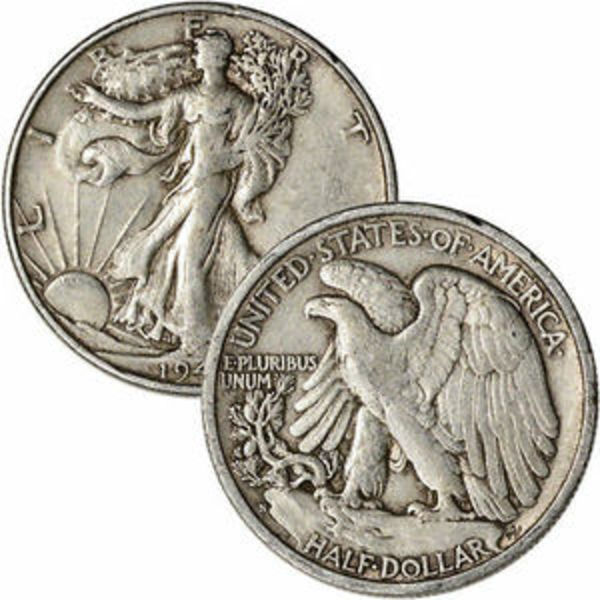
At a Glance: Walking Liberty Half Dollar (1916-1947)
The Walking Liberty half dollar is widely considered the most beautiful coin ever produced by the United States Mint. Designed by sculptor Adolph A. Weinman and minted from 1916 through 1947, this 90% silver coin captures Lady Liberty in full stride toward the sunrise — a powerful image of American optimism that later inspired the reverse of the American Silver Eagle in 1986.
Key Facts:
- Composition: 90% silver, 10% copper (12.50 grams)
- Silver Content: 0.3617 troy ounces per coin
- Current Melt Value: $22.90 (updated live)
- Diameter: 30.6 mm
- Designer: Adolph A. Weinman
- Mint Marks: None (Philadelphia), D (Denver), S (San Francisco)
- Total Issues: 65 date-and-mint combinations across the series
Walking Liberty half dollars are among the most actively traded U.S. coins. Common dates in circulated grades trade near silver melt value, making them popular among silver investors, while key dates in high grades command serious numismatic premiums. For current melt values across all silver denominations, see our silver coin melt value calculator.
The values and premiums in this guide are calculated dynamically based on today’s silver spot price. Each Walking Liberty half dollar contains 0.3617 troy ounces of silver, giving it a current melt value of $22.90. As silver prices change, the dollar values shown below update automatically — so the information you’re reading is always current.
Understanding Walking Liberty Half Dollar Pricing
Before diving into the value tables, it’s important to understand the two forces that determine what a Walking Liberty half dollar is worth: silver melt value and numismatic premium.
Silver melt value is the floor price for every Walking Liberty half dollar. With 0.3617 troy ounces of silver, each coin’s minimum value is $22.90 at today’s spot price. No Walking Liberty is worth less than this regardless of date, condition, or wear — the silver content alone guarantees it.
Numismatic premium is the additional value collectors pay above melt for rarity, condition, and demand. For common dates in lower circulated grades, this premium is small (0-15% over melt). For key dates and high-grade coins, the numismatic premium dwarfs the silver content — a 1921-S in MS-66 is worth over $100,000 regardless of whether silver is at $25 or $75 per ounce.
In the value tables below, we express common-date circulated values as premiums over melt so you always know what you should expect to pay relative to the current silver price. For scarcer dates and higher grades where numismatic demand drives pricing independently of silver, we show fixed dollar values.
Walking Liberty Half Dollar Values by Year and Grade
How to Read the Tables
For common dates, lower-grade columns show the premium over melt value:
- “Melt” means the coin trades at or within a few percent of its silver value ($22.90)
- “Melt +10%” means the coin typically sells for about 10% above melt value
- Dollar values ($XX) indicate the numismatic premium has decoupled from silver — these prices hold relatively steady regardless of daily silver fluctuations
Early Issues (1916-1921) — The Scarce Years
These first six years produced the most valuable Walking Liberty half dollars. Every date from this era carries a meaningful numismatic premium even in well-worn condition — none of these trade at melt.
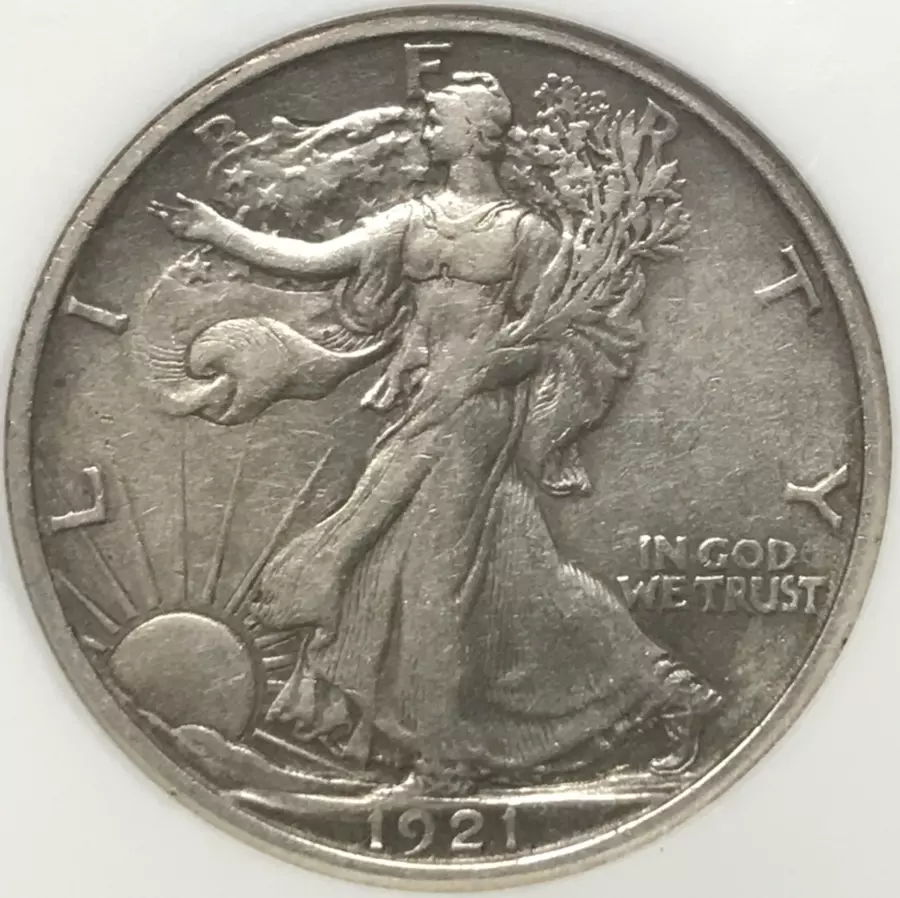
Estimated Value: $1,850
| Year/Mint | Mintage | G-4 | VG-8 | F-12 | VF-20 | XF-40 | AU-50 | MS-63 | MS-65 |
|---|---|---|---|---|---|---|---|---|---|
| 1916 | 608,000 | $75 | $95 | $130 | $185 | $275 | $375 | $775 | $2,500 |
| 1916-D | 1,014,400 | $65 | $85 | $110 | $155 | $240 | $340 | $700 | $2,200 |
| 1916-S | 508,000 | $125 | $175 | $250 | $400 | $675 | $1,000 | $2,500 | $12,000 |
| 1917 | 12,292,000 | $35 | $38 | $45 | $60 | $100 | $175 | $425 | $1,800 |
| 1917-D (Obv) | 765,400 | $60 | $80 | $120 | $200 | $425 | $775 | $2,800 | $15,000 |
| 1917-D (Rev) | 1,940,000 | $38 | $45 | $65 | $110 | $240 | $550 | $2,000 | $8,500 |
| 1917-S (Obv) | 952,000 | $45 | $65 | $110 | $215 | $625 | $1,275 | $5,500 | $25,000 |
| 1917-S (Rev) | 5,554,000 | $33 | $36 | $48 | $75 | $190 | $450 | $2,200 | $9,000 |
| 1918 | 6,634,000 | $33 | $36 | $48 | $75 | $190 | $425 | $2,200 | $7,500 |
| 1918-D | 3,853,040 | $35 | $40 | $55 | $100 | $240 | $600 | $3,500 | $22,000 |
| 1918-S | 10,282,000 | $33 | $36 | $45 | $65 | $175 | $450 | $3,200 | $14,000 |
| 1919 | 962,000 | $40 | $55 | $80 | $190 | $525 | $1,025 | $3,500 | $12,000 |
| 1919-D | 1,165,000 | $45 | $60 | $95 | $215 | $725 | $1,525 | $6,500 | $18,500 |
| 1919-S | 1,552,000 | $40 | $55 | $80 | $215 | $675 | $1,825 | $9,000 | $25,000 |
| 1920 | 6,372,000 | $33 | $36 | $42 | $60 | $160 | $425 | $2,400 | $8,500 |
| 1920-D | 1,551,000 | $38 | $48 | $70 | $150 | $500 | $1,125 | $6,000 | $17,500 |
| 1920-S | 4,624,000 | $33 | $36 | $45 | $75 | $265 | $775 | $6,500 | $15,000 |
| 1921 | 246,000 | $190 | $265 | $425 | $725 | $1,850 | $3,600 | $12,000 | $40,000 |
| 1921-D | 208,000 | $240 | $375 | $550 | $1,050 | $2,600 | $4,700 | $18,000 | $75,000 |
| 1921-S | 548,000 | $75 | $115 | $265 | $725 | $2,600 | $6,200 | $30,000 | $105,000 |
Mid-Series (1923-1929) — Moderate Production Years
Production resumed in 1923 after a two-year hiatus. These years saw larger mintages, though several San Francisco issues remain scarce in higher grades. In lower circulated grades, most of these dates trade near melt with modest premiums.
| Year/Mint | Mintage | G-4 | VG-8 | F-12 | VF-20 | XF-40 | AU-50 | MS-63 | MS-65 |
|---|---|---|---|---|---|---|---|---|---|
| 1923-S | 2,178,000 | $22.90 +5% | Melt +10% | Melt +20% | $65 | $190 | $525 | $3,000 | $10,000 |
| 1927-S | 2,392,000 | Melt +5% | Melt +10% | Melt +15% | $55 | $160 | $475 | $4,000 | $14,000 |
| 1928-S | 1,940,000 | Melt +5% | Melt +10% | Melt +15% | $58 | $170 | $500 | $4,500 | $15,000 |
| 1929-D | 1,001,200 | Melt +5% | Melt +10% | Melt +15% | $52 | $125 | $290 | $1,500 | $7,000 |
| 1929-S | 1,902,000 | Melt +5% | Melt +10% | Melt +15% | $52 | $125 | $290 | $1,400 | $6,500 |
Note: No Walking Liberty half dollars were minted in 1922, 1924, 1925, or 1926. Production was sporadic through the 1920s with only select mints operating in certain years.
Depression and War Era (1933-1947) — The Common Years
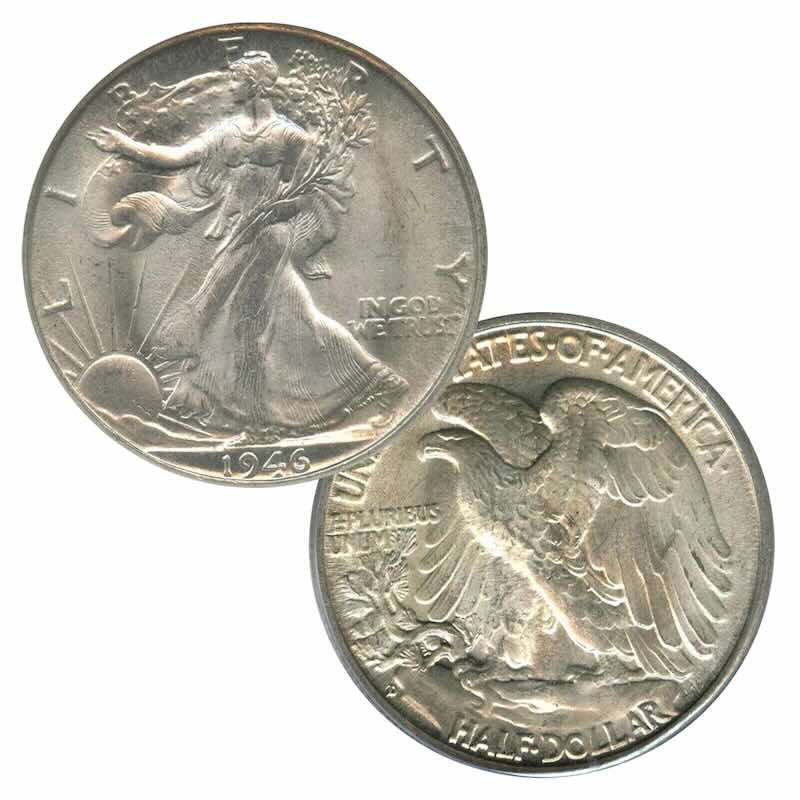
Mintages increased dramatically beginning in 1933. In circulated grades, most of these dates trade at or very near silver melt value with the premiums shown below. The 1938-D stands out as a sleeper key date with genuine numismatic premiums even in lower grades.
| Year/Mint | Mintage | G-4 | VG-8 | F-12 | VF-20 | XF-40 | AU-50 | MS-63 | MS-65 |
|---|---|---|---|---|---|---|---|---|---|
| 1933-S | 1,786,000 | $22.90 +5% | Melt +10% | Melt +15% | Melt +40% | $90 | $215 | $850 | $3,800 |
| 1934 | 6,964,000 | Melt | Melt +3% | Melt +5% | Melt +10% | Melt +60% | $85 | $250 | $900 |
| 1934-D | 2,361,400 | Melt | Melt +3% | Melt +5% | Melt +15% | Melt +75% | $120 | $400 | $1,400 |
| 1934-S | 3,652,000 | Melt | Melt +3% | Melt +5% | Melt +15% | Melt +75% | $125 | $475 | $2,200 |
| 1935 | 9,162,000 | Melt | Melt +3% | Melt +5% | Melt +8% | Melt +40% | $65 | $175 | $650 |
| 1935-D | 3,003,800 | Melt | Melt +3% | Melt +5% | Melt +10% | Melt +60% | $105 | $350 | $1,200 |
| 1935-S | 3,854,000 | Melt | Melt +3% | Melt +5% | Melt +10% | Melt +60% | $105 | $375 | $1,500 |
| 1936 | 12,617,901 | Melt | Melt +3% | Melt +5% | Melt +8% | Melt +35% | $60 | $165 | $550 |
| 1936-D | 4,252,400 | Melt | Melt +3% | Melt +5% | Melt +10% | Melt +55% | $90 | $300 | $900 |
| 1936-S | 3,884,000 | Melt | Melt +3% | Melt +5% | Melt +10% | Melt +55% | $90 | $325 | $1,000 |
| 1937 | 9,527,728 | Melt | Melt +3% | Melt +5% | Melt +8% | Melt +35% | $60 | $165 | $550 |
| 1937-D | 1,676,000 | Melt | Melt +3% | Melt +5% | Melt +15% | Melt +70% | $115 | $375 | $1,100 |
| 1937-S | 2,090,000 | Melt | Melt +3% | Melt +5% | Melt +15% | Melt +65% | $105 | $350 | $1,000 |
| 1938 | 4,118,152 | Melt | Melt +3% | Melt +5% | Melt +10% | Melt +60% | $105 | $350 | $1,000 |
| 1938-D | 491,600 | $85 | $100 | $115 | $140 | $175 | $215 | $400 | $1,000 |
| 1939 | 6,820,808 | Melt | Melt +3% | Melt +5% | Melt +8% | Melt +35% | $60 | $150 | $500 |
| 1939-D | 4,267,800 | Melt | Melt +3% | Melt +5% | Melt +8% | Melt +35% | $60 | $155 | $525 |
| 1939-S | 2,552,000 | Melt | Melt +3% | Melt +5% | Melt +10% | Melt +55% | $90 | $325 | $950 |
| 1940 | 9,167,279 | Melt | Melt +3% | Melt +5% | Melt +8% | Melt +25% | $55 | $140 | $425 |
| 1940-S | 4,550,000 | Melt | Melt +3% | Melt +5% | Melt +8% | Melt +35% | $60 | $165 | $575 |
| 1941 | 24,207,412 | Melt | Melt +3% | Melt +5% | Melt +8% | Melt +20% | $50 | $130 | $400 |
| 1941-D | 11,248,400 | Melt | Melt +3% | Melt +5% | Melt +8% | Melt +25% | $55 | $145 | $450 |
| 1941-S | 8,098,000 | Melt | Melt +3% | Melt +5% | Melt +8% | Melt +35% | $60 | $175 | $625 |
| 1942 | 47,839,120 | Melt | Melt | Melt +3% | Melt +5% | Melt +15% | $45 | $120 | $375 |
| 1942-D | 10,973,800 | Melt | Melt | Melt +3% | Melt +5% | Melt +20% | $52 | $135 | $425 |
| 1942-S | 12,708,000 | Melt | Melt | Melt +3% | Melt +5% | Melt +25% | $55 | $160 | $550 |
| 1943 | 53,190,000 | Melt | Melt | Melt +3% | Melt +5% | Melt +15% | $45 | $115 | $350 |
| 1943-D | 11,346,000 | Melt | Melt | Melt +3% | Melt +5% | Melt +20% | $50 | $130 | $400 |
| 1943-S | 13,450,000 | Melt | Melt | Melt +3% | Melt +5% | Melt +25% | $55 | $165 | $575 |
| 1944 | 28,206,000 | Melt | Melt | Melt +3% | Melt +5% | Melt +15% | $45 | $115 | $350 |
| 1944-D | 9,769,000 | Melt | Melt | Melt +3% | Melt +5% | Melt +20% | $52 | $135 | $425 |
| 1944-S | 8,904,000 | Melt | Melt | Melt +3% | Melt +5% | Melt +25% | $55 | $160 | $525 |
| 1945 | 31,502,000 | Melt | Melt | Melt +3% | Melt +5% | Melt +15% | $45 | $115 | $350 |
| 1945-D | 9,966,800 | Melt | Melt | Melt +3% | Melt +5% | Melt +20% | $50 | $130 | $400 |
| 1945-S | 10,156,000 | Melt | Melt | Melt +3% | Melt +5% | Melt +25% | $52 | $150 | $500 |
| 1946 | 12,118,000 | Melt | Melt | Melt +3% | Melt +5% | Melt +15% | $45 | $115 | $375 |
| 1946-D | 2,151,000 | Melt | Melt +3% | Melt +5% | Melt +10% | Melt +40% | $65 | $185 | $600 |
| 1946-S | 3,724,000 | Melt | Melt +3% | Melt +5% | Melt +10% | Melt +35% | $60 | $165 | $550 |
| 1947 | 4,094,000 | Melt | Melt +3% | Melt +5% | Melt +10% | Melt +35% | $60 | $165 | $525 |
| 1947-D | 3,900,600 | Melt | Melt +3% | Melt +5% | Melt +10% | Melt +35% | $60 | $165 | $525 |
Quick Premium Calculator: To convert any “Melt +X%” value to a dollar amount, take the current melt value of $22.90 and multiply. For example, “Melt +15%” = $22.90 × 1.15. For coins showing “Melt” with no percentage, expect to pay within a few percent of $22.90 from most dealers.
For coins grading MS-66 and above, consult professional grading services or auction records. Proof Walking Liberty half dollars (1936-1942) are covered separately below.
Key Dates and Rarities
Every Walking Liberty half dollar contains silver worth $22.90, but a handful of dates stand apart as the true prizes of the series. The values below are driven by numismatic demand and remain relatively stable regardless of daily silver price movements.
The “Big Three” Key Dates
1921-S ($75-$105,000) — The undisputed king of the series. San Francisco struck just 548,000 coins in 1921, and most entered heavy circulation. Surviving examples are almost universally weakly struck, making well-struck pieces extraordinarily valuable. A PCGS MS-66 sold for $188,000 at Heritage Auctions. Even well-worn Good-4 examples command $75+ — nearly 3× melt value.
1921-D ($240-$75,000) — Denver produced only 208,000 coins — the lowest mintage in the entire series. The 1921-D is the scarcest Walking Liberty in all grades. A PCGS MS-66 realized $168,000 at auction. Finding one in any grade is a notable accomplishment for a collector.
1921 Philadelphia ($190-$40,000) — With just 246,000 struck, the Philadelphia issue completes the notorious 1921 trio. These three dates represent the last Walking Liberty half dollars before a two-year production hiatus (1922-1923), and together they account for the vast majority of the series’ total value.
Semi-Key Dates
1916-S ($125-$12,000) — The San Francisco first-year issue with only 508,000 minted. Collectors pursuing the series by mint mark consider this essential. Higher-grade survivors are rare because the initial production run suffered from die adjustment issues and weak strikes. At current silver prices, the G-4 value of $125 represents a premium of roughly 350% over melt — reflecting strong collector demand regardless of silver’s daily price.
1919-D ($45-$18,500) — A notably scarce Denver issue that becomes quite expensive above VF-20. A PCGS MS-67 sold for $270,250 at Heritage Auctions in 2004, making it one of the most valuable Walking Liberty half dollars ever auctioned.
1917-D Obverse Mint Mark ($60-$15,000) — In 1917, the Denver mint placed the “D” mint mark on the obverse (below “In God We Trust”) for part of the year before switching it to the reverse. The obverse variety had a lower mintage of 765,400 and is scarcer in all grades.
1917-S Obverse Mint Mark ($45-$25,000) — Same story as the 1917-D obverse: the San Francisco obverse mint mark variety (952,000 minted) commands significant premiums, especially in uncirculated grades.
1938-D ($85-$1,000) — The sleeper of the series. With only 491,600 coins minted — the lowest regular-issue mintage after the 1921 dates — the 1938-D appears scarce on paper. However, collectors recognized its low mintage at the time and set aside rolls of uncirculated examples. As a result, the 1938-D is affordable in mint state compared to the 1921 trio but remains expensive in circulated grades where fewer examples were preserved. At G-4, the $85 price represents approximately a 210% premium over melt — solidly numismatic territory.
Condition Rarities
Several dates with higher mintages become surprisingly scarce in gem condition (MS-65 and above). The 1918-D, 1923-S, 1927-S, and 1928-S are all difficult in uncirculated grades due to typically weak strikes and heavy circulation during the Depression era. Collectors assembling high-grade sets should be prepared for competition and premium pricing on these dates.
Silver Content and Melt Value
Every Walking Liberty half dollar contains exactly 0.3617 troy ounces of pure silver. At today’s silver spot price, that gives each coin a melt value of $22.90. This melt value represents the absolute floor price for any Walking Liberty half dollar — even a dateless, heavily worn slug is worth at least this much for its silver alone.
Use our half dollar value calculator for real-time calculations across all U.S. silver denominations, and track today’s silver price on our live silver spot price page.
Walking Liberty Half Dollar Specifications
| Feature | Detail |
|---|---|
| Composition | 90% silver, 10% copper |
| Total Weight | 12.50 grams (0.4019 troy oz) |
| Silver Weight | 0.3617 troy ounces |
| Current Melt Value | $22.90 |
| Diameter | 30.6 mm |
| Edge | Reeded (150 reeds) |
| Designer | Adolph A. Weinman |
| Obverse | Lady Liberty striding toward sunrise |
| Reverse | Bald eagle perched on mountain pine |
Walking Liberties as Junk Silver
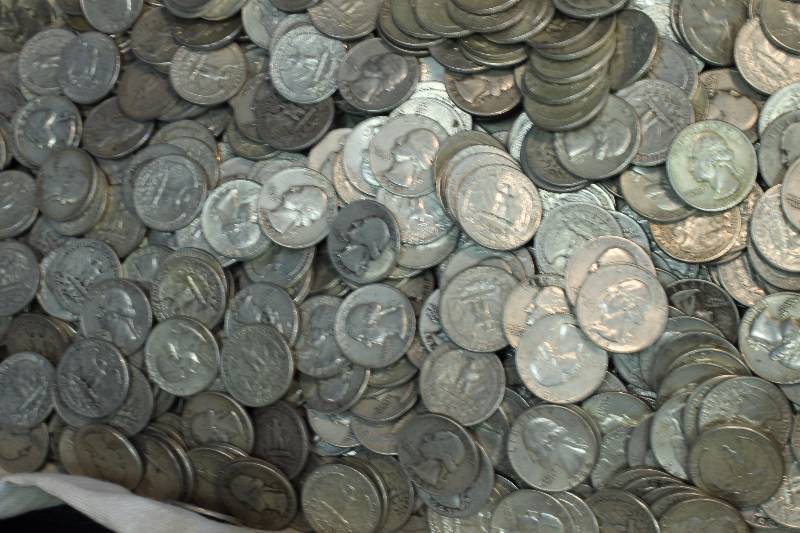
Common-date Walking Liberty half dollars (1934-1947) are among the most widely traded 90% silver coins in the precious metals market. Dealers typically sell these as “junk silver” in face-value lots — for example, $1 face value rolls (2 coins) or $10 face value lots are standard trading units.
At current prices, each Walking Liberty contains $22.90 worth of silver, meaning a $10 face value lot (20 coins) holds over $457.98 in silver content alone. Many investors prefer Walking Liberties over other junk silver denominations because the larger coin size (compared to dimes and quarters) means fewer pieces to handle per dollar of silver content. Walking Liberties also carry a slight historical premium that Roosevelt dimes or Washington quarters generally lack.
For a broader overview of silver half dollar collecting and investing, including Walking Liberties alongside Franklin and Kennedy half dollars, see our complete guide on Collecting and Investing in Silver Half Dollars.
Common-Date Premium Trends
The dealer premium over melt for common-date Walking Liberties fluctuates with market conditions. When silver prices spike rapidly, premiums tend to compress as dealers adjust — but when silver is in a sustained uptrend, premiums can expand as investor demand increases. Here’s a general guide to what you should expect:
| Grade | Typical Premium Over Melt | What You Pay (at $22.90 melt) |
|---|---|---|
| Cull / Heavily Worn | At or below melt | $22.90 or less |
| G-4 (Good) | Melt to Melt +3% | $22.90 – 23.58 |
| VG-8 (Very Good) | Melt +3% to +5% | $23.58 – 24.05 |
| F-12 (Fine) | Melt +5% to +10% | $24.05 – 25.19 |
| VF-20 (Very Fine) | Melt +8% to +15% | $24.73 – 26.34 |
| XF-40 (Extremely Fine) | Melt +15% to +40% | $26.34 – 32.06 |
| AU-50 (About Unc.) | Melt +60% to +120% | $36.64 – 50.38 |
Premiums shown are typical for high-mintage dates (1941-1947). Earlier common dates (1934-1940) and lower-mintage branch mint coins may carry slightly higher premiums.
History and Design
The 1916 Design Competition
In 1916, the U.S. Mint launched a redesign of three denominations: the dime, quarter, and half dollar. Treasury Secretary William McAdoo invited prominent sculptors to submit designs, and Adolph A. Weinman — a German-born artist trained under the legendary Augustus Saint-Gaudens — won the commission for both the dime (Mercury dime) and the half dollar.
Weinman’s Walking Liberty design depicts Lady Liberty wrapped in an American flag, striding confidently toward the dawn with her right arm extended as if to embrace the rising sun. She carries oak and laurel branches symbolizing civil and military glory. The reverse features a bald eagle perched on a mountain crag with wings partially raised, a design that conveys strength without aggression.
The design was immediately praised for its artistic beauty, though it presented practical challenges. The high relief of the original design caused striking difficulties, and the Mint adjusted the relief downward in subsequent years. These early striking problems explain why many 1916-1917 coins appear weakly struck even in higher grades.
Production Timeline
Walking Liberty half dollars were minted continuously from 1916 through 1947, with two notable gaps. No half dollars were produced in 1922, 1924, 1925, or 1926 — years of reduced coinage demand — and 1930-1932 saw no half dollar production during the depths of the Great Depression.
Production peaked during World War II, with 1942 and 1943 seeing combined mintages exceeding 100 million coins. These wartime issues are the most available Walking Liberty half dollars today and form the backbone of the junk silver market.
The Coinage Act of 1965 and the End of Silver
The Walking Liberty half dollar was replaced by the Franklin half dollar in 1948, but its legacy extends further. The Coinage Act of 1965 ended the use of 90% silver in circulating dimes and quarters and reduced the half dollar’s silver content to 40% (1965-1970) before eliminating it entirely in 1971. This legislation made pre-1965 silver coins — including all Walking Liberty half dollars — more valuable as silver bullion, driving the junk silver market that thrives today. With each coin now containing 22.90 worth of silver, the 1965 debasement looks more consequential with each passing year.
Legacy: The American Silver Eagle
In 1986, the U.S. Mint selected Weinman’s Walking Liberty design for the obverse of the new American Silver Eagle bullion coin, testifying to its enduring status as perhaps the finest coin design in American history. The 2016-W Walking Liberty Centennial Gold Coin further honored the design’s 100th anniversary, struck in half an ounce of .9999 fine gold — a modern tribute to Weinman’s masterpiece.
Mint Mark Location and Identification
Understanding where to find the mint mark on Walking Liberty half dollars is essential because the location changed during production.
1916-1917: The mint mark appears on the obverse of the coin, positioned below the motto “IN GOD WE TRUST” near Liberty’s hip. Some 1917-D and 1917-S coins have the mint mark on the obverse, while others have it on the reverse — creating two distinct and separately valued varieties for each.
1917 (later strikes) through 1947: The mint mark was moved to the reverse, placed on the lower left, approximately at the 8 o’clock position near the base of the branch or rim.
Mint Mark Guide:
- No mint mark: Philadelphia
- D: Denver
- S: San Francisco
Philadelphia did not use a mint mark during this era. When searching for the mint mark on early issues, examine the obverse first — if no mark appears below “IN GOD WE TRUST,” check the reverse near the rim at the lower left.
Error Varieties and Die Varieties
Walking Liberty half dollars were produced across three decades and millions of dies, creating numerous documented varieties. While this series lacks a dramatic doubled die on the scale of the 1955 Lincoln cent, several varieties attract specialist collectors and carry premiums well above their standard counterparts.
1942 Doubled Die Obverse (DDO)
The most significant Walking Liberty error is the 1942 DDO, showing clear doubling on “IN GOD WE TRUST” and “LIBERTY.” Values range from $500 in circulated grades to $5,000+ in mint state. This is a true doubled die (hub doubling), not machine doubling, and it commands strong premiums among error collectors. In circulated grades, this variety is worth approximately 15×-20× the value of a normal 1942 — a massive premium over the melt-level pricing a standard 1942 commands.
1946-S Doubled Die Reverse (DDR)
Doubling visible on “UNITED STATES OF AMERICA” and “HALF DOLLAR” on the reverse. This variety is less dramatic than the 1942 DDO but still sought by specialists. Values range from $100 in VF to $1,000+ in uncirculated grades.
Repunched Mint Marks (RPM)
Numerous Walking Liberty dates exhibit repunched mint marks, where the “D” or “S” was stamped into the die more than once with slight misalignment. Notable RPMs include the 1941-S (S over small S), 1944-D (D over D), and several San Francisco issues from the 1930s. RPMs typically carry premiums of $25-$200 depending on the date and visibility of the repunching.
Off-Center Strikes
Off-center Walking Liberty half dollars are encountered less frequently than off-center small-denomination coins because the larger planchet was less prone to misalignment. Examples with 5-10% offset are worth $150-$400, while dramatically off-center strikes (15%+) with visible dates can reach $800-$2,000.
Wrong Planchet Errors
Extremely rare examples of Walking Liberty half dollars struck on quarter planchets or foreign planchets have been documented. These are five-figure errors when authenticated.
Strike Characteristics and Full Strike Premiums
Walking Liberty half dollars are notorious for weak strikes, particularly on Liberty’s hand and the eagle’s breast feathers. Well-struck coins — especially from San Francisco in the 1920s — command significant premiums even without a formal “Full Strike” designation from grading services. A well-struck 1923-S or 1928-S is exponentially more desirable than a typically struck example at the same grade.
Grading Guide for Walking Liberty Half Dollars
The design’s high relief and complex details make grading Walking Liberty half dollars particularly nuanced. Key areas to examine include Liberty’s hand, the skirt lines over her left leg, the eagle’s breast feathers, and overall luster.
Circulated Grades:
G-4 (Good): Liberty’s outline is fully visible but most interior details are worn smooth. The date and mint mark remain readable. The reverse eagle shows limited feather detail. At this grade, most common dates (1934-1947) trade at or within a few percent of silver melt value (22.90).
VG-8 (Very Good): Approximately half of Liberty’s skirt lines are visible. The head and hand details are partially defined. The eagle shows some feather separation. Common dates bring Melt +3-5%.
F-12 (Fine): All major design elements are visible with moderate wear. Liberty’s skirt lines are mostly complete from the knee downward. The eagle shows moderate feather detail. Common dates bring Melt +5-10%.
VF-20 (Very Fine): Light to moderate wear on high points only. Liberty’s fingers are partially visible. The sandal and skirt details are well-defined. Eye appeal increases significantly at this grade. Common dates begin showing slightly more numismatic premium (Melt +8-15%).
XF-40 (Extremely Fine): Slight wear on the highest points — Liberty’s head, her outstretched hand, and the eagle’s breast. Considerable mint luster remains in protected areas. Many collectors target this grade as the “sweet spot” for key dates. Common dates carry premiums of 15-40% over melt.
AU-50 (About Uncirculated): Only trace wear visible on Liberty’s head, hand, and breast. Strong mint luster overall. This grade represents excellent value for collectors who want near-mint quality without full mint-state prices. Even common dates carry 60-120% premiums over melt at this grade.
Uncirculated Grades:
MS-60 to MS-62: Full mint luster but may show distracting bag marks or contact marks from storage. No wear. Values decouple significantly from silver melt at this point.
MS-63 (Choice Uncirculated): Above-average eye appeal with minor imperfections. Light bag marks visible under magnification but the overall appearance is attractive.
MS-65 (Gem Uncirculated): Exceptional eye appeal with only minor surface marks. Full, lustrous surfaces. This is where serious premiums begin, especially for pre-1934 dates.
MS-66 and above: Near-perfect coins with outstanding eye appeal. Population report scarcity drives very high prices. Professional certification from PCGS or NGC is essential at these grades.
Grading Tip: Walking Liberty half dollars are often weakly struck from worn dies, which can make an uncirculated coin appear circulated in certain areas (especially Liberty’s thumb and the head details). Learn the difference between strike weakness and wear — they affect value very differently.
Notable Auction Records
These sales illustrate the potential of top-grade Walking Liberty half dollars:
| Coin | Grade | Price | Auction |
|---|---|---|---|
| 1919-D | MS-67 | $270,250 | Heritage Auctions, Nov 2004 |
| 1921-S | MS-66 | $188,000 | Heritage Auctions |
| 1921-D | MS-66 | $168,000 | Heritage Auctions |
| 1917-S (Obv) | MS-67 | $143,750 | Stack’s Bowers |
| 1916-S | MS-67 | $120,000+ | Heritage Auctions |
| 1918-D | MS-67 | $92,000 | Heritage Auctions |
These auction results demonstrate that condition is the ultimate driver of value. A common-date 1943 half dollar in MS-67 can be worth more than a key-date 1921 in Good-4.
Collecting Strategies
Strategy 1: Build a Date-and-Mint Set
The ultimate goal for Walking Liberty collectors is a complete set of all 65 date-and-mint combinations. The most practical approach is to start with the common 1934-1947 dates in VF-XF (where you’ll pay roughly Melt +10% to Melt +40% per coin), then work backward through the 1930s, and tackle the expensive pre-1921 issues last. Budget approximately $1,200-$1,500 for a complete circulated set in Good to Fine condition at current silver prices, or $5,000-$8,000 for a set averaging VF-20.
Strategy 2: Key Dates Only
Focus resources on acquiring the scarce dates — the 1921 trio, 1916-S, 1919-D, 1938-D — in the best grades your budget allows. Even in lower circulated grades, these coins appreciate more consistently than common dates because their value is numismatic rather than silver-driven.
Strategy 3: Type Coin Collecting
Acquire one attractive example to represent the Walking Liberty design. An MS-65 common date (1941-1945) at $350-$425 makes a stunning display piece. Pair it with examples from adjacent series — the Barber half dollar (1892-1915) and Franklin half dollar (1948-1963) — for a beautiful three-coin half dollar design set.
Strategy 4: Invest in Silver Content
Common-date Walking Liberties in circulated grades are among the most cost-efficient ways to buy 90% silver. At current silver prices, you’re getting 0.3617 troy ounces of silver per coin at just a small percentage over melt. Browse Walking Liberty half dollars by face value for current pricing on investment-grade lots, or compare across all silver half dollar options. A $1 face value lot gives you 2 coins containing a combined 0.7234 troy ounces of silver — worth approximately $45.80 in melt value alone.
Certification Advice
Professional grading from PCGS or NGC is recommended for any Walking Liberty half dollar you believe grades AU-50 or above. For key dates (1916-S, 1919-D, 1921 trio), certification is worthwhile at any grade because counterfeits and altered coins exist. For common dates in circulated condition, raw (uncertified) coins are perfectly acceptable and avoid the $30-$50 grading fee.
Proof Walking Liberty Half Dollars (1936-1942)
The U.S. Mint produced proof Walking Liberty half dollars from 1936 through 1942, with total production ranging from 3,901 (1936) to 21,120 (1942). These coins feature mirror-like fields with frosted design elements and represent the highest-quality examples of Weinman’s design.
| Year | Proof Mintage | PF-63 | PF-65 | PF-67 |
|---|---|---|---|---|
| 1936 | 3,901 | $3,500 | $5,500 | $12,000 |
| 1937 | 5,728 | $2,800 | $4,200 | $9,000 |
| 1938 | 8,152 | $2,500 | $3,800 | $8,500 |
| 1939 | 8,808 | $2,400 | $3,600 | $8,000 |
| 1940 | 11,279 | $1,800 | $2,800 | $6,000 |
| 1941 | 15,412 | $1,600 | $2,500 | $5,500 |
| 1942 | 21,120 | $1,500 | $2,400 | $5,200 |
Proof Walking Liberty half dollars are popular with type collectors and make exceptional centerpieces for any half dollar collection.
Frequently Asked Questions
Q: How much is a Walking Liberty half dollar worth?
A: At minimum, every Walking Liberty half dollar is worth its silver melt value of $22.90 (based on today’s silver spot price). Common dates (1934-1947) in circulated condition trade at or within 0-15% of this melt value. Key dates like the 1921-S, 1921-D, and 1916-S are worth significantly more — from $75 in lower grades to over $100,000 for finest-known specimens. Check the value tables above for specific dates and grades.
Q: How much silver is in a Walking Liberty half dollar?
A: Every Walking Liberty half dollar contains exactly 0.3617 troy ounces of 90% pure silver, regardless of year or mint. The total coin weight is 12.50 grams. At today’s silver price, that silver is worth $22.90. Track real-time values on our silver melt value calculator and live silver spot price page.
Q: What are the key dates for Walking Liberty half dollars?
A: The most valuable key dates are the 1921-S, 1921-D, and 1921 (Philadelphia) — all with mintages under 550,000. Other important dates include the 1916-S (first-year San Francisco issue), 1919-D, 1917-D and 1917-S obverse mint mark varieties, and the 1938-D (lowest post-1921 mintage).
Q: Where is the mint mark on a Walking Liberty half dollar?
A: For 1916 coins and some 1917 coins, the mint mark is on the obverse, below “IN GOD WE TRUST.” For later 1917 and all 1918-1947 coins, the mint mark is on the reverse near the lower-left rim. Philadelphia coins carry no mint mark.
Q: Are Walking Liberty half dollars a good investment?
A: Walking Liberty half dollars offer two forms of value: silver bullion content and numismatic collector value. Common dates track silver prices closely — each coin contains $22.90 in silver at today’s prices, providing real precious metals exposure. Key dates in higher grades have historically appreciated well over time, independently of silver price movements. For silver content investing, face value bags of Walking Liberty halves are among the most popular ways to buy 90% silver coins. For more on silver half dollar investing strategies, see our guide to collecting and investing in 90% silver half dollars.
Q: What is the 1943 Walking Liberty half dollar worth?
A: A 1943 Walking Liberty half dollar (Philadelphia mint) is worth approximately $22.90 to $24.05 in circulated grades (melt value to melt +5%). In uncirculated grades, values range from $70 (MS-60) to $350 (MS-65). The 1943-D and 1943-S are worth slightly more in uncirculated condition. These wartime dates had enormous mintages (53+ million for 1943-P alone) and are among the most common in the series.
Q: Should I clean my Walking Liberty half dollar?
A: Never clean a coin. Cleaning permanently damages the original surfaces and significantly reduces numismatic value. Even coins that appear dark or toned should be left in their natural state. If you believe a coin has significant value, submit it to PCGS or NGC for professional grading in its current condition.
Q: What is the connection between Walking Liberty half dollars and Silver Eagles?
A: The American Silver Eagle, first minted in 1986, uses a modified version of Adolph Weinman’s Walking Liberty design on its obverse. This connection makes Walking Liberty half dollars popular with Silver Eagle collectors who appreciate the original 1916-1947 design that inspired the modern bullion coin.
Q: What replaced the Walking Liberty half dollar?
A: The Franklin half dollar replaced the Walking Liberty in 1948. Under U.S. law, a coin design must remain in production for at least 25 years before it can be changed — the Walking Liberty had exceeded that threshold by 1941, giving the Mint legal authority to introduce a new design after World War II. The Franklin half dollar was itself replaced by the Kennedy half dollar in 1964.
Q: How does the silver price affect my Walking Liberty half dollar’s value?
A: For common dates (1934-1947) in circulated grades, the silver price is the primary driver of value. Your coin’s floor price moves in lockstep with silver — at today’s price, that floor is $22.90. You can track this in real-time on our silver spot charts page. For key dates and high-grade coins, the numismatic premium far exceeds the silver content, so silver price movements have minimal impact on their market value.
Related Guides
Explore more coin values and silver content information:
- Live Spot Price — Track real-time silver prices
- Half Dollar Value Calculator — Real-time melt values
- Junk Silver Prices
- The Beginning of Dollar Debasement in the Mid-20th Century — Historical context for the end of silver coinage
- Shop Silver Half Dollars — Browse Walking Liberty, Franklin, and Kennedy half dollars for sale by established dealers
Last Updated: April 2026
This guide features dynamic pricing that updates automatically based on the current silver spot price. Numismatic values for key dates and high-grade coins reflect typical market conditions and may vary based on demand, eye appeal, and certification. For professional appraisals or authentication of valuable coins, consult a certified numismatist or professional grading service (PCGS, NGC).