The American Palladium Eagle is the official palladium bullion coin of the United States, issued by the U.S. Mint since 2017. Each coin contains one troy ounce of .9995 fine palladium, carries a $25 face value, and is struck at the West Point Mint. With mintages that have never exceeded 19,000 in any single year, the Palladium Eagle is one of the lowest-mintage series in the modern U.S. coin program.
Palladium belongs to the platinum group of metals and has a distinctive silver-white appearance. It trades on the same precious metals markets as gold and silver, though its price is driven more heavily by industrial demand, particularly from the automotive catalytic converter industry. The current palladium spot price can be tracked on our spot prices page.
Design
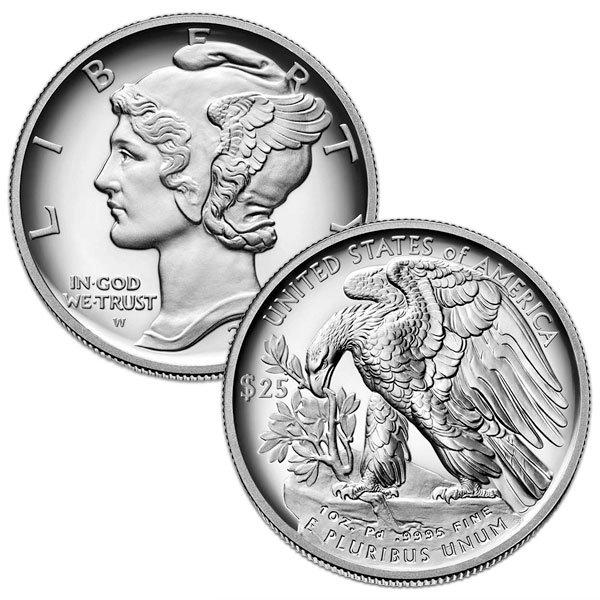
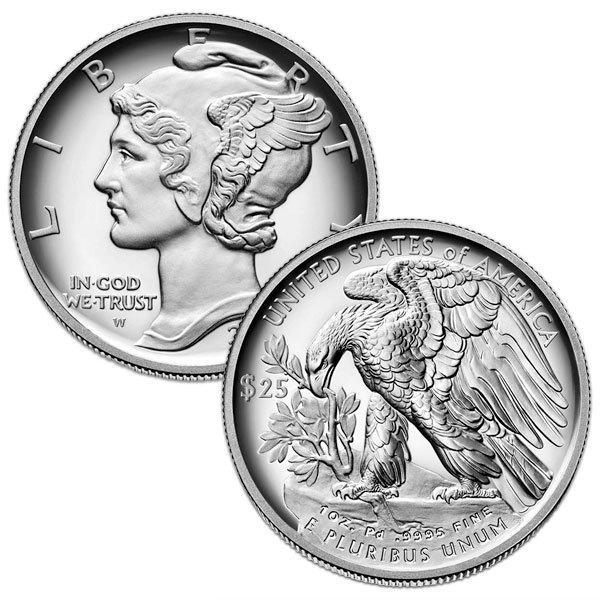
Both sides of the Palladium Eagle feature designs by sculptor Adolph A. Weinman, rendered in high relief. This is mandated by the authorizing legislation, Public Law 111-303.
The obverse carries Weinman’s Winged Liberty, originally designed for the 1916 Mercury Dime. The winged cap on Liberty’s head represents freedom of thought, not the Roman god Mercury, though the dime’s popular nickname has persisted for over a century. The obverse inscriptions include “LIBERTY,” “IN GOD WE TRUST,” the year of issue, and Weinman’s initials. A “W” mint mark confirms West Point production.
The reverse uses Weinman’s 1907 American Institute of Architects Gold Medal design, depicting an eagle grasping an oak branch. Reverse inscriptions include “UNITED STATES OF AMERICA,” “$25,” “1 OZ. Pd .9995 FINE,” and “E PLURIBUS UNUM.” The high-relief execution on both sides gives the coin a sculptural depth that flat-struck bullion coins do not have.
The Finish Rotation
Public Law 111-303 requires that each year’s Palladium Eagle use a different surface treatment than the prior year. The Mint has settled into a four-finish rotation: Bullion, Proof, Reverse Proof, and Uncirculated (Burnished). This cycle began with the 2017 Bullion launch and has repeated with minor variations.
The finishes differ in both appearance and grading designation:
- Bullion (2017, 2021): Standard production strike, sold to authorized purchasers rather than directly to collectors. Graded as MS (Mint State) by both PCGS and NGC.
- Proof (2018, 2021, 2024): Mirrored fields with frosted devices, creating the classic “cameo” contrast. Graded as PR DCAM (Deep Cameo) by PCGS, PF Ultra Cameo by NGC. Sold directly to collectors through usmint.gov.
- Reverse Proof (2019, 2022, 2025): The inverse of a standard proof, with frosted fields and mirror-like devices. Graded as PR by PCGS. Sold directly to collectors.
- Uncirculated / Burnished (2020, 2023, 2026): Struck on specially burnished planchets, producing a soft, even surface. PCGS grades these as SP (Specimen), while NGC uses MS (Mint State). Sold directly to collectors.
The grading designation difference matters when shopping the secondary market. A “PCGS SP70” and an “NGC MS70” on a 2020 or 2023 Palladium Eagle are the same coin with different labeling conventions.
Palladium Eagle Mintage Chart
The following chart shows reported sales for every American Palladium Eagle issued from 2017 through 2025, plus the upcoming 2026 release. Figures are from U.S. Mint cumulative sales reports as compiled by CoinNews.net.
| Year | Finish | Mintage | Issue Price | Mintage Limit |
|---|---|---|---|---|
| 2017 | Bullion | 15,000 | Sold to APs | 15,000 |
| 2018-W | Proof | 14,986 | $1,387.50 | 15,000 |
| 2019-W | Reverse Proof | 18,839 | $1,887.50 | 30,000 |
| 2020-W | Uncirculated | 9,746 | $2,587.50 | 10,000 |
| 2021 | Bullion | 8,700 | Sold to APs | N/A |
| 2021-W | Proof | 5,170 | $2,837.50 | 10,000 |
| 2022-W | Reverse Proof | 7,439 | $3,050.00 | 10,000 |
| 2023-W | Uncirculated | 5,779 | $2,162.50 | 7,500 |
| 2024-W | Proof | 5,417 | $1,900.00 | 7,500 |
| 2025-W | Reverse Proof | 3,991 | $1,695.00 | 6,000 |
| 2026-W | Uncirculated | TBD | TBD | 5,000 |
Two things stand out. First, the mintage trend is clearly declining. The 2017 and 2018 coins each approached 15,000. By 2025, actual sales fell below 4,000 for the first time. Second, 2021 is the only year with two releases: a bullion strike sold to authorized purchasers and a separate proof sold directly to collectors.
The 2019 Reverse Proof holds the highest mintage in the series at 18,839, against a 30,000 cap. It sold out on its first day. The 2025 Reverse Proof, with the lowest mintage at 3,991, had a 6,000-coin cap that it did not reach.
The upcoming 2026-W Uncirculated Palladium Eagle goes on sale September 3 with a 5,000-coin mintage cap and a one-per-household limit. It will carry the semiquincentennial dual date (1776~2026) and a Liberty Bell “250” privy mark, making it a one-year-only variety in the series.
Secondary Market Values
Palladium Eagles trade at premiums above their metal content, with the premium varying by year, finish, and grade. The following table shows current PCGS Price Guide values for the two most commonly traded grades (as of August 2026). NGC values are comparable.
| Year | Finish | PCGS Designation | Grade 69 | Grade 70 |
|---|---|---|---|---|
| 2017 | Bullion | MS | $2,400 | $2,600 |
| 2018-W | Proof | PR DCAM | $2,450 | $2,500 |
| 2019-W | Reverse Proof | PR | $2,400 | $2,500 |
| 2020-W | Uncirculated | SP | $2,400 | $2,600 |
| 2021 | Bullion | MS | $2,150 | $2,250 |
| 2021-W | Proof | PR DCAM | $2,650 | $3,200 |
| 2022-W | Reverse Proof | PR | $2,300 | $2,550 |
| 2023-W | Uncirculated | SP | $2,350 | $2,500 |
| 2024-W | Proof | PR DCAM | $1,950 | $2,550 |
| 2025-W | Reverse Proof | PR | $2,200 | $2,800 |
Values from PCGS Price Guide, August 2026. Entries marked * are estimated from recent auction results and dealer asking prices where PCGS guide data is limited. Prices fluctuate with palladium spot and collector demand.
A few patterns emerge from the secondary market data:
The 2021-W Proof commands the highest premium in the series. At $3,200 for a PCGS PR70 DCAM, it trades well above coins with higher mintages. The combination of a 5,170-coin mintage and the proof finish (the most popular among grading submitters) keeps demand strong.
The 2024-W Proof shows the lowest Grade 69 value at $1,950, barely above its $1,900 issue price. This reflects the fact that the 2024 had the highest reported sales in several years (5,417) and was available for an extended period, meaning fewer collectors paid secondary market premiums.
The grade 70 premium is significant across the series. Moving from a 69 to a 70 typically adds $150 to $600, depending on the year. For the 2021-W Proof, the jump is $550. This premium reflects both the difficulty of achieving a perfect grade on a high-relief coin and the small population of grade 70 holders relative to total graded coins.
Premium Over Melt
With palladium spot near $1,850, every Palladium Eagle in the series trades above its melt value. The premium varies widely:
- The 2021 Bullion MS69 at $2,150 carries a roughly $300 premium over melt, or about 16%. This is the most affordable way to own a graded Palladium Eagle.
- The 2021-W Proof PR70 DCAM at $3,200 carries a roughly $1,350 premium, or about 73%. This reflects its scarcity and the numismatic demand for the proof finish in perfect grade.
- Most years trade in the $2,200 to $2,600 range for grade 69 and 70, representing premiums of $350 to $750 (19% to 41%) over melt.
These premiums have held up over time. Even as palladium spot has moved from the $2,000+ range in 2022 down to the $1,800s in 2026, secondary market prices for graded Palladium Eagles have remained relatively stable, particularly for the low-mintage years.
Issue Price History
Mint pricing for Palladium Eagles is tied to palladium spot at the time of release, with a substantial markup for the collector finish. The range has been dramatic:
- The lowest issue price was $1,387.50 for the 2018-W Proof, when palladium spot was around $900.
- The highest was $3,050.00 for the 2022-W Reverse Proof, when palladium spot was near $2,100.
- The 2025-W Reverse Proof launched at $1,695.00 with spot around $950.
The Mint’s pricing matrix adjusts weekly based on the London PM Fix. As a result, the same coin can be priced differently depending on when in the sales window a collector orders.
Specifications
| Detail | Value |
|---|---|
| Composition | .9995 fine palladium |
| Weight | 1 troy oz (31.103 g) |
| Diameter | 34.0 mm (1.340 in) |
| Edge | Reeded |
| Face value | $25 |
| Mint | West Point |
| Mint mark | W (collector); none (bullion) |
| Designer | Adolph A. Weinman (obverse and reverse) |
Buying Palladium Eagles
New Palladium Eagles are sold directly through usmint.gov when released, typically once per year in September. The Mint stopped selling bullion-finish Palladium Eagles through authorized purchasers after 2021, so all current releases are collector-finish coins sold directly to the public.
On the secondary market, random-year Palladium Eagles are typically the most affordable option for buyers who want the coin without paying for a specific date. Graded examples from PCGS and NGC, as well as coins in their original government packaging (OGP), are available through major coin dealers and auction houses.
For palladium exposure at lower premiums over spot, palladium bars from refiners like Valcambi and PAMP trade closer to metal value. Our closest-to-spot palladium page tracks the lowest premiums available across dealers, and our Valcambi palladium bars guide covers the most widely traded bar options.
Frequently Asked Questions
How many American Palladium Eagles have been minted?
From 2017 through 2025, the U.S. Mint has sold roughly 95,000 Palladium Eagles across all finishes and years combined. This makes it one of the lowest-production coin series in the modern U.S. Mint program. For comparison, the Silver Eagle regularly produces millions of coins per year.
What is the rarest Palladium Eagle?
The 2025-W Reverse Proof has the lowest mintage at 3,991 coins. The 2024-W Proof (5,417) and 2021-W Proof (5,170) are also among the scarcest. Among proof finishes specifically, the 2021-W Proof at 5,170 is the key date.
Are Palladium Eagles a good investment?
Palladium Eagles carry significant premiums over their metal content, so they are numismatic purchases rather than pure bullion plays. The secondary market has generally supported these premiums, particularly for low-mintage years and high-grade examples. However, past performance does not guarantee future returns, and the $2,000+ entry point limits the buyer pool compared to gold or silver coins.
Why are some years graded SP and others PR?
PCGS uses SP (Specimen) for the uncirculated/burnished finish (2020, 2023, 2026) and PR (Proof) for proof and reverse proof finishes. NGC uses MS for uncirculated coins and PF for proofs. Bullion strikes from 2017 and 2021 are graded MS by both services. The designation does not indicate quality differences between the coins; it reflects the finish type.
Are Palladium Eagles eligible for a precious metals IRA?
American Palladium Eagles meet the purity requirements for inclusion in a precious metals IRA (.9995 fine palladium). However, the collector premiums on these coins mean you would be paying well above spot for the palladium content. Consult your IRA custodian for their approved product list and any restrictions on collector-finish coins.
When is the 2026 Palladium Eagle released?
The 2026-W Uncirculated Palladium Eagle goes on sale September 3, 2026, at noon ET through usmint.gov. It has a 5,000-coin mintage cap and a one-per-household limit. The price will be set closer to the release date based on prevailing palladium spot. This is the only palladium coin in the Mint’s semiquincentennial lineup, carrying the 1776~2026 dual date and Liberty Bell “250” privy mark. See our 2026 Palladium Eagle preview for full details.