The American Silver Eagle and the British Silver Britannia are the two most widely traded sovereign silver bullion coins outside the Canadian Maple Leaf. Each contains one troy ounce of fine silver, each is legal tender in its home country, and both are stocked by every major US dealer.
They are not interchangeable. The Britannia changed specification in 2013, which affects both what you are buying and whether it can go into a retirement account. That distinction matters more than any of the design differences.
Head-to-Head Comparison
| Feature | Silver Eagle | Silver Britannia (2013–present) | Silver Britannia (1997–2012) |
|---|---|---|---|
| Fineness | .999 | .999 | .958 (Britannia silver) |
| Fine silver content | 1 troy oz (31.10 g) | 1 troy oz (31.10 g) | 1 troy oz (31.10 g) |
| Gross weight | 31.10 g | 31.21 g | 32.45 g |
| Diameter | 40.6 mm | 38.61 mm | 40.00 mm |
| Face value | $1 | £2 | £2 |
| Obverse | Weinman’s Walking Liberty | Reigning monarch (Martin Jennings’ Charles III portrait since 2023) | Elizabeth II |
| Reverse | Heraldic eagle (Type 1) or landing eagle (Type 2) | Philip Nathan’s standing Britannia | Philip Nathan’s standing Britannia |
| Security features | Reeded-edge variation (Type 2, 2021+) | Four visual features (2021+) | None |
| IRA eligible | Yes, all years | Yes | No |
| First year | 1986 | 2013 | 1997 |
Every Britannia holds a full troy ounce of pure silver regardless of date. The older coins are heavier because the .958 alloy needs more total metal to carry the same ounce of silver. Buyers sometimes read the 32.45 g figure as extra value; it is not.
Design
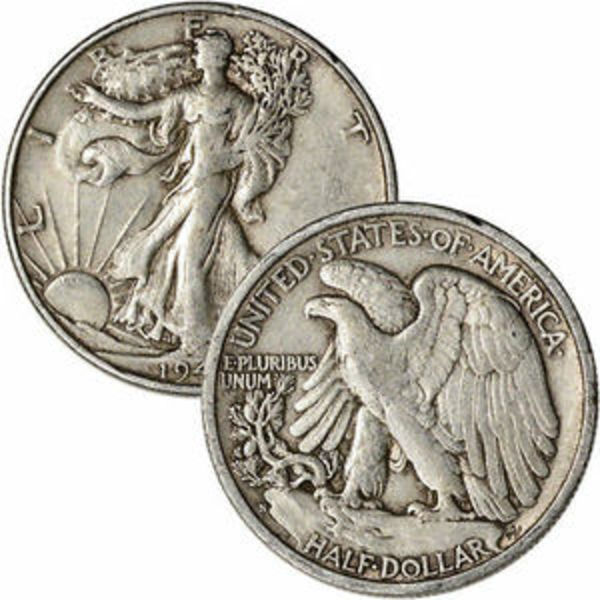
Silver Eagles carry Adolph Weinman’s Walking Liberty on the obverse, the design that ran on the Walking Liberty half dollar from 1916 to 1947. The reverse has changed once. John Mercanti’s heraldic eagle (Type 1) ran from 1986 until mid-2021, when Emily Damstra’s landing eagle with an oak branch (Type 2) replaced it.
Silver Britannias show the reigning monarch on the obverse, currently Martin Jennings’ portrait of King Charles III. The bullion reverse is Philip Nathan’s 1987 standing Britannia, and the Royal Mint has kept it on the bullion issue even while rotating alternate designs through its proof and commemorative releases.
Security Features
The Royal Mint added four visual security features to the Britannia in 2021 and describes the result as the most visually secure bullion coin it produces:
- Latent image. A padlock in the lower left of the reverse becomes a trident as the coin is tilted.
- Surface animation. The wave field behind Britannia catches light so the waves appear to move.
- Micro-text. The Latin phrase DECUS ET TUTAMEN (“an ornament and a safeguard”) is micro-etched along the inner rim.
- Tincture lines. Fine hatching on the Union flag of Britannia’s shield, the heraldic convention for indicating colour.
These are verifiable by eye in a few seconds, which is useful on the secondary market where you may be buying raw coins from a stranger.
The Silver Eagle’s protection is subtler. From 2021 the Type 2 coins carry a deliberate variation in the edge reeding, a gap that looks at first like a missing reed. It is a genuine anti-counterfeiting mark rather than a striking error, and we cover it in detail in our guide to the edge notch on US Mint Gold and Silver Eagles. Type 1 Eagles predate it.
If counterfeit risk is your main concern, the Britannia is easier to authenticate without tools, and 2021-and-later dates are the ones to ask for.
Bullion Premium Comparison
Premiums move with spot, so percentages travel better than dollar figures. As of September 7, 2026, with silver spot at $66.31, the lowest advertised dealer prices on our comparison pages were:
| Product | Best price | Premium over spot |
|---|---|---|
| 1 oz Britannia, random year | $67.50 | 1.8% |
| American Silver Eagle, random year | $69.16 | 4.3% |
| 2026 Britannia, 1 oz | $70.35 | 6.1% |
| 2026 American Silver Eagle, 1 oz | $71.74 | 8.2% |
Britannias undercut Eagles at both ends, by roughly $1.40 on current-year coins and $1.66 on random-year. Across a tube of 25, that is about $35 to $42. The gap narrows in bulk: 500-coin monster boxes for the two coins were priced within about $11 of each other.
Broadly, Eagles run 4% to 8% over spot and Britannias 2% to 6%, with current-year coins at the top of each range and random-year secondary-market coins at the bottom. Compare live figures on our Britannia bullion price comparison and Silver Eagle bullion price comparison pages, or sort every silver product by premium on closest-to-spot silver.
Liquidity and Resale
Silver Eagles are the most liquid silver bullion coin in the United States. Every dealer posts a buy price, spreads are tight, and quantity is rarely an obstacle. Selling back into the US market is where Eagles earn their higher purchase premium.
Britannias are the dominant sovereign silver coin in the UK. US dealers buy them without hesitation, but generally at a smaller premium over spot than they pay for Eagles, so expect a wider round-trip spread. Whether that cancels the purchase saving depends on how long you hold and where you sell.
Tax Treatment
UK buyers. Silver Britannias are exempt from Capital Gains Tax because they are UK legal tender, which is a real advantage on a long hold. VAT is the offsetting cost: silver bullion is charged the standard 20% rate at purchase in the UK, unlike gold, which is VAT-exempt.
US buyers. Neither coin gets special federal treatment, and both are taxed as collectibles on sale. Sales tax at purchase depends on the state. The one difference that matters is IRA eligibility, below.
IRA Eligibility: Check the Date
The IRS requires .999 fineness for silver in a precious metals IRA. Silver Eagles qualify in every year of issue. Britannias qualify only from 2013 onward. The 1997 to 2012 coins are .958 fine and cannot be held in an IRA even though they contain a full ounce of silver.
This is easy to trip over, because the cheapest Britannia listing on any comparison page is usually the random-year one, and random-year inventory mixes both specifications. If the coins are going into an IRA, buy a dated 2013-or-later product and confirm the year with the dealer before ordering.
Which One to Buy
Eagles are the better choice if you expect to sell in the US, want the narrowest resale spread, or are assembling a date set. That is most American buyers, and the premium is the price of the exit liquidity.
Britannias are the better choice if you are accumulating ounces and want the lowest premium from a sovereign mint, if you want security features you can check by eye on secondary-market purchases, or if you are a UK resident using the CGT exemption. They also diversify a stack that is otherwise entirely US-issued.
Holding both is reasonable. Eagles cover the domestic resale case; Britannias are worth loading when their premium spread is meaningfully wider than usual, which our premium data shows happening most often on random-year inventory.
Frequently Asked Questions
Are Silver Britannias .9999 fine like Maple Leafs? No. Britannias from 2013 onward are .999 fine, matching the Silver Eagle. Coins dated 1997 to 2012 are .958. The Canadian Maple Leaf is the only major sovereign silver bullion coin struck at .9999.
Which coin is cheaper to buy? The Britannia, consistently. On September 7, 2026, the gap was 2.5 percentage points on random-year coins and 2.1 points on current-year, or roughly $35 to $42 per tube of 25.
Can I hold Britannias in a US precious metals IRA? Only those dated 2013 or later. Earlier Britannias are .958 fine and fall below the IRS .999 minimum for silver.
Do pre-2013 Britannias contain less silver? No. Every Silver Britannia contains one troy ounce of pure silver. The older coins are simply heavier overall because of the lower-purity alloy.
Which holds its premium better on resale? Eagles, in the US, particularly in small quantities. Britannias hold up better in UK and European markets and in bulk lots.
Related Guides:
- Compare Silver Eagle bullion prices
- Compare Britannia bullion prices
- Closest-to-Spot Silver
- Current Silver Spot Price
- The edge notch on US Mint Gold and Silver Eagles
- American Silver Eagle Mintages by Year
- Silver Eagles vs. Junk Silver
- Silver Eagles vs. Silver Bars