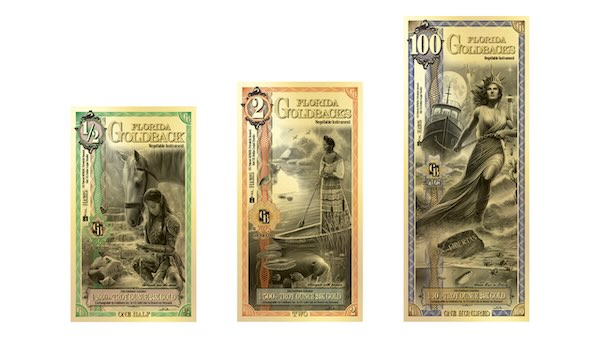
Oklahoma has become the seventh state to receive its own Goldback series when the collection launched at the American Numismatic Association World’s Fair of Money in Oklahoma City in August 2025. The series spans eight denominations, from a fractional 1/2 note containing just 1/2000th of a troy ounce of gold up to a 100-denomination note carrying a full tenth of an ounce.
For investors looking to accumulate fractional gold in a format that doubles as collectible artwork, and for those already familiar with earlier state series like Utah, Nevada, or Florida, the Oklahoma collection introduces new design themes rooted in the state’s frontier heritage, Native American culture, and Route 66 iconography.
What Are Goldbacks?
Goldbacks are privately issued notes produced by Goldback, Inc. using Valaurum’s patented Aurum technology, which permanently bonds a precise amount of .9999 fine 24-karat gold between durable polymer layers. The result is a flexible, tear-resistant note that functions as both a bullion product and a voluntary medium of exchange.
Unlike coins or bars, Goldbacks are designed to be spent in small transactions at participating merchants. They currently hold legal recognition as specie legal tender in several states, including Utah, Nevada, New Hampshire, Wyoming, South Dakota, Oklahoma, and Florida. Each state series features unique allegorical artwork depicting classical virtues, rendered in detailed intaglio-style line work with built-in security features including microtext, guilloché patterns, and—new for 2025—UV-reactive ink that glows under the official Goldback Penlight.
If you’re new to Goldbacks, our coverage of the Florida Goldbacks and their new denominations provides a good primer on how these notes work and why collectors are drawn to them. We’ve also covered the growing physical distribution network, including Goldback ATM machines appearing in Florida.
Oklahoma Goldback Denominations and Gold Content

The Oklahoma series follows the expanded denomination structure introduced with the Florida release, offering eight standard notes. Each contains a specified weight of .9999 fine gold sealed within the Aurum polymer substrate.
| Denomination | Gold Content | Virtue (Latin) | Virtue (English) | Approx. Melt |
| 1/2 | 1/2000 oz | Honestas | Honor | $2.34 |
| 1 | 1/1000 oz | Perseverantia | Perseverance | $4.68 |
| 2 | 1/500 oz | Benevolentia | Kindness | $2.34 |
| 5 | 1/200 oz | Industria | Industry | $9.35 |
| 10 | 1/100 oz | Unitas | Unity | $46.77 |
| 25 | 1/40 oz | Hospitalitas | Hospitality | $116.92 |
| 50 | 1/20 oz | Vigilantia | Vigilance | $233.84 |
| 100 | 1/10 oz | Libertas | Liberty | $467.67 |
Note: Melt values are approximate based on recent spot prices and will fluctuate with the gold market. Goldbacks typically trade at a significant premium above melt due to manufacturing costs, collectibility, and utility as a medium of exchange.
Artwork and Design: Oklahoma’s Story in Gold
Every Goldback series tells its state’s story through allegorical figures representing classical virtues. The Oklahoma collection draws on the state’s identity as a crossroads of frontier grit, Indigenous heritage, oil-boom ambition, and Great Plains resilience. Here’s what each denomination depicts.
1/2 Goldback — Honestas (Honor)
The smallest denomination features a young cowgirl guiding her herd along the historic Chisholm Trail, the legendary cattle route that ran through Indian Territory and helped define Oklahoma’s ranching identity. The design celebrates the honest, hardworking spirit of the state’s agricultural roots.
Compare prices: 1/2 Oklahoma Goldback
1 Goldback — Perseverantia (Perseverance)
The flagship denomination honors the Land Run of 1889, when over 50,000 settlers raced to claim 160-acre plots in what would become Oklahoma. A young pioneer woman on horseback grips a land stake embroidered with the word “Perseverantia,” embodying the determination that built the state.
Compare prices: 1 Oklahoma Goldback
2 Goldback — Benevolentia (Kindness)
This denomination pays tribute to Oklahoma’s deep Native American heritage. The design features a Cherokee mother wearing a traditional tear dress and beaded headband, carrying a woven basket overflowing with the bounty of the land. It’s a recognition of the generosity and resilience of the tribal nations that call Oklahoma home—the state’s name itself derives from the Choctaw words for “red people.”
Compare prices: 2 Oklahoma Goldback
5 Goldback — Industria (Industry)
A young woman strides through the oil fields during the 1905 Glenpool Oil Strike, which transformed Oklahoma into one of the world’s leading petroleum producers. Her expression conveys discovery, pride, and transformation—reflecting the industrial boom that shaped the state’s modern economy.
Compare prices: 5 Oklahoma Goldback
10 Goldback — Unitas (Unity)
Created in collaboration with Native voices, this denomination depicts an intertribal powwow—one of the defining cultural traditions of Oklahoma, which is home to 39 federally recognized tribal nations (more than any other state). The artwork features a woman performing the Fancy Shawl Dance alongside a figure performing the men’s Fancy Dance, celebrating the unity found in shared tradition.
Compare prices: 10 Oklahoma Goldback
25 Goldback — Hospitalitas (Hospitality)
Hospitality is embodied by a young woman sitting on the hood of a classic 1960 Chevrolet Impala along Route 66, which runs through Oklahoma for nearly 400 miles. The design captures the open-hearted, welcoming spirit that Route 66 travelers have associated with the state for nearly a century.
Compare prices: 25 Oklahoma Goldback
50 Goldback — Vigilantia (Vigilance)
Oklahoma sits squarely in Tornado Alley, and the 50 denomination reflects that reality. The figure of Vigilance kneels in tall prairie grass, steady and composed, as a powerful tornado spirals across the horizon. It’s a tribute to the preparedness and courage that living on the Great Plains demands.
Compare prices: 50 Oklahoma Goldback
100 Goldback — Libertas (Liberty)
The highest standard denomination honors the 45th Infantry Division, the “Thunderbird Division,” which was headquartered at Fort Sill, Oklahoma, and served with distinction in both World Wars and the Korean War. Libertas, the Roman goddess of freedom, stands at the center of the composition—a fitting tribute for a note containing a full tenth of a troy ounce of gold.
Compare prices: 100 Oklahoma Goldback
Pricing and Premiums: What to Expect
Like all Goldbacks, the Oklahoma series trades at a premium above the melt value of the gold it contains. This is standard for the format—the Aurum manufacturing process, intricate artwork, and anti-counterfeiting features add cost that isn’t reflected in the raw gold weight alone.
As a general rule, lower denominations carry higher percentage premiums but lower dollar premiums. The 1/2 Goldback might trade at 100–200% above its $2.25 melt value (so roughly $4–$7 per note), while the 100 Goldback’s premium narrows to roughly 90–110% above its $449.75 melt (in the $850–$950 range at most dealers). Shopping across multiple dealers matters—we’ve seen spreads of $3–$4 on the 1-denomination note alone.
For current dealer pricing across all denominations, you can compare live prices on our product pages linked above. We track pricing from major dealers including APMEX, SD Bullion, Hero Bullion, BGASC, and others.
How Oklahoma Fits Into the Goldback Series
Oklahoma is the seventh state in the Goldback lineup, following Utah (2019), Nevada, New Hampshire, Wyoming, South Dakota, and Florida. Arizona has been announced as the next state in the pipeline.
Each state series has developed its own collector following, and some earlier series—particularly Utah first-edition notes—have appreciated significantly on the secondary market. Whether the Oklahoma series follows a similar trajectory will depend on mintage numbers, collector demand, and the broader gold market.
One notable addition to the Oklahoma release is a limited-edition 3 Goldback denomination featuring the virtue Ingenium (Ingenuity), a tribute to Oklahoma’s rich musical heritage from Woody Guthrie to modern country and rock artists. Set beneath the skies of Black Mesa State Park with prairie flora, mule deer, and a Western Tanager, this note was capped at just 4,000 pieces—making it one of the rarest Goldbacks ever produced. It contains 0.003 troy ounces of gold. Due to its limited mintage, the 3 Goldback is not part of our standard product comparison but may be available through specialty dealers.
For context on how state-level gold-backed products are evolving beyond the Goldback format, see our coverage of Texas’s state-branded bullion coins and gold notes.
Who Should Consider Oklahoma Goldbacks?
Goldbacks occupy a unique niche at the intersection of bullion investing and numismatic collecting. They’re worth considering if you fall into one or more of these categories:
- Fractional gold buyers. If you want to accumulate gold in increments smaller than a gram, Goldbacks are one of the few products that make that practical. The 1/2 denomination contains just $2.25 worth of gold at current spot, making it one of the most accessible entry points in the physical gold market.
- Collectors of state series. If you’re building a set across all seven (soon eight) state releases, Oklahoma fills the next slot. The allegorical artwork and state-specific themes give each series a distinct identity.
- Sound money advocates. Goldbacks are accepted as voluntary currency at a growing network of merchants, particularly in states with specie legal tender laws. Oklahoma’s inclusion in that legal framework adds another state where these notes carry formal recognition.
- Gift buyers. The low-denomination notes (1/2 and 1 Goldback) are popular as gifts and stocking stuffers—tangible gold for under $10.
Important Considerations Before Buying
A few things to keep in mind as you evaluate the Oklahoma Goldback series:
- Premiums are significant. You’re paying well above the melt value of the gold content, often 90–200% or more depending on the denomination. If your primary goal is accumulating gold weight at the lowest cost per ounce, traditional bullion products like gold bars or coins closer to spot price will be more cost-effective.
- Liquidity varies. While Goldbacks are gaining wider merchant acceptance, they’re still far less liquid than sovereign-minted bullion coins like American Gold Eagles or Canadian Maple Leafs. Selling back to dealers or on the secondary market is straightforward, but the buy-sell spread can be wider than for traditional bullion.
- These are not legal tender. Despite recognition as specie legal tender in several states, Goldbacks are privately issued and not backed by any government. Their acceptance depends entirely on willing counterparties.
- Storage is easy but handle with care. The polymer substrate is durable, but the notes should be stored flat in a cool, dry environment. Many collectors keep them in protective sleeves or binders.
Disclaimer: This article is for informational purposes only and does not constitute financial or investment advice. Precious metals carry risk, and past performance of collectible bullion products does not guarantee future returns. Premiums above melt value may not be recoverable at resale. Always conduct your own research and consult a qualified financial advisor before making investment decisions. FindBullionPrices.com is a price comparison platform and does not sell bullion directly.