PAMP Suisse is one of the most recognized names in precious metals refining, and its gold bars are among the most widely traded bullion products in the world. Founded in 1977 in the Ticino canton of Switzerland, PAMP (Produits Artistiques Metaux Precieux) has built a reputation for precision manufacturing, artistic bar designs, and industry-leading anti-counterfeit technology. The refinery holds Good Delivery accreditation from both the London Bullion Market Association (LBMA) and the London Platinum and Palladium Market (LPPM) — a distinction shared by only a handful of refiners worldwide.
This guide covers everything buyers need to know about PAMP Suisse gold bars: the company’s history, its product lines and available sizes, current melt values by weight, how to verify authenticity using PAMP’s proprietary VeriScan technology and other methods, and how PAMP bars compare to competing refiners. For current dealer pricing, compare PAMP Suisse gold bar prices across multiple trusted dealers.
PAMP Suisse: History and Reputation
PAMP was established in 1977 as a family-owned precious metals refinery in Castel San Pietro, a small town in the Italian-speaking Ticino canton of southern Switzerland. The company’s name — Produits Artistiques Metaux Precieux, or “artistic precious metals products” — reflected an ambition that set it apart from the start: PAMP did not just want to produce bullion. It wanted to produce bullion that people would recognize on sight.
In 1979, the Lady Fortuna design was introduced on PAMP’s minted gold bars, and it quickly became the most recognizable bar design in the precious metals industry. That same period saw PAMP come under the umbrella of the MKS Group, a Geneva-based precious metals trading house founded by Mahmoud Kassem Shakarchi. Today the combined entity operates as the MKS PAMP GROUP, with PAMP handling the refining and manufacturing side while MKS manages global trading operations. The parent company, MKS PAMP Group BV, is headquartered in Amsterdam.
PAMP’s refinery processes gold, silver, platinum, and palladium to the highest standards. Its gold bars are struck at .9999 fine (24 karat, 99.99% pure gold), its silver at .999 fine, and its platinum and palladium products at .9995 fine. The refinery is also one of only three facilities in the world designated as an Approved Good Delivery Referee by both the LBMA and the LPPM — meaning PAMP is trusted not just to produce bars that meet the standard, but to evaluate whether other refiners’ bars meet it as well.
Beyond Switzerland, PAMP operates a joint venture facility in India called MMTC-PAMP, which has held LBMA Good Delivery status for silver since 2013 and for gold since 2014. This global footprint makes PAMP one of the most liquid brands in the bullion market — a PAMP bar is readily bought and sold by dealers on every continent.
The Lady Fortuna Design
The Lady Fortuna motif is the signature design of PAMP Suisse and appears on the majority of its minted gold, silver, and platinum bars. The design depicts Fortuna, the Roman goddess of fortune and prosperity, blindfolded and pouring bounty from a cornucopia. It is widely considered the most iconic bar design in the precious metals industry — more recognizable than any competing refiner’s motif — and has been in continuous production since 1979.
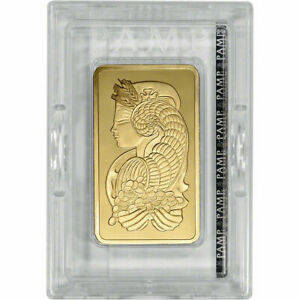
The design’s detail level is part of what makes PAMP bars difficult to counterfeit convincingly. Fortuna’s hair strands, facial features, and the folds of her garment are rendered with a precision that requires PAMP’s proprietary minting technology to reproduce accurately. Under magnification, genuine bars show consistent depth and sharpness across all design elements — a quality that counterfeiters struggle to replicate.
The reverse of each bar carries the PAMP Suisse name, the weight, purity (.9999 for gold), and a unique serial number. Every minted bar is individually sealed in CertiPAMP tamper-evident packaging with an integrated assay certificate.
Available Sizes and Current Gold Content Value
PAMP Suisse produces gold bars in a wider range of sizes than most competing refiners, from 1 gram fractional bars up to 1 kilogram institutional bars. Every size is minted at .9999 fine gold purity. The table below shows each standard size, its gold content in troy ounces, and the current melt value based on the live gold spot price. For a broader overview of gold bar sizing, see the complete gold bar sizes and weights guide.
| Bar Size | Gold Content (troy oz) | Current Melt Value |
|---|---|---|
| 1 gram | 0.03215 | $139.49 |
| 2.5 gram | 0.08038 | $348.74 |
| 5 gram | 0.16075 | $697.44 |
| 10 gram | 0.32151 | $1,394.92 |
| 20 gram | 0.64301 | $2,789.80 |
| 1 troy ounce | 1.00000 | $4,338.66 |
| 50 gram | 1.60754 | $6,974.57 |
| 100 gram | 3.21507 | $13,949.10 |
| 250 gram | 8.03769 | $34,872.80 |
| 500 gram | 16.07537 | $69,745.56 |
| 1 kilogram | 32.15074 | $139,491.13 |
Premiums over melt vary by size. As a general rule, smaller bars carry higher percentage premiums because manufacturing and packaging costs are spread over less gold. A 1 gram PAMP bar might carry a 15-30% premium over melt, while a 1 oz bar typically trades at 3-8% over melt, and a 1 kilo bar might trade at 1-3% over melt. For fractional sizes below 1 ounce, see the fractional gold bars guide for a detailed premium comparison across brands.
PAMP Suisse Product Lines
While the Lady Fortuna design accounts for the majority of PAMP’s sales, the refinery produces several distinct product lines. All share the same .9999 gold purity and CertiPAMP packaging.
Lady Fortuna
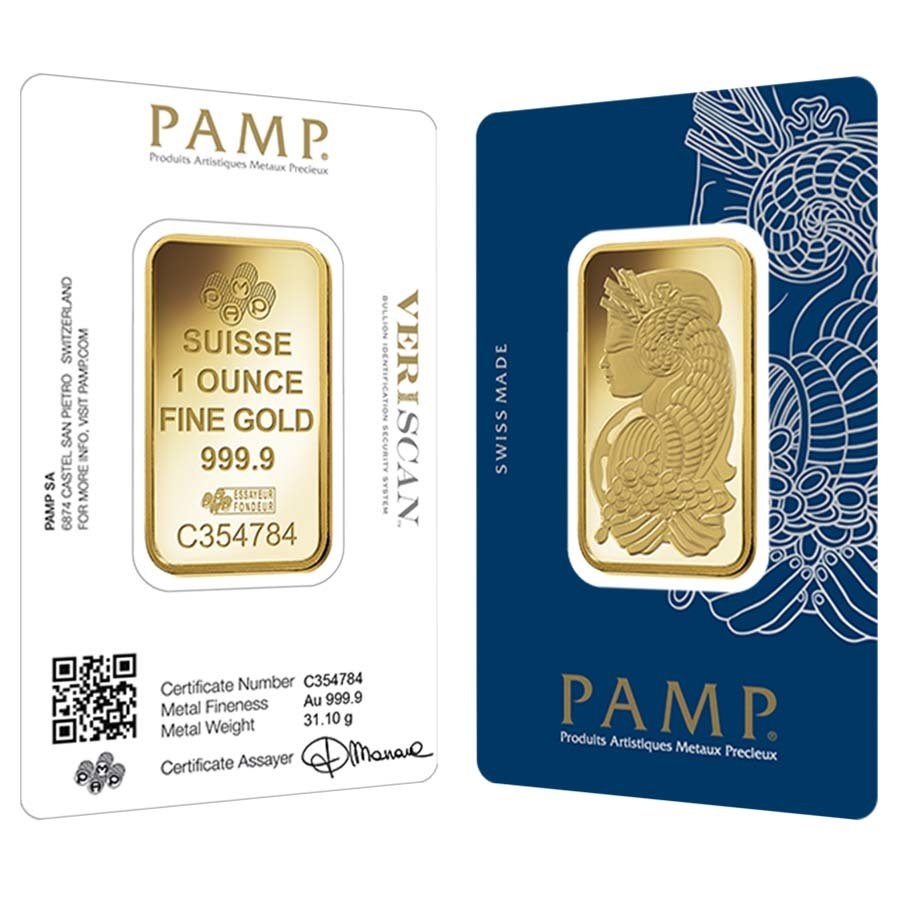
The flagship line, available in every standard size from 1 gram to 1 kilogram. Lady Fortuna bars are the most widely stocked PAMP product among online bullion dealers and typically offer the tightest bid-ask spreads of any PAMP bar due to their high liquidity. For most buyers, the Lady Fortuna in their preferred size is the default choice. Compare prices for 1 oz gold bars across all brands to see how PAMP premiums stack up.
Rosa

The Rosa collection features an intricate rose motif on each bar. Available primarily in gold, Rosa bars are produced in a range of sizes including 1 gram, 2.5 gram, 5 gram, 10 gram, 1 ounce, 50 gram, and 100 gram weights. The Rosa line tends to carry slightly higher premiums than the Lady Fortuna due to smaller production runs and the detail of the design work.
Lunar Series

PAMP’s Lunar series follows the Chinese zodiac, with each year featuring a new animal design on the bar’s obverse and its corresponding Chinese character. The 2026 Lunar Horse bars are the current issue, available in sizes including 1 gram, 5 gram, and 1 ounce. These bars appeal to both bullion investors and collectors who appreciate the annual design rotation. Limited production for each zodiac year can push secondary market premiums above those of the standard Lady Fortuna bars.
Multigram+

The Multigram+ is a divisible set of 25 individual 1-gram gold bars packaged in a single CertiPAMP card. Each 1-gram bar is individually sealed and can be separated from the set without losing its assay certification or resale value. The Multigram+ is available in Lady Fortuna, Lunar, and other designs. It appeals to buyers who want the flexibility of fractional gold — the ability to sell or gift a single gram at a time — without committing to a single larger bar.
Cast Bars
In addition to its minted (stamped) bars, PAMP produces cast gold bars in larger sizes, typically 50 gram, 100 gram, and 1 kilogram. Cast bars have a rougher, more industrial finish compared to the polished surface of minted bars, but they carry the same .9999 purity and come with PAMP assay documentation. Cast bars generally carry lower premiums than minted bars of the same weight because the manufacturing process is simpler.
How to Verify a PAMP Suisse Gold Bar
PAMP’s popularity makes its bars a frequent target for counterfeiters. Whether you are buying a PAMP bar from a dealer, receiving one as a gift, or evaluating one on the secondary market, verification is essential. There are four methods available, ranging from PAMP’s own proprietary technology to independent testing equipment. For broader guidance on testing precious metals, see the home gold testing guide.
Method 1: PAMP VeriScan Technology
The most reliable authentication method is PAMP’s proprietary VeriScan system. During manufacturing, PAMP scans the microscopic surface topography of every bar it produces — a pattern as unique as a fingerprint — and stores that digital record in a secure database. The VeriScan mobile app (available for Apple iOS devices) uses your phone’s camera to scan the bar’s surface and compare it against PAMP’s records. If the surface pattern matches a registered bar, the app confirms authenticity.
VeriScan works with PAMP gold, silver, and platinum bars. For the most accurate scan, remove the bar from its packaging, though the enhanced authentication mode supports scanning through CertiPAMP packaging for certain larger bars. Bars produced before VeriScan was implemented may not appear in the database. The app is currently iOS only — Android users will need to rely on the other verification methods below.
Method 2: CertiPAMP Packaging Inspection
Every PAMP minted bar ships in tamper-evident CertiPAMP packaging (formerly called Certicard). Authentic CertiPAMP packaging includes several security features worth examining carefully. The assay card shows the bar’s serial number, weight, purity, and the signature of an authorized PAMP assayer. A QR code on the packaging links to PAMP’s database and displays the bar’s registered specifications — scan it and verify that the information matches what is printed on the card. The packaging itself uses tamper-evident sealing that shows visible damage if opened or resealed. Check for clean printing, proper alignment, and consistent font quality. Counterfeit packaging often has subtle printing defects — uneven spacing, slightly wrong colors, or misaligned security features.
Method 3: Physical Inspection
Even without VeriScan, a careful physical inspection can catch most counterfeits.
Weight: Use a precision scale accurate to at least 0.01 grams. A 1 oz PAMP gold bar should weigh exactly 31.10 grams (31.1035 grams to be precise). Any deviation beyond manufacturing tolerance — even 0.1 grams — is a red flag. Also measure the bar’s length, width, and thickness against PAMP’s published specifications for that product.
Serial number: Every PAMP bar carries a unique serial number laser-engraved on its surface. This number should match the number on the CertiPAMP assay card exactly. The engraving should be clean, evenly spaced, and consistent in depth. Irregularities in font, spacing, or depth are common tells on counterfeits.
Design quality: PAMP’s Lady Fortuna design is extremely detailed. Examine the bar under magnification and look for fine hair strands, delicate facial features, and crisp lettering. Counterfeit bars often show blurred or soft details, particularly in the hair and facial features. The “SUISSE” text and PAMP logo should be perfectly crisp.
Magnet test: Gold is not magnetic. If a strong neodymium magnet sticks to or noticeably attracts the bar, it is not pure gold. Note that this test alone cannot confirm authenticity — tungsten-core counterfeits will also pass the magnet test — but it can quickly eliminate low-quality fakes.
Method 4: Sigma Metalytics Precious Metal Verifier
The Sigma Metalytics Precious Metal Verifier uses electromagnetic measurements to determine whether a bar’s electrical conductivity matches that of pure gold. This non-destructive test can detect tungsten-core counterfeits that pass weight and dimension checks, because tungsten has different electrical properties than gold despite having nearly identical density. Many coin shops and bullion dealers have Sigma testers available and may verify a bar at no charge or a nominal fee. For high-value purchases — especially on the secondary market — a Sigma test provides a level of confidence that physical inspection alone cannot match.
Red Flags for Counterfeit PAMP Bars
Be alert to any of the following warning signs when evaluating a PAMP Suisse gold bar:
Weight that does not match the stated denomination, even by a fraction of a gram. Packaging that appears resealed, wrinkled, or has misaligned printing. Serial numbers that do not match the assay card or that show irregular spacing and font quality. Blurry or soft details on the Lady Fortuna design, especially in the hair and facial features. A QR code that links to an invalid page or returns specifications that do not match the bar in hand. Any magnetic attraction when tested with a strong neodymium magnet. Unusual color tone compared to known genuine bars. And perhaps the most obvious red flag: a price significantly below the current market value from a seller you cannot verify.
If any of these conditions are present, do not complete the purchase without independent verification from a Sigma tester or a trusted dealer.
Where to Buy PAMP Suisse Gold Bars
The most reliable way to avoid counterfeit bars is to purchase from established bullion dealers who source directly from PAMP or its authorized distributors. Use FindBullionPrices.com to compare PAMP Suisse bar prices across multiple trusted online dealers in real time. Premiums vary by dealer, bar size, and market conditions, so checking multiple sources before buying can save a meaningful amount on a single purchase.
Be cautious when purchasing PAMP bars from peer-to-peer marketplaces, social media sellers, or any source offering prices well below the current gold spot price. Dealers competing for your business will undercut each other on premiums — but a price that seems too good is almost always a warning sign, not a deal. For the lowest available premiums on gold bars from any refiner, check the lowest-premium gold page.
PAMP Suisse vs. Other Gold Bar Refiners
PAMP is one of several LBMA-accredited refiners whose bars are widely traded in the bullion market. Here is how it compares to the other major names.
Valcambi: Also Swiss-based (Balerna, Ticino) and also LBMA Good Delivery accredited. Valcambi produces the CombiBar — a divisible bar of small units similar to PAMP’s Multigram+. Valcambi bars are generally comparable in purity (.9999 gold) and liquidity, but the Lady Fortuna design gives PAMP a recognition advantage among retail buyers. Premiums are usually similar between the two brands for equivalent sizes.
Credit Suisse: Credit Suisse gold bars were manufactured by Valcambi under the Credit Suisse brand for decades and were among the most popular bars in the U.S. market. Following UBS’s acquisition of Credit Suisse in 2023, newly produced Credit Suisse bars have become scarce, though existing bars continue to trade actively on the secondary market. PAMP bars have absorbed much of the market share that Credit Suisse bars once held.
Perth Mint: Australia’s Perth Mint produces .9999 gold bars with its distinctive kangaroo and swan designs. Perth Mint bars are backed by the government of Western Australia, which is a selling point for some investors. However, PAMP’s VeriScan verification technology and wider global distribution network give it an edge in anti-counterfeit protection and resale liquidity outside the Australian and Asian markets.
Royal Canadian Mint (RCM): RCM gold bars are .9999 fine and carry government backing. Like PAMP, RCM bars feature individual serial numbers and tamper-evident packaging. Both brands are highly liquid and carry similar premiums. The choice between them often comes down to design preference and regional availability.
For most buyers, the practical question is not which refiner makes the “best” bar — at .9999 purity, the gold content is identical — but which brand offers the best combination of premium, liquidity, and anti-counterfeit protection for their situation. PAMP’s VeriScan technology, global brand recognition, and the wide range of sizes available make it a strong default choice. To see how premiums compare across all major refiners, use the gold price comparison tool.
Disclaimer: This article is for informational purposes only and does not constitute investment advice. Gold bar prices and premiums change frequently. Always verify current prices before making purchase decisions. FindBullionPrices.com is a price comparison platform and does not buy or sell gold bars directly.