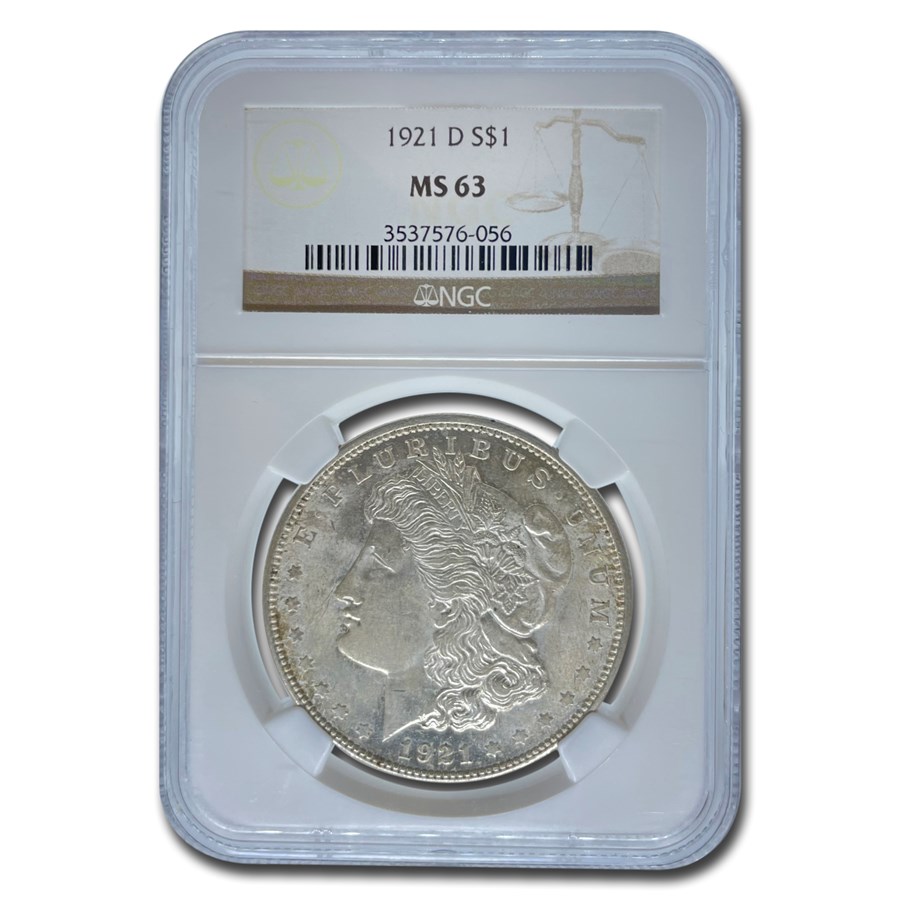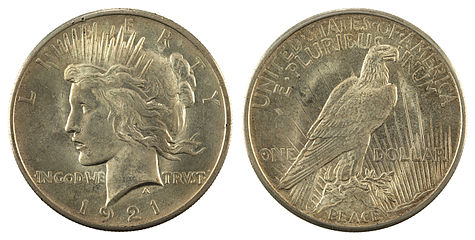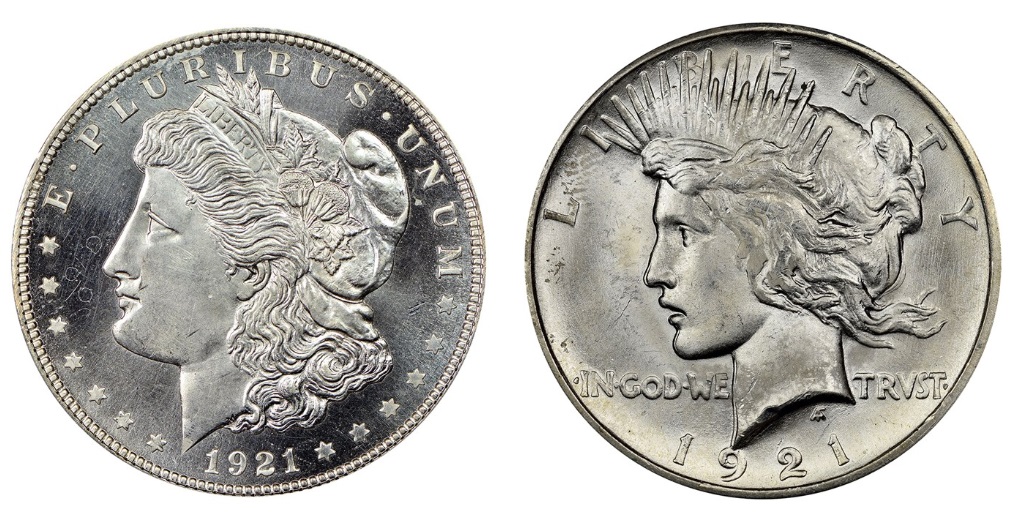
The year 1921 produced two of the most collected silver dollars in American history — and they couldn’t be more different. The 1921 Morgan Silver Dollar returned from a seventeen-year absence with a massive, three-mint production run of more than 86 million coins, making it the most common date in the entire Morgan series. The 1921 Peace Silver Dollar, struck the same autumn at Philadelphia, exists in a mintage of just over one million coins — and was made in a distinctive high-relief design never used again. Understanding what you have, what it’s worth, and why 1921 stands alone in U.S. numismatic history is the goal of this guide.
1921 Silver Dollar: Key Facts
| Denomination | $1 (One Dollar) |
| Composition | .900 silver, .100 copper |
| Silver Content | 0.77344 troy oz per coin |
| Weight | 26.73 grams |
| Diameter | 38.1 mm |
| Two coin types minted | Morgan Dollar (Philadelphia, Denver, San Francisco) & Peace Dollar (Philadelphia only) |
| Total 1921 production | ~87.7 million coins combined |
| Melt value | 56.46 (updates with silver spot price) |
The 1921 Morgan Silver Dollar
Why the Morgan Dollar Came Back in 1921
The Morgan Dollar had not been minted since 1904. By 1918, the United States had entered World War I, and the government needed silver. The Pittman Act of 1918 authorized the melting of up to 350 million silver dollars held in Treasury reserves to supply silver to Britain and its allies. Approximately 270 million coins were melted — a staggering destruction of the nation’s silver dollar stock.
The Pittman Act also required the government to replace every melted coin, ounce for ounce, with new silver purchased from domestic mines. Beginning in March 1921, the U.S. Mint resumed Morgan Dollar production at all three active facilities — Philadelphia, Denver, and San Francisco — striking coins to fulfill that legal obligation. By year’s end, more than 86 million Morgan Dollars had been produced, making 1921 by far the single largest output year in the entire series.
The irony is considerable: these replacement coins were made using the same aging Morgan design that many in Congress and the Treasury already considered outdated. The Peace Dollar competition was already underway when the Pittman-replacement Morgans were being struck. The Morgan Dollar’s 1921 comeback was, from the start, a temporary measure.
Mint Marks and Mintage: Where Was Your 1921 Morgan Made?
Identifying your coin’s mint mark is the first step in determining its value. The mint mark on a 1921 Morgan Dollar is located on the reverse of the coin, above the letters “DO” in “DOLLAR”, just below the eagle’s tail feathers. Philadelphia-struck coins carry no mint mark. Denver coins show a “D” and San Francisco coins show an “S” in that position.
| Mint | Mint Mark | 1921 Mintage | Notes |
|---|---|---|---|
| Philadelphia | None | 44,690,000 | Highest mintage of the three; first Morgan struck at Philadelphia since 1904 |
| Denver | D | 20,345,000 | First time the Denver Mint ever produced Morgan Silver Dollars |
| San Francisco | S | 21,695,000 | Also produced the rare 1921-S Zerbe Proof in a tiny quantity |
Among the three, the 1921-P (Philadelphia, no mint mark) is the most common. The 1921-S and 1921-D are slightly scarcer but still widely available in all grades. None of the three are considered rare in any absolute sense — the high mintages of 1921 mean that even uncirculated examples are obtainable.
1921 Morgan Silver Dollar Values by Grade
Because 1921 Morgans were produced in such large numbers, circulated examples are priced close to silver melt value. Collector premiums grow significantly only as you move into uncirculated grades — and sharply again for coins graded MS-65 and above, where the 1921-S and 1921-D command meaningful premiums over the Philadelphia coin.
| Coin | Mintage | Good (G-4) | Fine (F-12) | EF-40 | AU-50 | MS-63 | MS-65 |
|---|---|---|---|---|---|---|---|
| 1921 (Philadelphia) | 44,690,000 | $56.46 | $56.46 | $58.40 | $58.40 | $89.06 | $175 |
| 1921-D (Denver) | 20,345,000 | $56.46 | $56.46 | $59.13 | $62.05 | $89.06 | $225 |
| 1921-S (San Francisco) | 21,695,000 | $56.46 | $56.46 | $61.32 | $62.78 | $98.55 | $290 |
Higher-grade values based on recent dealer and auction market data. Circulated values reflect current silver melt value. Premiums for NGC/PCGS certified coins may exceed the values shown, particularly at MS-64 and above.
How to Grade a 1921 Morgan Dollar: What to Look For
The Morgan Dollar’s design provides excellent reference points for grading. Here’s what distinguishes each grade level in practical terms:
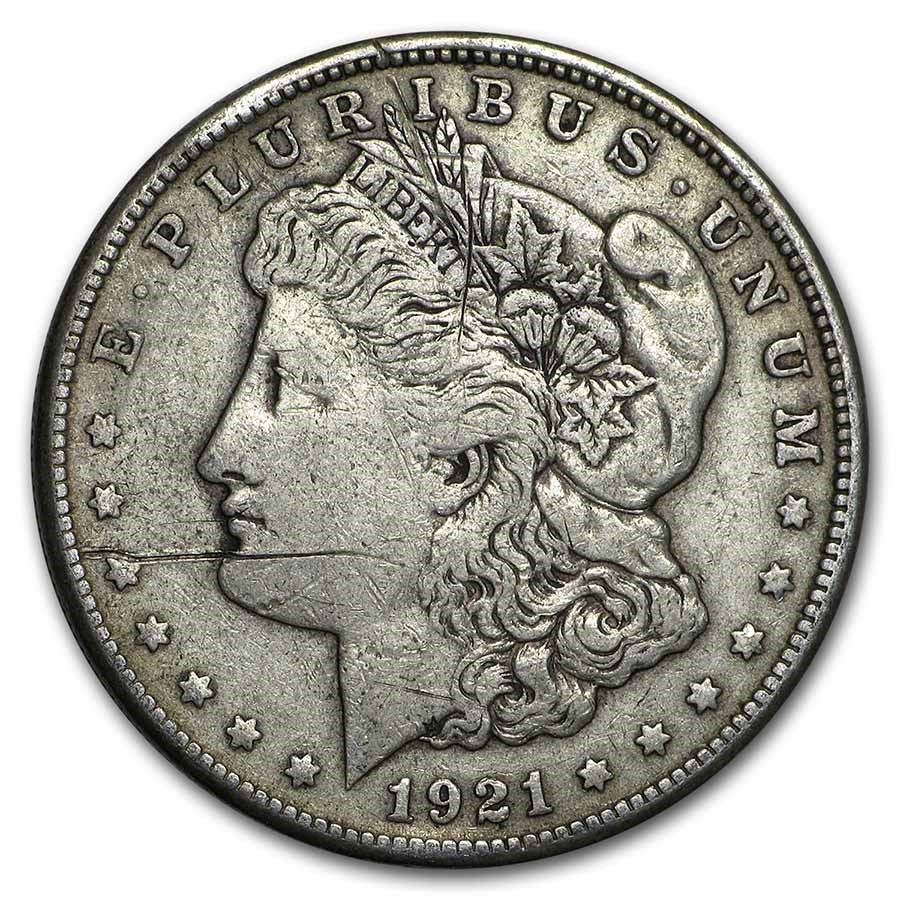
Good (G-4): The coin is heavily worn. Liberty’s portrait is flat with little detail remaining in her hair and cap. The eagle on the reverse is visible but nearly featureless. The rim may be partially worn down toward the lettering. At this grade, the coin’s value is driven almost entirely by its silver content.
Fine (F-12): Moderate wear throughout. Liberty’s hair shows some separation between strands, particularly above the ear and along the top of the head. The eagle’s breast feathers are visible but worn flat. Lettering and date are sharp and clear.
Extremely Fine (EF-40): Light wear on the high points only. Liberty’s hair above the ear shows some flattening, but individual strands are clear. The eagle’s breast feathers show distinct detail, and the arrows and olive branch in the talons are well-defined. Original luster is typically gone on circulated coins at this level.
About Uncirculated (AU-50 to AU-58): The design high points — Liberty’s cheek and hair above the ear, the eagle’s breast — show just a trace of wear or light friction. At AU-58, the coin can appear nearly mint-state, with most original luster intact. Bag marks from storage are common and do not significantly affect grade.
Mint State (MS-60 to MS-65+): No trace of wear anywhere on the coin. The distinction within the Mint State range is luster quality and the number and severity of contact marks (bag marks). An MS-63 coin has some distracting marks but good luster; an MS-65 has only minor marks that are not immediately noticeable under normal viewing. For 1921, finding an MS-65 with full, frosty luster is genuinely difficult — the Mint struck these coins quickly and without special care, and many were stored loosely in bags for decades.
For coins you’re considering for certification, PCGS and NGC are the two major third-party grading services. A certified MS-63 or better 1921 Morgan is significantly more liquid and commands a premium over raw (uncertified) coins of the same grade.
VAM Varieties and Error Coins
The 1921 Morgan Dollar is one of the most heavily studied dates in the Morgan series for die varieties, known in numismatic circles as VAMs (named after Leroy Van Allen and A. George Mallis, who catalogued them). Because the Mint had to produce tens of millions of coins quickly, many different die pairs were used, and numerous varieties resulted — from minor differences in die positioning to dramatic die clashes, off-center strikes, and doubled dies.
Notable 1921 Morgan VAMs include the VAM 1A Clashed E, where the obverse die clashed with the reverse and left a phantom “E” from the word “ONE” impressed into Liberty’s neck — visible under magnification. Off-center strike errors on 1921-D coins have sold at auction for hundreds of dollars even in circulated condition. The VAM 44 Wide Reeds variety features unusually wide edge reeding, detectable to the naked eye.
If you believe you have a valuable 1921 Morgan variety, we cover them in detail — including photographs and current auction values — in our 1921 Morgan Dollar VAM varieties guide. The VAMworld database (vamworld.com) is also an authoritative free reference for the entire Morgan series.
The 1921 Peace Silver Dollar
The Only High-Relief Peace Dollar
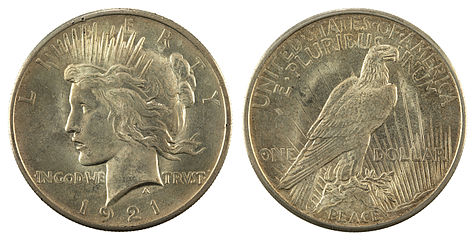
The 1921 Peace Dollar is not simply the first year of a long series — it is the only Peace Dollar struck in high relief. When sculptor Anthony de Francisci’s winning design was selected in the autumn of 1921, the Mint produced working dies that rendered Liberty’s portrait and the perched eagle in dramatically deep relief. The result is a coin where Liberty’s hair, the feathers on the eagle, and the fine details of her crown stand in much greater three-dimensional relief than in any later Peace Dollar.
The Mint abandoned high relief after 1921. The dies wore out more quickly, strike quality was inconsistent, and the coins did not stack properly — a practical problem for banking. Beginning in 1922, the design was reduced to a shallower, more production-friendly relief that remained standard through 1935. Place a 1921 side by side with a 1922 Peace Dollar and the difference is immediately apparent.
The 1921 Peace Dollar was struck only at Philadelphia, with a mintage of 1,006,473 coins. That’s roughly 1/44th the production of the 1921 Morgan. Most survivors exist in circulated grades — mint state examples above MS-63 are genuinely scarce, and MS-65 coins are rare enough to command prices of $4,000 or more.
1921 Peace Dollar Values by Grade
| Coin | Mintage | Good (G-4) | VF-20 | EF-40 | AU-50 | MS-63 | MS-65 |
|---|---|---|---|---|---|---|---|
| 1921 Peace Dollar (Philadelphia) | 1,006,473 | $87.60 | $160 | $200 | $350 | $1,000 | $4,000+ |
Values based on recent dealer listings and major auction results. High-relief design makes striking quality particularly important: full, sharp strikes command significant premiums at every grade level.
What Makes a 1921 Peace Dollar Valuable?
Strike quality matters more for the 1921 than for any other Peace Dollar. Because the dies were cut in high relief, getting a full, sharp impression on every coin was difficult — many 1921 Peace Dollars show areas of weakness, particularly on Liberty’s hair above the ear and on the eagle’s breast feathers. Coins with full, sharp strikes across the entire design are worth meaningfully more than weakly struck examples in the same certified grade.
Luster is the other critical factor. The 1921 Peace Dollar is known for a distinctive, somewhat subdued luster compared to Morgan Dollars of the same era. Coins with original, unimpaired luster — not cleaned or whizzed — are strongly preferred by serious collectors. A raw coin showing artificial brightening is worth considerably less than its certified equivalent.
For a complete grading and variety guide to the 1921 Peace Dollar — including the rare high-relief VAMs and what makes the Philadelphia mintage unique — see our dedicated 1921 Peace Dollar value guide.
Morgan vs. Peace: Which 1921 Silver Dollar Should You Buy?
This is one of the most common questions from people new to 1921 silver dollars, and the answer depends entirely on your purpose.
If you’re buying for silver content at or near melt value: The 1921 Morgan is the clear choice. Both coins contain the same 0.77344 troy ounces of silver, but a circulated 1921 Morgan can be purchased for a dollar or two over spot price from most bullion dealers. A circulated 1921 Peace Dollar commands a $20–40 collector premium even in worn condition. The Morgan wins easily as a silver value play.
If you’re buying as a numismatic collectible with investment upside: The 1921 Peace Dollar has the stronger long-term collector thesis. It’s a key date in one of the most popular U.S. coin series, produced for exactly one year in a design that was never repeated. Supply is fixed and genuinely limited compared to the Morgan. Quality MS-63+ examples have appreciated meaningfully over the past decade, and the series has a large, enthusiastic collector base.
If you’re a Morgan specialist: The 1921 Morgan is an interesting study in die varieties (VAMs), mint errors, and the mechanics of high-volume Mint production. There is more to explore in 1921 Morgans than the common date status suggests, and a VAM specialist can find coins with significant premiums at prices that are still accessible to new collectors.
The historical angle: No other year in American coinage history produced two different silver dollar designs simultaneously. The 1921 Morgan and 1921 Peace Dollar together represent a genuine transition moment — the end of a 43-year design era and the beginning of what would become the last silver dollar struck for general circulation. For collectors interested in U.S. history as much as numismatics, owning one of each is a natural pairing.
Silver Content and Melt Value
Both the 1921 Morgan and 1921 Peace Dollar contain exactly 0.77344 troy ounces of silver. All U.S. silver dollars minted from 1878 through 1935 share this composition: 90% silver, 10% copper, weighing 26.73 grams. The silver melt value at current spot prices is:
1921 Silver Dollar melt value: $56.46
Heavily worn or “cull” 1921 Morgan Dollars — coins with significant damage, cleaning, or illegible dates — are typically sold in bulk lots at or just below melt. These represent the floor value for any 1921 silver dollar in circulated condition. Use our silver coin melt value calculator to check the current melt value of any silver coin based on live spot price.
How to Sell Your 1921 Silver Dollar
Where and how you sell depends on what you have. For circulated, common-date 1921 Morgan Dollars, your best options are local coin dealers, coin shows, or bullion dealers who buy junk silver — all of whom will pay near melt value with minimal paperwork. Expect to receive 90–100% of spot silver value for ungraded circulated coins.
For uncirculated 1921 Morgans in the MS-62 to MS-64 range, coin shows and reputable online dealers (Heritage Auctions, Stack’s Bowers, eBay with completed sales research) are better options than walk-in dealers who may not specialize in numismatic premiums. If you have a coin you believe grades MS-64 or better, PCGS or NGC certification before selling is worth the cost — certified coins sell faster and at higher prices.
For 1921 Peace Dollars in any condition, the premium above silver is always meaningful, and the collector market is strong. Heritage Auctions and Stack’s Bowers Galleries both regularly handle 1921 Peace Dollars and can achieve strong results for nicer examples. NGC and PCGS certification is especially important for any 1921 Peace Dollar you believe grades AU-55 or better, where the price difference between an overgraded raw coin and a certified genuine example is substantial.
For either coin: do not clean, polish, or dip your coin before having it evaluated. Cleaning — even professional-looking cleaning — permanently reduces a coin’s value and results in a “details” grade designation from PCGS or NGC rather than a numerical grade. Present the coin as-found.
The 1921 Silver Dollar Content Cluster: Related Guides
This page provides a comprehensive overview of both 1921 silver dollars. For deeper research, we have dedicated guides for each:
- 1921 Morgan Silver Dollar Value, VAM Varieties & Error Coins — Full VAM reference, die clash varieties, off-center strikes, key Morgan series dates, and the GSA Hoard story.
- 1921 Peace Dollar Value, High Relief Design & Varieties — High-relief grading guide, scarce VAMs, and Peace Dollar key dates beyond 1921.
- Peace Dollar Values Guide (1921–1935) — Complete value guide for the full Peace Dollar series, including all mint marks and key dates.
- Silver Coin Melt Value Calculator — Live melt values for Morgan Dollars, Peace Dollars, and all U.S. silver coinage.
Frequently Asked Questions
How much is a 1921 silver dollar worth?
The value depends on which coin you have and its condition. A circulated 1921 Morgan Silver Dollar (the common type) is generally worth its silver melt value — approximately 56.46 at current silver prices — with modest collector premiums for nicer grades. A circulated 1921 Peace Silver Dollar, which is considerably rarer, starts around $87.60 in worn (G-4) condition and can exceed $1,000 in MS-63. Uncirculated Morgan Dollars in MS-65 trade for $175–$290 depending on the mint mark.
Where is the mint mark on a 1921 silver dollar?

On both the 1921 Morgan and 1921 Peace Dollar, the mint mark is on the reverse (back) of the coin. On the Morgan Dollar, look above the letters “DO” in “DOLLAR,” just below the eagle’s tail feathers. On the Peace Dollar, the mint mark appears above “ONE DOLLAR” on the lower reverse. Philadelphia-struck coins of both types carry no mint mark. Denver coins show “D” and San Francisco coins show “S.”
What makes a 1921 silver dollar rare or valuable?
For the common 1921 Morgan Dollar, rarity comes not from the date itself but from condition (MS-65 and above are scarce), die varieties (VAMs — particularly clashed-die and off-center strike errors), and certification. The 1921 Peace Dollar is inherently rare as a key date with only ~1 million struck; high-grade examples are genuinely scarce, and coins with sharp, full strikes are especially sought after by collectors.
Is a 1921 silver dollar good silver for stacking?
The 1921 Morgan Dollar is one of the most common and liquid forms of pre-1965 U.S. silver. With 86+ million minted, circulated examples are easy to find close to silver spot price. Each coin contains 0.77344 troy ounces of silver, and a $1 face value bag of mixed Morgan Dollars contains a known, predictable silver content. For silver stackers, 1921 Morgans are practical — widely recognized and easy to buy, sell, and trade. Use our junk silver price comparison to find the best current prices on Morgan Dollars from major dealers.
How do I know if my 1921 silver dollar has been cleaned?
Cleaned coins typically show an unnaturally bright, uniform shine without the soft, flowing luster of an original uncirculated coin. Under magnification, look for fine hairline scratches running in all directions — the telltale sign of wiping or polishing. Dipped coins (treated with chemical silver dip) may look deceptively original at first glance, but show a dull, somewhat flat appearance where original luster has been stripped. If you’re unsure, a coin dealer or third-party grader can evaluate the coin; both PCGS and NGC designate cleaned coins as “Details” grades rather than numerical grades, which significantly affects market value.
Were both the Morgan and Peace Dollar made in 1921?
Yes — 1921 is the only year in U.S. history when two different silver dollar designs were produced simultaneously. The Morgan Dollar production began in March 1921 to fulfill the replacement obligation under the Pittman Act. The Peace Dollar was struck at Philadelphia in December 1921. Collecting one of each is a natural goal for anyone interested in American numismatic history.