The Peace Dollar is one of the most recognizable silver coins in American numismatics. Minted from 1921 to 1935, it contains 0.77344 troy ounces of .900 fine silver, which puts the base Peace Dollar melt value near $48.97 at current silver prices. But most Peace Dollars trade well above melt, and the right date, mint mark, and condition can push values into the hundreds or thousands.
This guide covers every year in the series, identifies the key dates worth a premium, and breaks down what drives Peace Dollar prices in today’s market.
Peace Dollar Specifications
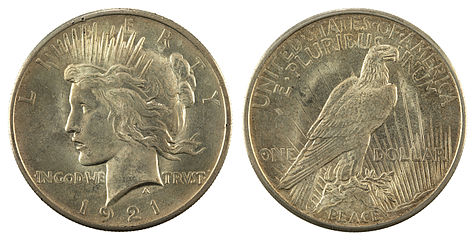
Every Peace Dollar shares the same physical specifications regardless of year or mint:
| Composition | 90% silver, 10% copper |
| Weight | 26.73 grams (0.8594 troy oz total) |
| Silver content | 0.77344 troy ounces pure silver |
| Diameter | 38.1 mm |
| Designer | Anthony de Francisci |
| Mints | Philadelphia (no mint mark), Denver (D), San Francisco (S) |
| Mint mark location | Reverse, below eagle’s tail feathers above “ONE” |
| Years minted | 1921-1928, 1934-1935 |
The silver content is the price floor for any Peace Dollar. At $63.31 per troy ounce of silver, the melt value sits near $48.97. You can track the live melt value on our silver calculators page.
Peace Dollar Value by Year and Mint Mark
The table below shows approximate values for each date and mint mark combination. Prices reflect current market conditions and assume problem-free coins with no cleaning, damage, or environmental issues. Key dates are marked with an asterisk ().
| Year/Mint | Mintage | Good-VG | Fine-VF | XF-AU | MS63 | MS65 |
|---|---|---|---|---|---|---|
| 1921 | 1,006,473 | $150 | $180 | $225 | $500 | $3,000+ |
| 1922 | 51,737,000 | $52 | $55 | $58 | $85 | $250 |
| 1922-D | 15,063,000 | $52 | $55 | $60 | $100 | $1,200 |
| 1922-S | 17,475,000 | $52 | $55 | $60 | $100 | $3,500 |
| 1923 | 30,800,000 | $52 | $55 | $58 | $85 | $250 |
| 1923-D | 6,811,000 | $52 | $58 | $65 | $130 | $3,000 |
| 1923-S | 19,020,000 | $52 | $55 | $60 | $110 | $4,500 |
| 1924 | 11,811,000 | $52 | $55 | $58 | $85 | $250 |
| 1924-S | 1,728,000 | $60 | $80 | $200 | $1,500 | $31,000+ |
| 1925 | 10,198,000 | $52 | $55 | $58 | $85 | $250 |
| 1925-S | 1,610,000 | $55 | $65 | $110 | $1,200 | $31,000+ |
| 1926 | 1,939,000 | $52 | $58 | $65 | $110 | $500 |
| 1926-D | 2,348,700 | $52 | $58 | $65 | $130 | $2,500 |
| 1926-S | 6,980,000 | $52 | $55 | $60 | $110 | $3,000 |
| 1927 | 848,000 | $55 | $65 | $80 | $200 | $2,500 |
| 1927-D | 1,268,900 | $55 | $70 | $100 | $350 | $8,000 |
| 1927-S | 866,000 | $55 | $70 | $100 | $400 | $10,000+ |
| 1928 | 360,649 | $225 | $260 | $300 | $550 | $5,000+ |
| 1928-S | 1,632,000 | $55 | $65 | $100 | $350 | $8,000 |
| 1934 | 954,057 | $55 | $65 | $80 | $200 | $2,000 |
| 1934-D | 1,569,500 | $55 | $65 | $80 | $200 | $3,000 |
| 1934-S | 1,011,000 | $70 | $120 | $400 | $5,000 | $135,000+ |
| 1935 | 1,576,000 | $52 | $58 | $65 | $130 | $700 |
| 1935-S | 1,964,000 | $52 | $58 | $70 | $200 | $3,500 |
Peace Dollar values by year and mint mark. Prices reflect current market conditions for problem-free coins. Key dates marked with asterisk (*).
A few patterns stand out. Common Philadelphia issues from 1922 to 1925 trade near the $50.90 to $56.73 range in circulated grades — just a small premium above silver melt value. The San Francisco and Denver mint coins from the mid-to-late 1920s carry progressively higher premiums in all grades. And the five key dates (1921, 1924-S, 1925-S, 1928, and 1934-S) command substantial premiums even in well-worn condition.
Key Dates and Rarities
Five dates in the Peace Dollar series stand apart from the rest. Understanding why each one commands a premium helps buyers and sellers set realistic expectations.
1921 Peace Dollar (High Relief)
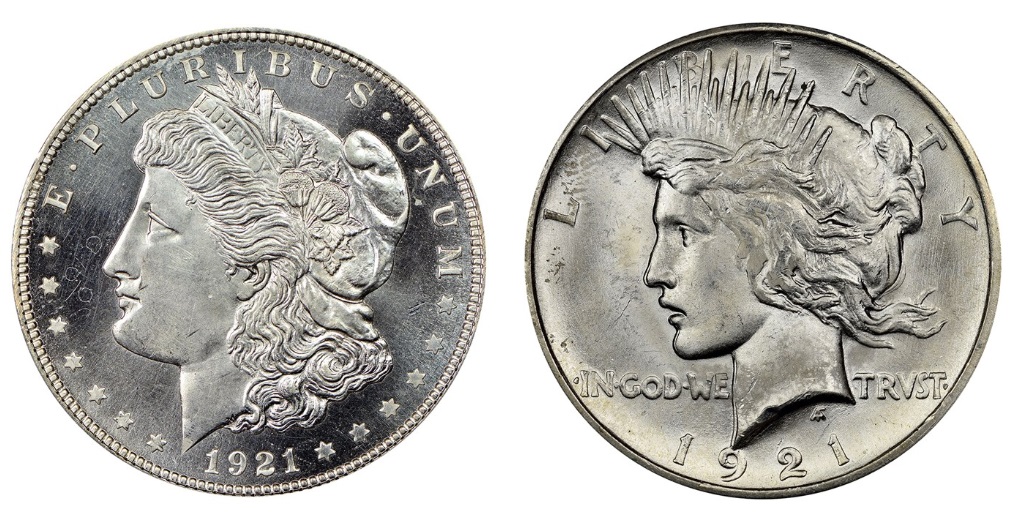
The inaugural Peace Dollar was struck in high relief, with deeper, more sculpted features than any subsequent year. The Mint produced just over one million coins before switching to a lower relief design in 1922 because the high-relief dies wore out quickly and caused production problems. A circulated 1921 in Good to VG condition typically sells in the $150 range. Uncirculated examples climb quickly — MS63 coins trade around $500, and gem MS65 specimens bring $3,000 or more.
1928 Peace Dollar (Lowest Mintage)
With a mintage of just 360,649, the 1928 Philadelphia Peace Dollar is the scarcest regular issue in the series. It was struck only at Philadelphia, with no Denver or San Francisco production that year. Even well-circulated examples start around $225. In uncirculated condition, MS63 coins bring $550, and MS65 examples exceed $5,000.
1934-S Peace Dollar (Condition Rarity)
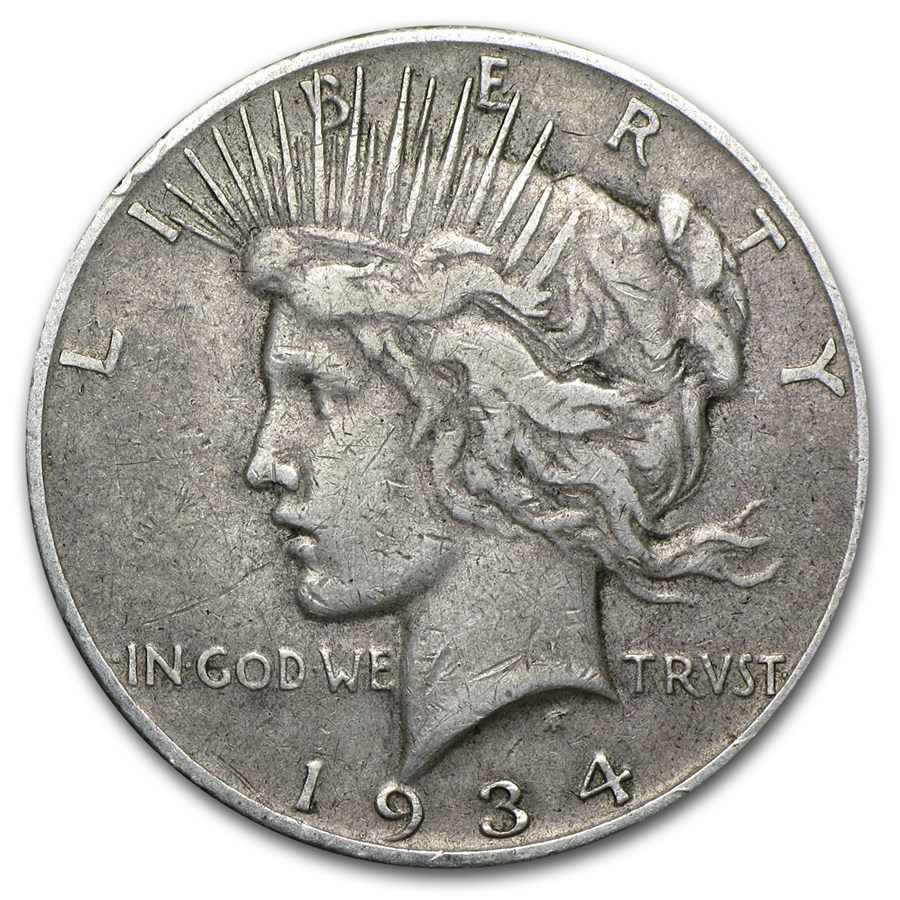
The 1934-S is the most condition-sensitive coin in the series. While its mintage of 1,011,000 is not exceptionally low, surviving examples in high grades are extremely scarce. Circulated coins in Fine to VF sell for $100 to $150, which is modest compared to the 1928. But in gem uncirculated condition, the 1934-S is one of the most valuable 20th-century U.S. coins — MS65 examples have sold for over $135,000 at auction. The value curve from VF to MS65 is one of the steepest in all of American numismatics.
1924-S and 1925-S
Both San Francisco issues from the mid-1920s are semi-key dates with low mintages under 1.75 million. In circulated condition they are only moderately expensive ($60 to $80 in Fine), but in uncirculated grades the prices escalate rapidly. MS63 examples of either date run $1,200 to $1,500, and MS65 coins from both years have sold above $30,000.
Error Varieties Worth Money
Several Peace Dollar error varieties carry premiums above their date and grade:
1922 High Relief (Proof): A small number of 1922 Peace Dollars were struck in high relief, possibly as experimental or presentation pieces. Fewer than a dozen are known. Depending on condition, these have sold for $10,000 to over $100,000 at auction. Be aware that most purported 1922 high relief coins turn out to be ordinary low relief strikes — professional authentication is required.
1922 Double Die Reverse (DDR): Several 1922 Philadelphia issues show strong die doubling on the reverse lettering, particularly on “PEACE” and “UNITED STATES OF AMERICA.” These can bring $200 to $500 in circulated condition, and significantly more in uncirculated grades.
Die breaks and die cracks: Various dates show die cracks running through the design, particularly on the obverse. While minor die cracks add only a small premium, major die breaks (where a piece of the die has broken away, leaving a raised irregular blob on the coin) can be worth $50 to $200 above the normal price for the date and grade.
How Condition Affects Value
Grading matters more for Peace Dollars than for many other 90% silver coins. Here is what the standard condition grades mean in practical terms:
| Grade | Description | Common Date Value |
|---|---|---|
| Cull | Heavy wear, damage, or cleaning. Sold primarily for silver content. | $46.98 to $50.90 |
| Good to Very Good (G-VG) | Major design features worn smooth but still identifiable. Date and mint mark clear. | $50.90 to $53.81 |
| Fine to Very Fine (F-VF) | Moderate wear on high points. Hair detail on Liberty and feather detail on the eagle partially visible. | $53.81 to $63.63 |
| Extremely Fine to About Uncirculated (XF-AU) | Light wear on the highest points only. Most original luster remains on an AU coin. | $56.73 to $78.25 |
| Mint State 60-63 (MS60-63) | No wear, but contact marks from bag handling. MS63 has fewer marks with better eye appeal. | $83.19 to $127.19 |
| Mint State 64-65 (MS64-65) | Strong luster, minimal marks, attractive eye appeal. MS65 is a gem with near-perfect surfaces. | $200 to $400+ |
Common date Peace Dollar values by condition grade at current market prices.
The jump from AU to MS63 is where prices begin to separate from silver melt value. A common date Peace Dollar in AU might sell for $58.69, while the same date in MS63 brings $83.19 to $127.19. The jump to MS65 is even more dramatic — common dates bring $250 and scarcer dates can reach four or five figures.
History of the Peace Dollar
The Peace Dollar emerged from the aftermath of World War I. In 1918, Congress passed the Pittman Act, which authorized the melting of over 270 million silver dollars (mostly Morgan Dollars) and mandated that new ones be struck from domestically mined silver. The Mint briefly resumed Morgan Dollar production in 1921, but a push from the American Numismatic Association and others led to a public design competition for a new coin symbolizing peace.
Italian-American sculptor Anthony de Francisci won the competition. His design features Lady Liberty in profile on the obverse, wearing a radiant crown, with “LIBERTY” above and “IN GOD WE TRUST” below. The reverse shows a bald eagle perched on a rock, clutching an olive branch, with rays of sunlight extending behind it and the word “PEACE” inscribed at the bottom.
Production began in late December 1921 with a high-relief striking. The Mint switched to a standard relief in 1922, and production continued through 1928. After a six-year gap, the Mint struck Peace Dollars again in 1934 and 1935 before ending the series permanently. The Peace Dollar was the last silver dollar produced for general circulation in the United States.
Peace Dollars as Silver Bullion Investments
For investors interested primarily in silver content, common-date Peace Dollars offer an alternative to modern bullion coins and bars. Each coin contains 0.77344 troy ounces of silver, giving it a melt value near $48.97 at current silver prices around $63.31 per ounce.
Common dates in circulated condition — particularly 1922, 1923, 1924, and 1925 Philadelphia issues — trade near $50.90 to $56.73, which means you are paying only a modest premium above the raw silver value. This puts them in a similar price range to other 90% silver coins, though Peace Dollars typically carry slightly higher premiums than dimes, quarters, and half dollars of the same era because of collector demand.
The advantage of Peace Dollars over generic 90% silver is that they carry numismatic upside. If silver prices rise, the melt value rises with them. But Peace Dollars also have collector demand that puts a floor under their premium even when silver is flat. This dual appeal — silver content plus collector interest — is why Peace Dollars consistently trade above their melt value in all market conditions.
Compare current bullion silver prices on our silver closest-to-spot page to see how Peace Dollar premiums stack up against modern bullion options.
Modern Peace Dollar Reissues
The U.S. Mint has reissued the Peace Dollar design several times in recent years. A 2021 centennial edition was struck in .999 fine silver to mark the 100th anniversary of the original. The Mint has continued with proof and enhanced uncirculated versions, including the 2023 Proof Peace Dollar and 2026 editions. These modern issues contain more pure silver than the originals (one full troy ounce of .999 fine vs. 0.77344 oz of .900 fine) and are collectible in their own right, though they trade on different fundamentals than the 1921-1935 originals.
Buying and Selling Peace Dollars
When buying Peace Dollars, condition and authenticity matter most. For coins graded MS63 and above, third-party grading from PCGS or NGC is standard and reduces authentication risk. For circulated coins, raw (ungraded) examples are common and acceptable as long as you buy from reputable sources.
Key dates like the 1928 and 1934-S should always be purchased in graded holders. The premium difference between a VF and an XF on a 1934-S can be hundreds of dollars, and counterfeits of high-value dates exist.
For sellers, the year-by-year value chart above provides a starting point. Cull and heavily circulated common dates will sell near silver melt value. Better-date coins in higher grades should be evaluated individually — a quick check of recent auction results on PCGS CoinFacts or Heritage Auctions will confirm current market pricing.
Browse Peace Dollars available on FindBullionPrices to compare current bullion dealer pricing on circulated coins.
Related Guides
- Peace Dollar Melt Value Calculator
- Silver Bullion Hub — compare silver bullion prices across products
- Silver Value Hub — track silver spot price and historical data
- 90% Silver Coins (Junk Silver)
- Silver Calculators — melt value tools for all silver coin types
This article is for informational purposes only and does not constitute financial or investment advice. Precious metals carry market risk, and past performance does not guarantee future results. Always conduct your own research and consult with a qualified financial advisor before making investment decisions.