A Morgan Silver Dollar is worth at minimum $48.97 in any condition — that’s the melt value based on its 0.77344 troy ounces of pure silver at today’s spot price. Most circulated common-date Morgans trade at melt plus a modest collector premium. Rare key dates in top grades can reach six figures. The exact value depends on three factors: date and mint mark, grade, and the current silver spot price.
💡 Current Morgan Dollar Melt Value: $48.97 Based on 0.77344 troy oz of pure silver at today’s spot price. This is the floor value for any Morgan Dollar, regardless of date or condition.
Use the value tables below to find your specific date and mint mark, then factor in condition using the grading guide. To calculate the value of other silver coins, use our coin value calculators.
What Is the Morgan Silver Dollar?
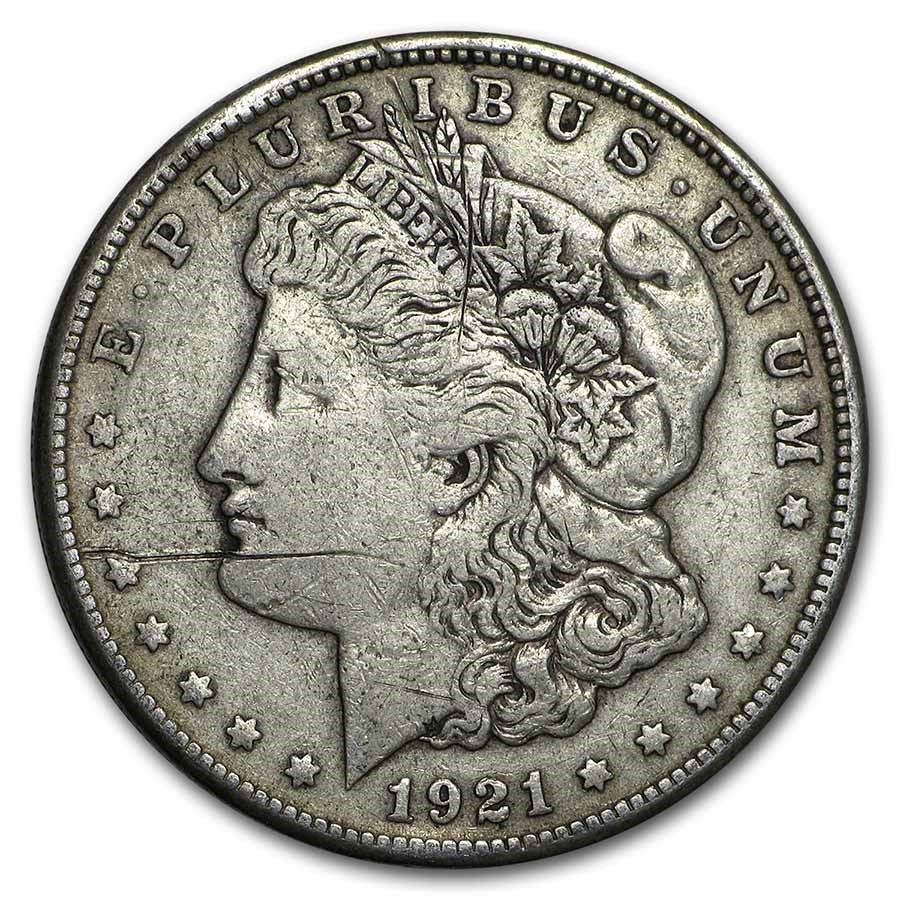
The Morgan Silver Dollar was minted from 1878 through 1904 and again in 1921. Designed by George T. Morgan, an English-born engraver recruited by the U.S. Mint in 1876, it remains one of the most recognized and actively collected coins in American numismatics. The obverse features a helmeted Liberty — modeled on Philadelphia schoolteacher Anna Willess Williams — and the reverse shows a heraldic eagle whose tail feather count famously changed multiple times during the first year of production.
Five mints struck Morgans across the series, with combined output exceeding 650 million coins. Yet some individual dates from short-lived or lower-volume mints had fewer than 100,000 struck — creating the scarcity that makes key-date Morgans among the most valuable U.S. coins in existence. The coin was a product of the western silver boom that followed the Comstock Lode, and the overproduction of silver dollars eventually fueled the monetary policy debates of the 1890s.
Specifications and Silver Content
Every Morgan Dollar contains exactly 0.77344 troy ounces of pure silver. This silver content is what gives every coin a hard floor value regardless of date, condition, or collector demand.
Specification
Value
Designer
George T. Morgan
Years Minted
1878–1904, 1921
Composition
90% silver, 10% copper
Total Weight
26.73 grams
Pure Silver Content
0.77344 troy oz
Diameter
38.1 mm
Edge
Reeded
Mints
Philadelphia (P), New Orleans (O), San Francisco (S), Carson City (CC), Denver (D)
The live melt value right now is $48.97. A dealer buying common circulated Morgans will typically pay at or near melt for heavily worn examples. Most Morgans trade above melt even in worn condition because of recognizability and consistent collector demand — the spread between spot and dealer price stays narrow.
Understanding Mint Marks
The mint mark on a Morgan Dollar is on the reverse, above the letters “DO” in DOLLAR, between the eagle’s tail feathers. Philadelphia coins carry no mint mark. The mint mark directly determines scarcity — an 1884 Philadelphia Morgan and an 1884 Carson City Morgan share the same design and silver content, but the difference in value can be hundreds of dollars.
Mint
Mark
Active Years
Character
Philadelphia
None
1878–1904, 1921
Highest mintages; most common dates
New Orleans
O
1879–1904
Variable quality; some significant dates
San Francisco
S
1878–1904
Generally well-struck; S-mint coins highly regarded in high grades
Carson City
CC
1878–1893
Lowest mintages overall; most valuable as a group
Denver
D
1921 only
Common — one year only; value near melt in circulated grades
Why Carson City Morgans Command a Premium
The Carson City Mint was a small Nevada operation opened to process Comstock Lode silver. Where Philadelphia struck tens of millions of coins per year, Carson City often struck fewer than a million. The mint closed permanently in 1893 after just sixteen years of Morgan production — giving the CC series a defined endpoint and historically low mintages across the board.
Even the most common CC dates (1882-CC, 1883-CC, 1884-CC) carry meaningful premiums over equivalent Philadelphia dates. The rarest — 1889-CC, 1893-CC — reach tens of thousands of dollars in Mint State. Collector demand for Carson City Morgans has never wavered.
How Much Is a Morgan Silver Dollar Worth?
Value depends on date, mint mark, and condition. Most people who find a Morgan Dollar in a drawer or estate have a common date. Here’s what that means in dollar terms — and where the real money is.
Common Dates
Common Philadelphia and New Orleans dates include: 1878-P, 1879-P through 1888-P, 1879-O through 1888-O, 1890-P/O, 1891-P/O, 1896-P through 1900-P, and all 1921-P/D/S issues. These were struck in the millions and survive in large quantities.
Values below are expressed as current melt value ($48.97) plus a collector premium. This format stays accurate as silver moves.
Grade
Premium Over Melt
Approx. Value at $63.31/oz
What to Look For
Good (G-4/6)
Melt + $2–6
~$50.65–56.98
Heavy wear; LIBERTY partially legible; date and mint readable
Very Good (VG-8/10)
Melt + $4–10
~$53.81–58.88
LIBERTY readable; main design features clear
Fine (F-12/15)
Melt + $8–16
~$60.14–69.64
All features visible; moderate wear on high points
Very Fine (VF-20/30)
Melt + $14–25
~$63.31–75.97
Light wear on high points only; hair and feather detail present
Very Fine (VF-35)
Melt + $22–35
~$69.64–$75.97
—
Extremely Fine (EF-40)
Melt + $30–45
~$75.97–85.47
Slight wear; most luster still present in protected areas
Extremely Fine (EF-45)
Melt + $38–55
~$75.97–91.80
—
About Uncirculated (AU-50)
Melt + $45–70
~$85.47–87.37
Trace wear on highest points; luster mostly intact
About Uncirculated (AU-55)
Melt + $55–85
~$94.97–120.29
—
About Uncirculated (AU-58)
Melt + $65–100
~$113.96–126.62
Near-Mint; difficult to distinguish from MS without experience
Note: San Francisco common dates (1880-S through 1884-S) typically carry a 10–20% additional premium in MS grades for their superior strike quality.
Semi-Key Dates
Not rare outright, but these carry meaningful premiums due to lower mintages, popular varieties, or unusual scarcity in high grades:
1880-CC — Significant premium in any grade
1881-CC — Lower mintage than most CC dates
1885-CC — Among the most attractive CC issues
1879-S Reverse of 1878 — Variety collectors pay a premium for the earlier reverse punch
1886-O — Deceptively scarce in high grades; MS examples are genuinely rare
1893-P — Sharply lower mintage than surrounding Philadelphia years
1895-O — Low mintage; frequently found cleaned; original-surface examples worth significantly more
1903-O — Famous for the Redfield Hoard discovery; strong collector identity
Key Dates
Key date Morgans are where numismatic value takes over from silver content entirely. At $48.97 melt, the collector premium on these coins is measured in multiples of melt, not percentages. Values reflect early 2026 market conditions — verify against the current PCGS Price Guide and Heritage Auctions realized prices before any transaction.
Date/Mint
Mintage
VG–Fine
Very Fine
EF–AU
MS-63
Notes
1893-S
100,000
$2,500–4,000
$5,000–8,000
$12,000–25,000
$65,000–140,000
Undisputed key date; most survivors cleaned or damaged
1895-P
~880 (proof only)
—
—
$45,000–65,000 (Proof)
$80,000–120,000 (Proof)
No confirmed business strikes; all known are proofs
1889-CC
350,000
$500–900
$900–1,800
$3,500–7,000
$22,000–50,000
Extremely low survival rate; nearly all heavily circulated
1893-CC
677,000
$600–1,100
$1,200–2,500
$5,000–12,000
$18,000–45,000
Second-rarest Carson City Morgan
1892-CC
1,352,000
$200–400
$400–800
$1,500–4,000
$6,000–18,000
—
1879-CC
756,000
$200–375
$375–700
$1,200–3,500
$6,000–20,000
Capped Die variety commands additional premium
1884-S
3,200,000
$56.98–69.64
$90–200
$350–900
$25,000–100,000
Common circulated; extraordinarily rare in Mint State
1893-O
300,000
$250–500
$550–1,100
$2,500–6,000
$12,000–40,000
Most survive only in low grades
1901-P
6,962,000
$56.98–69.64
$80–150
$200–500
$12,000–75,000
Common circulated, extremely rare as a Gem
1882-O/S
—
$56.98–75.97
$100–200
$250–600
$1,500–5,000
Overmintmark: O punched over S
Values sourced from PCGS Price Guide and Heritage Auctions realized prices. Always verify against current records before buying or selling any key-date coin.
How to Grade a Morgan Silver Dollar
You can’t determine what a Morgan Dollar is worth without knowing its grade. Grading follows the standardized 70-point Sheldon scale, where specific wear patterns define each level. On a Morgan, wear shows up in predictable places — knowing where to look is the difference between a $63.31 coin and a $200 coin.
The Grading Scale
Good (G-4/6): Heavy wear. LIBERTY on the headband is partially visible. Eagle’s breast feathers flat and merged. Date and mint mark readable. Worth melt plus a small premium.
Very Good (VG-8/10): LIBERTY readable but worn. Main design elements clear with uniform wear. Hair above Liberty’s ear shows some detail.
Fine (F-12/15): LIBERTY fully visible. Hair strands above ear beginning to separate. Eagle’s breast feathers show individual separation.
Very Fine (VF-20/30/35): Moderate wear on highest points only. Hair detail visible above ear and in curls below. Eagle’s breast feathers mostly separated. Cheek shows light wear.
Extremely Fine (EF-40/45): Slight wear on the highest points — Liberty’s cheek, hair above ear, eagle’s breast, wing tips. Most detail sharp. Original luster may show in protected areas.
About Uncirculated (AU-50/55/58): Trace wear only, visible on high points under good lighting. AU-58 can be difficult to distinguish from Mint State without a loupe and raking light. Luster mostly present but broken on high points.
Mint State (MS-60 through MS-70): No wear. Grading at this level is about luster quality, strike sharpness, and the number and severity of bagmarks in the fields. The jump from MS-63 to MS-65 can mean thousands of dollars — on a key date, the MS-64 to MS-65 gap can exceed $50,000.
Where to Look When Grading
Liberty’s cheek — First area to show wear; any flatness moves the coin below AU
Hair above Liberty’s ear — Primary grading point for VF/EF
Eagle’s breast feathers — Degree of separation defines Fine through Very Fine
Eagle’s wing tips — Show early wear in AU grades
The fields — Bagmarks here define the Mint State grade
When to Submit for Professional Grading
PCGS and NGC are the two universally accepted third-party grading services. A slabbed coin commands a premium over raw because the grade is certified — buyers don’t need to independently assess it.
Submission fees run $30–75 per coin. The rule is simple: if the potential grade difference represents more than the grading fee, submit. A worn G-4 common date isn’t worth the $40 fee. An AU-58 that might be MS-62 — where the gap is $75–100 — often is. Any coin that might grade MS-63 or better on a semi-key date should be submitted without question.
VAM Varieties — Hidden Value in Ordinary Dates
VAM (Van Allen-Mallis) varieties are die-specific anomalies — doubled dies, repunched mint marks, clashed dies, polishing lines, die gouges — catalogued from the hundreds of die pairs used across five mints over three decades. They can transform a common-date Morgan into a $500+ collector piece.
Notable VAMs
1881-S VAM-1 (Hot Lips): Dramatically repunched date — “1881” appears doubled, visible without magnification. Among the most visually striking Morgan varieties.
1891-CC VAM-3 (Spitting Eagle): Die gouge in the eagle’s beak area. One of the most famous Morgan varieties; consistently popular at auction.
1879-S VAM-44 (Donkey Tail): Extended die polish line behind Liberty’s head. A Top 100 VAM.
1900-O/CC (Overmint Mark): Carson City mint mark punch used on New Orleans dies — visible under magnification. Commands a strong premium.
The authoritative reference is VAMworld.com. The “Top 100 VAMs” and “Hot 50 VAMs” lists are the standard collector checklists. Attribution is best confirmed through PCGS VarietyPlus or NGC’s variety designation service.
The 1878 First-Year Varieties
The eagle on the original 1878 reverse had eight tail feathers. The Mint changed the design within months, producing three distinct reverses that collectors pursue as a sub-series:
8 Tail Feathers (8TF): The original reverse, struck only in 1878. Most visually distinct variety; commands a premium across all grades.
7 Tail Feathers, Reverse of 1878 (7TF/78): Modified mid-year. Concave eagle breast, parallel arrow feathers. Used in 1878 only.
7 Tail Feathers, Reverse of 1879 (7TF/79): Convex eagle breast, slanted arrow feathers. Became the standard reverse for the rest of the series (1879–1921).
The 8TF variety is the most sought after, typically trading at a 15–25% premium over the 7TF varieties in equivalent grades. Many collectors pursue one of each as a three-coin set.
The 1921 Morgan Dollar
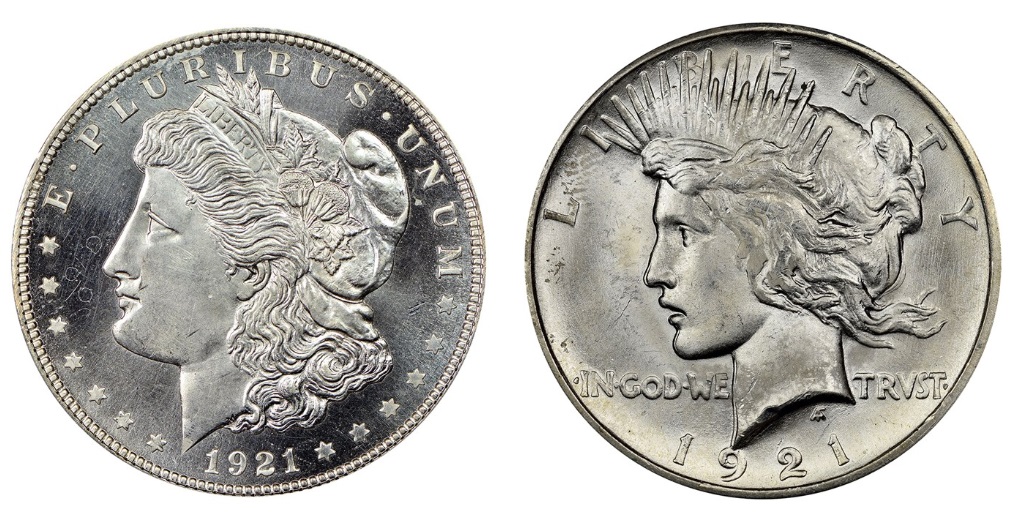
After a 17-year absence, the Morgan returned in 1921 to replace silver dollars melted under the Pittman Act of 1918 (270 million coins destroyed to supply wartime silver to Britain). More than 86 million 1921 Morgans were struck across Philadelphia, Denver, and San Francisco — making it the most heavily produced year of the series by a wide margin.
In circulated grades, 1921 Morgans trade at melt plus a very small premium. What makes 1921 historically unique is that it’s the only year two different silver dollar designs were produced simultaneously — the Peace Dollar was also introduced in 1921. See our complete 1921 Silver Dollar guide for the full story.
Buying Morgan Silver Dollars
Spotting Cleaned Coins
The single most important assessment when buying a Morgan is whether its surfaces are original. Cleaning permanently destroys collector value — a cleaned coin is worth melt, sometimes less, regardless of date or apparent grade.
Signs of cleaning: fine hairline scratches under 10x magnification, an unnaturally bright “white” appearance inconsistent with age, and no natural toning or mint bloom in recessed areas. A VF-30 with original patina is more valuable than a lightly dipped VF-30.
Where to Buy
Common circulated dates: Reputable coin and bullion dealers offer competitive pricing near melt. Major coin shows (ANA conventions, regional shows) provide the widest selection for in-person comparison.
Key dates and high-grade examples: Heritage Auctions and Stack’s Bowers Galleries are the two leading venues. Their realized price archives are the most accurate real-world value references — more reliable than fixed price guides because they reflect actual buyer behavior.
eBay: Produces reasonable retail pricing for mid-range coins, but grade claims are unguaranteed and cleaned coins are common. Buy only slabbed coins from reputable sellers, or raw coins only if you can assess the photos yourself.
Common dates, circulated grades: Any reputable dealer will buy them. Expect 90–95% of melt for heavily worn examples. eBay produces retail pricing but the margin on a $63.31 common Morgan often doesn’t justify the fees. Sell larger accumulations to a dealer as a lot.
Semi-key and key dates: Get multiple offers. Dealer spreads vary significantly — one dealer’s $2,800 for an 1889-CC in Fine is another’s $3,400. Heritage Auctions and Stack’s Bowers have the deepest buyer pools for coins worth $500+.
Certify before selling: Any coin that might grade MS-63 or better, or any key date above Good, is worth sending to PCGS or NGC first. Certification typically increases realized prices by more than the submission cost.
Frequently Asked Questions
How much is a Morgan silver dollar worth?
Every Morgan silver dollar contains 0.77344 troy oz of silver — a melt value of $48.97 at today’s spot price. Common circulated dates trade at roughly $50.65–69.64 in Good through Fine grades. Key dates in top grades can reach six figures.
What is the most valuable Morgan silver dollar?
The 1893-S, with a mintage of 100,000 and very low survival rates. In Very Fine it trades for $5,000–8,000; certified MS-65 examples have brought over $500,000 at auction. The 1895-P — struck as proofs only, with no confirmed business strikes — is also among the rarest, with Proof-65 examples at $80,000–120,000.
Where is the mint mark on a Morgan dollar?
On the reverse, above “DO” in DOLLAR, between the eagle’s tail feathers. Philadelphia coins have no mint mark. Carson City: CC. San Francisco: S. New Orleans: O. Denver: D.
Are Morgan dollars rare?
As a series, no — over 650 million were minted. But individual dates vary enormously. The 1893-S had 100,000 struck; the 1921-P had over 44 million. Value depends entirely on date and mint mark.
What does MS-65 mean?
Mint State 65 — a “Gem” uncirculated coin on the 70-point Sheldon scale. No wear, above-average luster, well struck, minimal contact marks. On common dates, MS-65 sells for a modest premium. On key dates, MS-65 can be 10–20x the MS-63 value.
How do I know if my Morgan dollar has been cleaned?
Look for hairline scratches under magnification, unnatural brightness, and missing toning in recessed areas. If a 100-year-old coin looks freshly minted, it’s been cleaned. Cleaning reduces collector value but doesn’t affect melt value.
What’s the difference between a Morgan dollar and a Peace dollar?
Both are 90% silver containing 0.77344 troy oz. The Morgan (1878–1904, 1921) shows a helmeted Liberty and heraldic eagle, by George T. Morgan. The Peace Dollar (1921–1935) shows an Art Deco Liberty and perched eagle, by Anthony de Francisci. Both designs were produced simultaneously in 1921.
Should I clean my Morgan dollar?
No. Cleaning permanently destroys original surfaces and dramatically reduces collector value. A naturally toned coin is always worth more than a cleaned one of equivalent grade. If unsure about a coin’s condition, consult a dealer or submit to PCGS/NGC before doing anything to it.