Most silver stackers know the Mexican Libertad as a low-mintage alternative to Eagles and Maples. Fewer know what came before it. The Libertad’s predecessor — the Mexican Silver Onza, sometimes called the “Balanza” for its balance-scale design — launched in 1949 and has a strong claim to being the world’s first modern silver bullion coin. It predates the Krugerrand by 18 years, the Silver Eagle by 37 years, and the Maple Leaf by 30 years.
This guide covers the full lineage: the original .925 sterling Onza, the transitional .999 Onzas, and the early Libertad key dates that command serious premiums today. If you are looking for the latest on 2025 and 2026 mintages, see our 2026 Libertad outlook. For complete year-by-year mintage data, see the Libertad mintage history page.
The 1949 Silver Onza: Where It All Started
1949 Mexican Onza Silver Coin
In 1949, La Casa de Moneda de Mexico struck a coin that would quietly establish the template for every modern bullion coin that followed: a government-issued silver piece containing exactly one troy ounce of fine silver, sold at a small premium over melt. The coin was the “Onza de Plata” — the Silver Ounce.
The 1949 Onza was struck in .925 sterling silver, the same alloy used in pre-1920 British coinage and classic American sterling flatware. Because sterling is only 92.5% silver, the coin had to weigh more than a troy ounce to contain a full ounce of fine silver. The total weight came to 33.625 grams (1.0809 troy ounces), with the remaining 7.5% composed of copper. The result was a coin with exactly 1.0000 troy ounces of pure silver content — the same net silver as a modern .999 Libertad, just in a slightly heavier package.
If you are calculating the value of a .925 sterling Onza, our sterling silver calculator will give you the melt value based on the current silver spot price. Keep in mind that the melt value represents the floor — collector premiums on the 1949 issue typically run 2 to 3 times the silver spot price for uncirculated examples.
Design and Specifications
The obverse features a hand-operated screw press, an image drawn from the Mexican Mint’s own early coining equipment. The reverse shows a balance scale — the “balanza” that gives the series its collector nickname — flanked by the legend “1 ONZA TROY DE PLATA PURA” (1 Troy Ounce of Pure Silver). The reverse was engraved by Manuel Luna Negrete. The coin measures 41.5mm in diameter with a reeded edge, making it slightly larger than a modern Silver Eagle (40.6mm).
1949 Onza Values
Approximately one million 1949 Onzas were struck, making this a relatively available coin despite its age. Circulated examples in AU condition typically sell for $90 to $130. Uncirculated pieces in the MS63-MS64 range have sold at auction for $190 to $250 in recent years, with a PCGS MS64 realizing $192 at a Stack’s Bowers auction in 2023. Higher grades command significantly more — a PCGS MS66 sold for $432 at the January 2022 NYINC auction, and MS65 examples have brought $500 to $650 at Heritage sales.
After the initial 1949 production run, the Onza went dormant for nearly three decades. Mexico continued to produce circulating silver coinage through the 1960s, but the bullion Onza program was shelved until global silver demand and the Hunt Brothers-era price surge brought it back in the late 1970s.
The 1978-1980 Onzas: Transition to .999 Fine
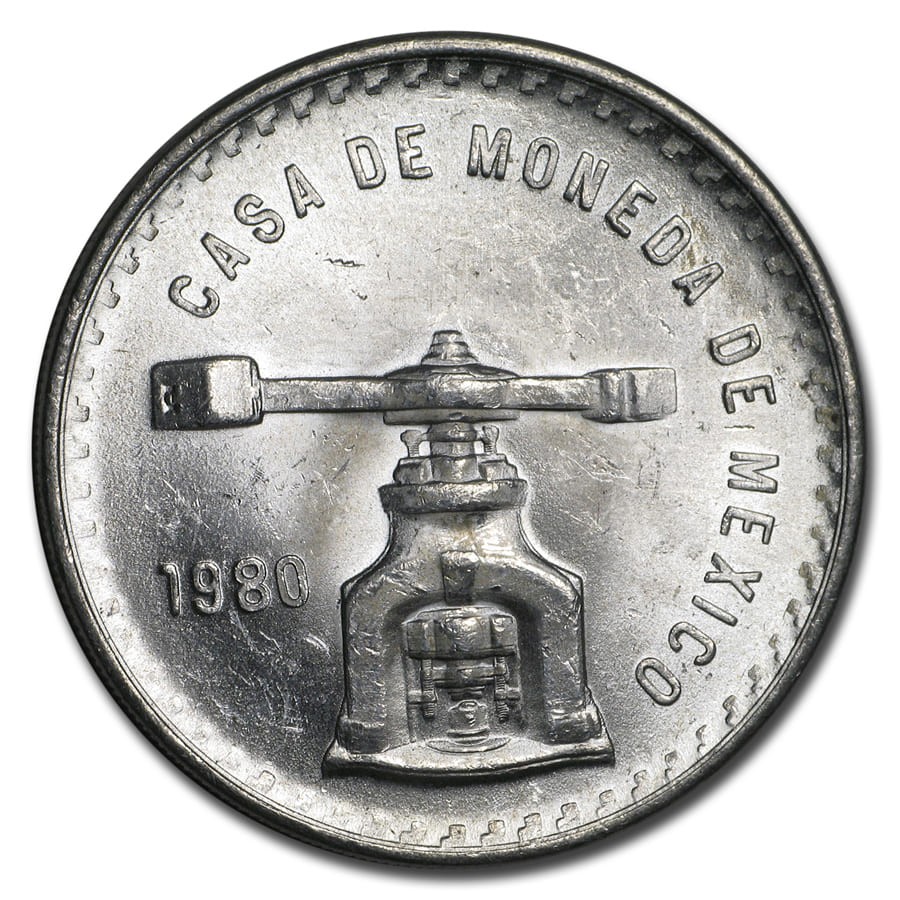
When the Mexican Mint revived the Onza in 1978, it made a fundamental change: the new coins were struck in .999 fine silver rather than the original .925 sterling. The total weight dropped to exactly one troy ounce (31.103 grams), and the coin’s diameter shrank slightly to 36mm. The design retained the screw press and balance scale but with updated lettering and positioning. These transitional coins bridge the gap between the original 1949 Onza and the Libertad series that would replace them in 1982.
1980 1 oz Onza Silver Coin
The 1978 Key Date
The 1978 Onza is the clear key date of the .999 series, with a mintage of just 280,000 — far below the 4.5 million struck in 1979 or the 6.1 million struck in 1980. The low mintage makes it a collector favorite, and it consistently commands a premium over common-date Onzas.
Recent auction results and dealer sales show 1978 Onzas trading in a wide range depending on grade and variety. An NGC MS61 sold for roughly $225 on eBay, while PCGS-graded MS64 to MS66 examples have brought $268 to $488 on Greysheet’s sold-coin tracker through mid-2026. The variety matters: the 1978 comes in “close spacing” and “wide spacing” types, distinguished by the distance between legends on the reverse, and the wide-spacing variety tends to sell for more in comparable grades.
1979 and 1980 Varieties and Overdates
The 1979 and 1980 Onzas were produced in much higher numbers — 4.5 million and 6.1 million respectively — and most examples trade close to melt value. Krause catalogs them as KM# M49b.3 through M49b.5, covering several minor die varieties. Collectors have identified a 1979/9 overdate (Type 3), a 1979 dot-left-of-date variety (Type 4), and 1980 overdates including 1980/79 and 1980/70 varieties. These overdates are scarce and not well-documented in standard price guides, so confirmed examples in certified holders can command premiums above the typical $69.64 to $82.30 that common-date BU Onzas bring.
For investors rather than variety collectors, the 1978-1980 Onzas remain one of the cheapest ways to own government-issued .999 silver from a sovereign mint. Dealer premiums on random-date BU examples typically run 15% to 25% above silver spot, comparable to or slightly below current Silver Eagle premiums. At today’s spot price of $63.31, a random-date Onza in AU or BU condition might cost $75.97 to $94.97 from a dealer.
The Silver Libertad: 1982 to Present
1997 1 oz Libertad Silver Coin
In 1982, the Mexican Mint replaced the Onza with the Silver Libertad — a coin that would become one of the most recognized silver bullion issues in the world. The Libertad introduced a new design featuring the Winged Victory statue (also called the Angel of Independence) from the top of Mexico City’s Independence Column. The coin was struck in .999 fine silver from the very beginning — a fact worth noting because many references incorrectly state that early Libertads used .925 sterling. That confusion likely arises from the earlier Onza series, which did use sterling for the 1949 issue.
The Libertad is unique among major sovereign bullion coins in carrying no face value. Unlike the Silver Eagle ($1), the Maple Leaf (C$5), or the Britannia (2 GBP), the Libertad is legal tender but its denomination is tied to its silver content and the prevailing market price rather than a fixed number. This has not hurt its popularity — if anything, the absence of a face value reinforces the coin’s identity as a pure silver investment vehicle.
Major Design Changes
The Libertad has gone through three major design periods. From 1982 to 1995, the reverse showed the full Winged Victory statue in profile. In 1996, the reverse was redesigned with a three-quarter profile of Winged Victory’s face and upper torso — a more intimate portrait that remains the design standard today. On the obverse, the original design featured the Mexican coat of arms surrounded by the full country name; in 2000, this was updated to show the coat of arms ringed by ten historical versions of Mexico’s national emblem.
The 1996 redesign also expanded the series. Prior to 1996, the Libertad was available only in the 1 oz size. The 1991 vintage introduced fractional sizes — 1/20, 1/10, 1/4, and 1/2 oz — and the 1996 vintage added 2 oz and 5 oz sizes to the BU lineup. The kilo format followed later.
Key Date Silver Libertads
Libertad mintages have always been low compared to other major bullion programs. A typical year might see 500,000 to 1.5 million 1 oz BU Libertads struck, compared to 30 to 40 million Silver Eagles or 20 to 30 million Maple Leafs. That lower production baseline means even “common” Libertad dates carry higher premiums than equivalent Eagles or Maples, and the true key dates can command multiples of spot price.
1998: The Series Key Date
The 1998 1 oz BU Silver Libertad is the undisputed key date of the series, with a mintage of just 67,000 coins. To put that in perspective, the U.S. Mint struck 4.8 million Silver Eagles that same year. The 1998 Libertad’s mintage was so low that many collectors did not realize its scarcity until years later, when the coins began drying up on the secondary market.
Values have climbed dramatically. In the mid-2000s, a BU 1998 could be found for $30 to $50. By 2015, gem examples were cataloged at $200. In 2026, a 1998 Libertad graded NGC MS70 — the finest possible grade — sold at GreatCollections for $46,125. Even in lower grades, BU examples now trade in the $800 to $1,000 range from dealers. A PCGS MS69 has been valued at north of $4,000 by PCGS’s own price guide, though actual market transactions at that level are thin.
The 1998 fractional issues are also scarce. The 1/20, 1/10, and 1/4 oz BU coins each had a mintage of approximately 6,400 — making them more elusive in absolute terms than the 1 oz, though they attract less collector attention and trade for less.
Other Key and Semi-Key Dates
Beyond the 1998, several other early Libertad dates deserve collector attention.
The 1996 1 oz BU had a mintage of roughly 300,000 — not rare by Libertad standards, but it carries the distinction of being the first year of the redesigned reverse. PCGS MS69 examples have traded around $650, while raw BU coins bring $65 to $80. The 1997 1 oz BU is scarcer at 100,000 mintage and trades at similar levels.
The 1987 1 oz BU mintage was approximately 500,000 — relatively low for the early series. The 1995 1 oz BU came in at roughly 500,600. Both are considered semi-key dates, typically trading at modest premiums over common Libertad dates.
The 1982 1 oz BU is the first-year-of-issue coin and always attracts a following among type collectors, though its mintage of roughly 1 million makes it more available than the later keys. What makes the 1982 unusual is the production timeline: coins were struck in 1982 but held by Banco de Mexico until autumn 1984 before being released into commerce.
Proof Libertads: The 1983 Rarity
The proof Libertad series launched in 1983 with a mintage of just 998 coins — the lowest proof mintage in the entire series and one of the lowest for any sovereign bullion proof program. No proof Libertads were struck in 1984 or 1985, and when the proof returned in 1986 the mintage jumped to 30,006. The 1983 proof is extremely difficult to find, especially in top grades. The only certified examples most collectors will encounter are in the occasional complete 1983 8-coin proof set, which includes all fractional sizes. Sets with the key 1 oz coin graded PF68 Ultra Cameo have been listed at roughly $2,500.
Other scarce proof issues include the 1999 5 oz proof (approximately 100 coins), 1999 2 oz proof (roughly 280 coins), and the 1998 1 oz proof (500 coins). The 1999 5 oz proof has been described by specialists as the crown jewel of the entire Libertad series — a coin that essentially never appears on the market.
Buying Onzas and Key Date Libertads
Common-date Onzas and Libertads are available from most online bullion dealers and typically carry premiums of 15% to 30% above spot for BU examples — higher than Eagles in percentage terms but still reasonable for a low-mintage sovereign coin. For the cheapest available silver from any sovereign mint, check the silver closest to spot page.
Key dates are a different market. The 1998 Libertad, the 1978 Onza, and the 1983 proof trade primarily through auction houses like Heritage and Stack’s Bowers, or through specialist dealers who focus on Mexican numismatics. Certification matters — a PCGS or NGC holder confirms the date, variety, and grade, which is critical for coins where a single grade point can mean hundreds of dollars in value. Dealer pricing comparison tools can help you find the best available prices, though truly rare dates may only surface at auction.
One practical consideration: because the Libertad has no face value and smaller mintages than U.S. or Canadian bullion, premiums on Libertads tend to compress less than Eagles or Maples during selloffs. If you are buying Libertads primarily as a bullion play — intending to sell when silver rises — be aware that the premium you pay going in may not fully translate into a higher selling price. Key dates, on the other hand, have shown sustained collector demand independent of the spot price, particularly since the 2025 mintage collapse drew broader attention to the series.
Quick Reference: Key Dates at a Glance
Coin
Year
Mintage
Approximate Value Range
Onza (.925)
1949
~1,000,000
$90-$650 (AU to MS66)
Onza (.999)
1978
280,000
$225-$490 (MS61 to MS66)
Onza (.999)
1979-1980
4.5M / 6.1M
$75.97 to $88.63 (BU, common varieties)
Libertad BU
1982
~1,000,000
$88.63 to $101.30 (first year of issue)
Libertad Proof
1983
998
$1,500+ (single coin est.)
Libertad BU
1996
~300,000
$65-$650 (BU to MS69)
Libertad BU
1998
67,000
$800-$46,000+ (BU to MS70)
Libertad 5 oz Proof
1999
~100
Rarely offered
Values are approximate and based on recent auction results and dealer listings as of late 2026. Prices vary significantly by grade, certification, and market conditions. Verify current prices before making purchase decisions.
The Bigger Picture
The Mexican Silver Onza and early Libertad key dates occupy an unusual niche. They combine the investment appeal of government-issued silver bullion with the collector dynamics of a low-mintage numismatic series. The Onza’s historical significance — as arguably the first modern bullion coin — adds a layer of appeal that pure bullion products cannot match. And the Libertad’s consistently tight mintages, combined with the unprecedented scarcity of recent vintages, have drawn new attention to the earlier dates that formed the foundation of the series.
Disclaimer: This article is for informational purposes only and does not constitute investment advice. Prices are approximate and may have changed since publication. Always verify current prices before making purchase decisions.