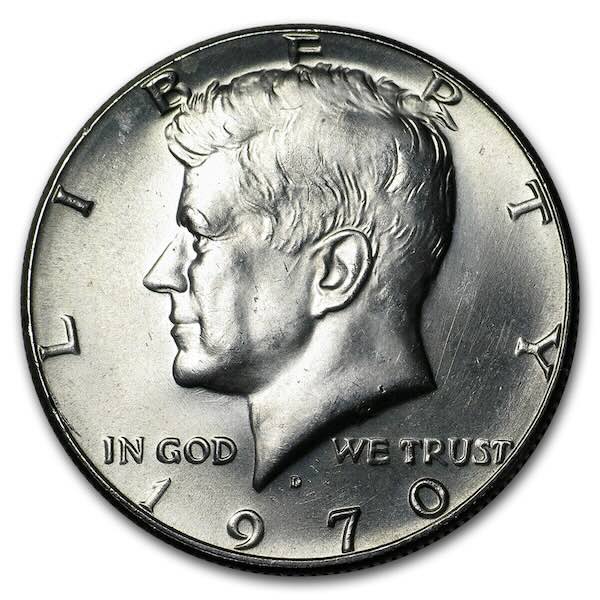
The Kennedy half dollar series spans more than 60 years, from its 1964 debut in 90% silver to the copper-nickel clad coins still produced today. For bullion buyers, the silver-bearing dates (1964 through 1970) remain the most relevant. For collectors, a handful of key dates, die errors, and special finishes push certain coins well beyond melt value.
This guide covers the full series with a focus on silver composition, key date values, known errors, and what to look for when buying Kennedy halves for their metal content or numismatic premium.
Silver Composition by Era
Kennedy half dollars went through three distinct composition phases. The table below breaks down the silver content, weight, and melt relevance for each.
| Years | Composition | Silver Content (troy oz) | Notes |
|---|---|---|---|
| 1964 | 90% silver, 10% copper | 0.3617 oz | First year of issue. Full silver. |
| 1965-1970 | 40% silver clad (80% silver outer / 21% silver inner) | 0.1479 oz | Reduced silver due to Coinage Act of 1965. |
| 1971-present | Copper-nickel clad | 0 oz | No silver content in circulation strikes. |
| 1992-present (S-mint proofs) | 90% silver | 0.3617 oz | Silver proof sets only. Not for circulation. |
The 1964 coins contain nearly 2.5 times the silver of the 1965-1970 issues. At any given silver spot price, a 1964 half dollar’s melt value will be roughly $22.90 (depending on spot), while a 40% silver half runs $9.36. FBP tracks live melt values and dealer premiums across the market, so you can check the current spread before buying or selling.
The 40% silver halves from 1965-1970 are often overlooked. They trade at lower premiums than 90% silver coins and can be a cost-effective way to accumulate silver weight. These coins fall into the broader category of junk silver, which trades based on silver content rather than face value.
1964 Kennedy Half Dollar: The First Year
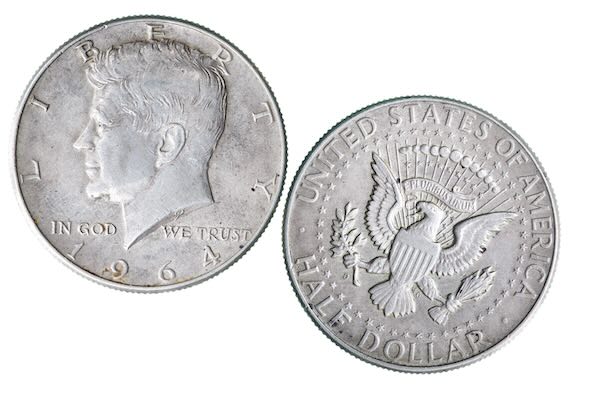
The 1964 Kennedy half dollar was authorized by Congress just weeks after President Kennedy’s assassination in November 1963. Gilroy Roberts designed the obverse portrait; Frank Gasparro designed the reverse Presidential Seal. Production began in early 1964 at both the Philadelphia and Denver mints.
Combined mintage for 1964 was approximately 430 million coins across both mints. That is a massive number. Despite the high mintage, public demand was so intense that the coins were hoarded almost immediately. Banks limited distribution, and the coins rarely circulated as intended.
Because of the enormous mintage, regular 1964 Kennedy halves are common in all grades. Their value tracks closely to silver melt. In circulated condition, expect to pay melt plus a small premium. Uncirculated examples (MS63-MS65) typically sell for $20-$80 depending on grade. Only coins grading MS67 or higher command strong premiums, often $100-$400+.
The mint mark on 1964 coins appears on the reverse, just below the eagle’s tail feathers. Philadelphia coins have no mint mark; Denver coins carry a “D.”
Key Dates and Error Coins
While most Kennedy halves are worth melt or close to it, several varieties across the series carry real numismatic premiums. These are the coins worth examining carefully.
1964 Accented Hair Proof
Early 1964 proof strikes used a die with extra detail in Kennedy’s hair, particularly above the ear. The U.S. Mint modified the dies shortly after production began, making these “Accented Hair” proofs scarcer than the standard proof variety.
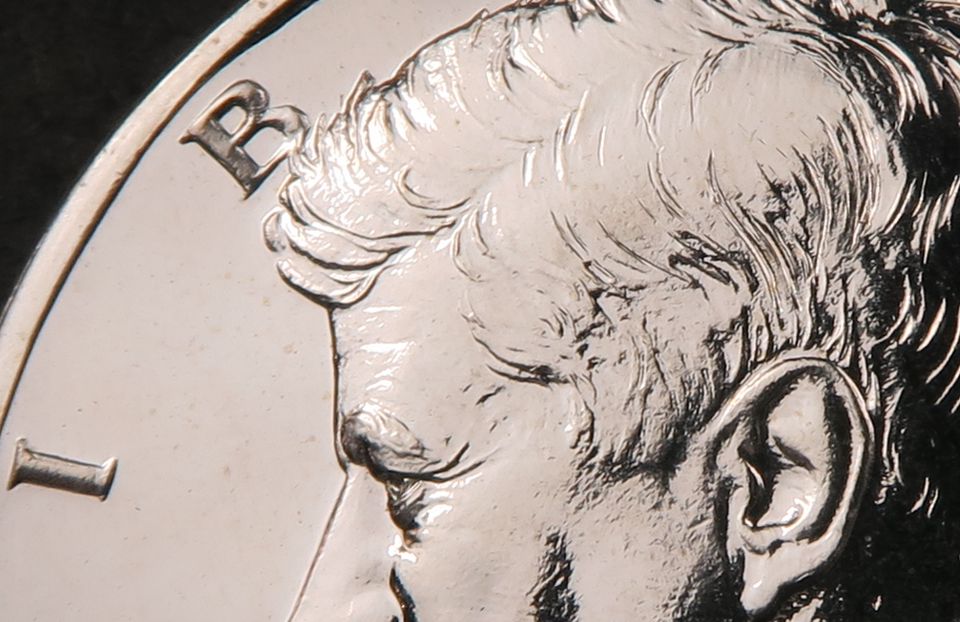
Value Range: $100 to $6,000
Identifying features: Look for stronger, more defined hair strands above Kennedy’s ear compared to the standard proof. The difference is subtle but visible under magnification.
| Grade | Approximate Value |
|---|---|
| PR63-PR64 | $75-$150 |
| PR65 | $200 |
| PR66 DCAM | $300-$500 |
| PR67 DCAM | $500-$1,000 |
| PR68 DCAM | $3,000-$6,000 |
A PR68 Deep Cameo example sold at auction for $6,000 through PCGS-verified sale. These are legitimate four-figure coins in top grades.
1964-D Doubled Die Obverse (DDO FS-101)
The most significant business strike error in the Kennedy series. This Denver mint variety shows clear doubling on “IN GOD WE TRUST” and on the date. It is cataloged as FS-101 (First Strike 101) in the Cherrypickers’ Guide.
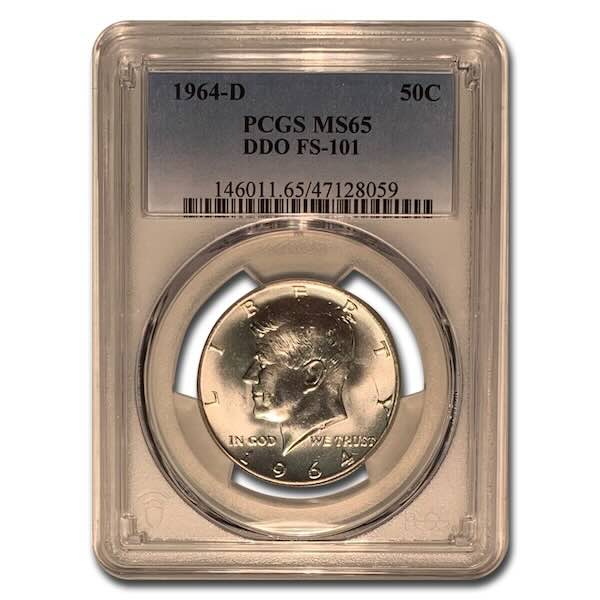
The doubling is visible to the naked eye on strong examples, making this one of the more accessible DDO varieties to identify without specialized equipment.
| Grade | Approximate Value |
|---|---|
| VF-XF (circulated) | $50-$100 |
| MS60 | $150 |
| MS63 | $250 |
| MS65 | $500 |
| MS67+ | $1,000-$2,000 |
Because these are 90% silver coins, even a misidentified example still holds its full silver melt value as a floor.
1974-D Doubled Die Obverse
A less well-known DDO variety on a clad (non-silver) coin. The doubling appears on “LIBERTY” and “IN GOD WE TRUST.” This coin does not carry a silver premium, but numismatic value in MS65 runs $100-$300 depending on the strength of the doubling.
1998-S Matte Finish Kennedy
This is the key modern rarity in the Kennedy series. The 1998-S Matte Finish half dollar was included exclusively in the Robert F. Kennedy commemorative coin set. It has a distinctive satin-like surface that differs from both business strikes and standard proofs.
Only 62,000 sets were produced, and many were broken up or damaged over time. PCGS and NGC grade these with an “SP” (Specimen) designation.
| Grade | Approximate Value |
|---|---|
| SP65 | $150-$200 |
| SP67 | $300-$500 |
| SP68 | $1,000-$2,000 |
| SP69 | $3,000+ |
The 1998-S Matte Finish is a copper-nickel clad coin with no silver content. Its value is entirely numismatic.
2014-W Gold Kennedy Half Dollar
For the 50th anniversary of the Kennedy half dollar, the U.S. Mint struck a special gold version at the West Point mint. Specifications: 3/4 troy oz of .9999 fine gold, proof finish. Original issue price was $1,240, and the coin sold out quickly.
Current market value tracks gold spot price plus a collector premium. At today’s gold prices, the melt alone places this coin well above its original issue price. FBP tracks gold coin pricing across dealers if you are comparing offers on the secondary market.
Value Summary Table: Key Kennedy Half Dollars
| Coin | Silver? | Circulated | MS/SP 65 | MS/SP 67+ |
|---|---|---|---|---|
| 1964 (regular) | Yes, 90% | Melt + small premium | $25-$80 | $100-$400 |
| 1964 Accented Hair Proof | Yes, 90% | N/A (proof only) | $200 (PR65) | $500-$6,000 |
| 1964-D DDO FS-101 | Yes, 90% | $50-$100 | $500 | $1,000-$2,000 |
| 1965-1970 (regular) | Yes, 40% | Melt | Melt + $2-5 | $20-$100 |
| 1971-present (regular) | No | $0.50 | $1-$5 | $10-$50 |
| 1974-D DDO | No | $20-$50 | $100-$300 | $500+ |
| 1998-S Matte Finish | No | N/A | $150-$200 (SP65) | $300-$3,000+ |
| 2014-W Gold | Gold (.9999) | N/A | Gold melt + premium | Gold melt + premium |
Buying Tips for Silver Kennedy Halves
90% silver (1964). These are the most liquid Kennedy halves on the secondary market. They trade as 90% silver coins with premiums typically running 5-15% over melt. When buying in bulk ($10 face value rolls or larger lots), premiums compress. FBP’s price comparison shows live dealer pricing so you can find the lowest premium available.
40% silver (1965-1970). These carry lower premiums than 90% coins and are often sold in $100 face value bags. They are a viable option for accumulating silver at a lower per-transaction cost, though the silver content per coin is significantly less. Check current 40% silver half dollar prices on FBP to compare dealer offers.
Graded vs. raw. For regular-date Kennedy halves, professional grading rarely makes economic sense unless the coin grades MS66 or higher. The cost of grading ($20-$40 per coin) often exceeds the premium that a slab adds to a common-date coin. For error coins and key dates, grading is worth the cost because it authenticates the variety and protects the coin’s value.
Authentication on errors. If you believe you have a 1964-D DDO FS-101 or 1964 Accented Hair proof, get it authenticated by PCGS or NGC before selling. The premium difference between a certified and uncertified error coin is substantial. Raw coins claimed as DDO varieties sell at steep discounts because buyers factor in the risk of misattribution.
Know the silver content. If you are buying Kennedy halves for their silver, the composition matters. A quick way to confirm: 1964 coins have a silver edge with no visible copper stripe. Coins from 1965-1970 show a faint copper line on the edge but are noticeably lighter than their 1964 counterparts. Clad coins from 1971 onward have a distinct copper-orange stripe on the edge. For more on identifying silver coins by date, see our guide on which quarters are silver; the same era-based logic applies to halves.
Related Guides
- Kennedy Half Dollar Values by Year – Year by year guide to mint marks, mintages and values
- Collecting and Investing in 90% Silver Half Dollar Coins
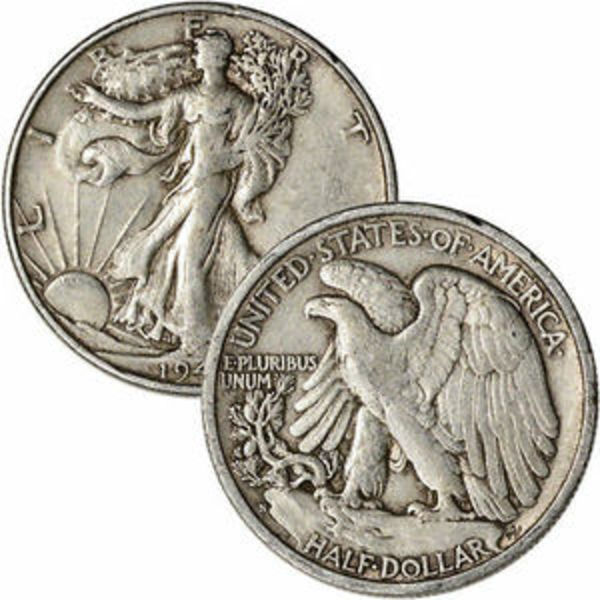
- Walking Liberty Half Dollar Value: Complete Price Guide (1916-1947)
Frequently Asked Questions
How much is a 1964 Kennedy half dollar worth?
Most 1964 Kennedy half dollars are worth their melt price, which fluctuates with the silver spot price. Each coin contains 0.3617 troy oz of silver. In circulated condition, expect melt value plus a small premium. Uncirculated coins in MS65 or higher grade $25-$400+ depending on condition.
What is the most valuable Kennedy half dollar?
The highest auction prices have gone to 1964 Accented Hair proofs in PR68 Deep Cameo, which have sold for $6,000+. Among business strikes, the 1964-D DDO FS-101 in MS67 can reach $2,000. The 1998-S Matte Finish in SP69 has also sold for over $3,000.
Are 1965-1970 Kennedy half dollars silver?
Yes, but they contain 40% silver (0.1479 troy oz per coin), not 90% like the 1964 issue. They are still worth more than face value due to their silver content.
Where is the mint mark on a Kennedy half dollar?
On 1964 coins, the mint mark is on the reverse below the eagle’s tail feathers. Starting in 1968, the mint mark moved to the obverse, just below the date on Kennedy’s neck truncation.
Are Kennedy half dollars still being made?
Yes. The U.S. Mint still produces Kennedy half dollars, though they are no longer released for general circulation. They are available in mint sets, proof sets, and through direct orders from the Mint. Circulation strikes from 1971 onward are copper-nickel clad with no silver content.
How do I know if my Kennedy half dollar is silver?
Check the date and the edge. 1964 coins are 90% silver and will have a uniform silver-colored edge. 1965-1970 coins are 40% silver and show a thin copper line on the edge. 1971 and later clad coins have a thick copper-orange stripe on the edge. A kitchen scale can also help: 1964 halves weigh 12.5 grams, while clad halves weigh 11.34 grams.
Should I clean my Kennedy half dollar before selling?
No. Cleaning coins reduces their numismatic value. Professional grading services will designate cleaned coins as “details” grades, which sell for significantly less than uncleaned examples. If you are selling for silver melt value only, cleaning is irrelevant but still not recommended.