At a Glance: What Are Your Dimes Worth?
- Silver dimes (1892-1964) contain 0.0723 troy ounces of 90% silver, giving every silver dime a minimum melt value of $4.58 based on the current silver spot price — check today’s silver dime melt value
- Mercury dimes (1916-1945) are worth $6 to $10 in average circulated grades, with key dates and Full Bands (FB) specimens reaching $1,000 to $100,000+
- Roosevelt silver dimes (1946-1964) are worth $6 to $8 in circulated grades based primarily on their silver content
- Clad Roosevelt dimes (1965-present) are generally worth face value in circulated condition, but transition-year errors and high-grade specimens can be worth $1,000 to $13,000+
- The 1942/1 overdate Mercury dime is one of the most famous U.S. coin errors, worth $300 to $108,000 depending on grade
- The 1916-D Mercury dime is the key date of the series, with values starting around $1,000 even in low grades
Three Dime Series: A Quick Guide
The U.S. dime has been produced in three major design series since 1892, and knowing which series you have is the first step in determining value.
Barber Dimes (1892-1916)
Designed by Charles E. Barber, these dimes feature a right-facing Liberty head wearing a laurel wreath and Phrygian cap on the obverse. The reverse displays an oak and laurel wreath surrounding the denomination. Barber dimes were struck in 90% silver and weigh 2.5 grams. Key dates include the legendary 1894-S (one of the rarest U.S. coins, with only 24 minted) and the 1895-O.

Barber Dime (1892-1916) — obverse showing Liberty head, reverse showing wreath design. Public domain.
Mercury Dimes (1916-1945)
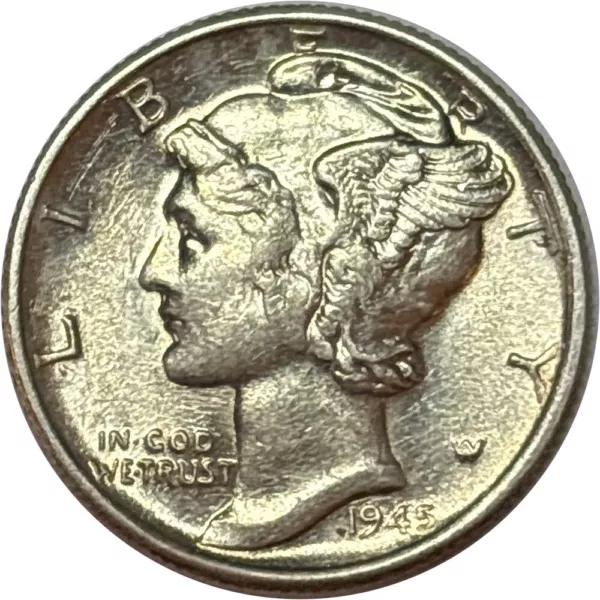
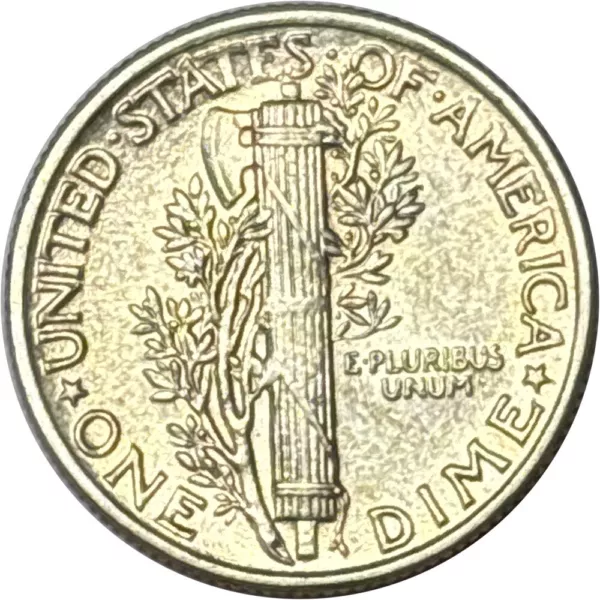
Designed by Adolph A. Weinman, the “Mercury” dime actually depicts a young Liberty wearing a winged Phrygian cap — symbolizing freedom of thought — not the Roman god Mercury. The reverse features a Roman fasces intertwined with an olive branch. These were also struck in 90% silver at 2.5 grams. The Mercury dime series includes some of the most collectible and valuable U.S. coins, particularly the 1916-D, the 1921 and 1921-D, and the 1942/1 overdate error.
Roosevelt Dimes (1946-Present)
Designed by John R. Sinnock, the Roosevelt dime was introduced in 1946 to honor President Franklin D. Roosevelt, who died in 1945 and was closely associated with the March of Dimes campaign to fight polio. Roosevelt dimes struck from 1946 through 1964 are 90% silver (2.5 grams). Beginning in 1965, the Mint switched to a copper-nickel clad composition (2.27 grams) — a change that fundamentally altered the collectibility and value of the series.
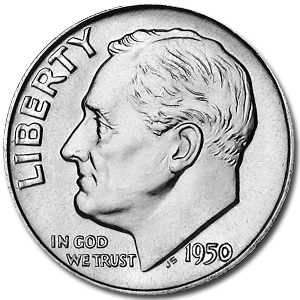
Roosevelt Dime — Franklin D. Roosevelt portrait obverse, torch and olive branch reverse. Public domain.
Silver Dime Melt Value
Every dime minted from 1892 through 1964 contains 0.0723 troy ounces of pure silver (90% silver, 2.5 grams total weight). This gives all silver dimes a floor value tied to the current spot price of silver, regardless of date or condition.
Use our Silver Coin Melt Value Calculator to check the current melt value based on today’s silver spot price. As of early 2026, a single silver dime’s melt value is approximately $2.00 to $3.50 depending on the spot price.
For Mercury dimes in particular, the silver content alone sets the minimum value. Even heavily worn, dateless Mercury dimes are worth their silver melt value. For a deeper dive into which dimes contain silver and which do not, see our guide: What Dimes Contain Silver?
Mercury Dime Values by Year (1916-1945)
Mercury dimes are among the most popular coins in the hobby, prized for their elegant design and the wide range of values across dates, mint marks, and conditions. Below is a value chart covering the most commonly searched dates.
Mercury Dime Value Chart: 1940s Dates
| Year | Mint | Mintage | G-4 | F-12 | EF-40 | AU-50 | MS-63 | MS-65 | MS-65 FB |
|---|---|---|---|---|---|---|---|---|---|
| 1941 | P | 175,106,557 | $1.50 | $2 | $3 | $8 | $12 | $25 | $75-200 |
| 1941 | D | 45,634,000 | $1.50 | $2 | $3 | $10 | $15 | $30 | $100-250 |
| 1941 | S | 43,090,000 | $1.50 | $2 | $3 | $10 | $15 | $30 | $125-300 |
| 1942 | P | 205,410,000 | $1.50 | $2 | $3 | $8 | $12 | $22 | $60-80 |
| 1942 | D | 60,740,000 | $1.50 | $2 | $3 | $8 | $14 | $25 | $65-100 |
| 1942 | S | 49,300,000 | $1.50 | $2 | $3 | $10 | $15 | $28 | $80-150 |
| 1943 | P | 191,710,000 | $1.50 | $2 | $3 | $8 | $12 | $20 | $50-75 |
| 1943 | D | 71,949,000 | $1.50 | $2 | $3 | $8 | $14 | $22 | $55-85 |
| 1943 | S | 60,400,000 | $1.50 | $2 | $3 | $10 | $15 | $25 | $65-100 |
| 1944 | P | 231,410,000 | $1.50 | $2 | $3 | $8 | $12 | $20 | $40-75 |
| 1944 | D | 62,224,000 | $1.50 | $2 | $3 | $8 | $14 | $25 | $55-85 |
| 1944 | S | 49,490,000 | $1.50 | $2 | $3 | $10 | $15 | $28 | $70-120 |
| 1945 | P | 159,130,000 | $1.50 | $2 | $3 | $8 | $12 | $22 | $45-125 |
| 1945 | D | 40,245,000 | $1.50 | $2 | $3 | $10 | $15 | $28 | $65-150 |
| 1945 | S | 41,920,000 | $1.50 | $2 | $3 | $10 | $15 | $28 | $70-150 |
Values based on published price guides from PCGS, USA Coin Book, and Greysheet. Full Bands (FB) values represent significant premiums. Actual values may vary.
What Are “Full Bands” Mercury Dimes?
The horizontal bands across the fasces on the reverse of Mercury dimes are a key grading feature. When both sets of bands (called “split bands” or “full bands”) are fully separated and sharply struck, grading services designate the coin as FB (Full Bands). This designation dramatically increases value — often by 3x to 10x or more at the MS-65 level and above.
Full Bands coins are scarce because the bands area is the highest point of the reverse die and often shows weakness from metal flow issues during striking. Some dates and mints are notoriously difficult to find with Full Bands, making them especially valuable.
For a complete year-by-year Mercury dime pricing reference, see our Mercury Dime Value Chart.
Most Valuable Mercury Dime Errors
| Error/Variety | Year | Estimated Value |
|---|---|---|
| 1942/1 Overdate (P) | 1942 | $300 – $108,000 (MS-67 FB) |
| 1942/1-D Overdate | 1942 | $400 – $73,000+ |
| 1945-S Micro S | 1945 | $10 – $25,850 (MS-68 FB) |
| 1941 Doubled Die Obverse | 1941 | $200 – $2,600 (MS-65) |
| 1941-S Large S “Trumpet Tail” | 1941 | $135 – $800 (MS-66) |
| 1943-D Repunched Mintmark | 1943 | $20 – $14,688 (MS-68+ FB) |
The 1942/1 overdate is the crown jewel of Mercury dime errors. It was created when a 1942-dated hub was pressed over dies already impressed with a 1941 hub. The underlying “1” is visible beneath the final “2” of the date. Approximately 3,600 examples survive in all grades. For a full breakdown, see our 1942 Dime Value Guide.
Sources: PCGS CoinFacts, Heritage Auctions
Roosevelt Dime Values: Silver Era (1946-1964)
Roosevelt silver dimes are primarily valued for their silver content in circulated grades, but first-year issues, key dates, and Full Torch (FT) specimens command meaningful premiums.
Roosevelt Silver Dime Value Chart: Key Dates
| Year | Mint | Mintage | G-4 | F-12 | EF-40 | AU-50 | MS-63 | MS-65 | MS-65 FB |
|---|---|---|---|---|---|---|---|---|---|
| 1946 | P | 255,250,000 | $2 | $3 | $3 | $4 | $8 | $15 | $12-46 |
| 1946 | D | 61,043,500 | $2 | $3 | $3 | $5 | $10 | $20 | $25-50 |
| 1946 | S | 27,900,000 | $2 | $3 | $4 | $6 | $12 | $25 | $30-60 |
| 1964 | P | 929,360,000 | $2 | $2 | $3 | $3 | $5 | $10 | $15-25 |
| 1964 | D | 1,357,517,180 | $2 | $2 | $3 | $3 | $4 | $8 | $12-20 |
Values from PCGS and USA Coin Book. Silver dimes have a floor value tied to the current silver melt value.
1946 is the first year of the Roosevelt dime and carries a modest premium as a type coin. The 1946-S has the lowest mintage of the three mints and is the scarcest in high grades. For a complete analysis, see 1946 Dime Value Guide.
1964 is the last year silver was used in U.S. dimes. The combined mintage of over 2.28 billion coins across both mints makes this the most common silver dime by far, but its historical significance as the “last silver dime” keeps collector interest high. Extremely rare 1964 SMS (Special Mint Set) specimens are worth $8,500 to $20,000. See our 1964 Dime Value Guide.
For a broader look at valuable Roosevelt dimes you might find in pocket change, see 5 Valuable Roosevelt Dimes That Could Be in Your Change.
Roosevelt Dime Values: Clad Era (1965-Present)
When the Mint switched to copper-nickel clad composition in 1965, it also temporarily suspended mint marks for three years (1965-1967) to discourage hoarding. This makes the 1965-1967 transition years particularly interesting to collectors.
Clad Roosevelt Dime Value Chart: Transition Years
| Year | Mint | Mintage | Circulated | MS-63 | MS-65 | MS-67 | Key Error Value |
|---|---|---|---|---|---|---|---|
| 1965 | P | 1,652,140,570 | $0.10 | $1 | $3 | $50-100 | Silver planchet: $3,000-$13,200 |
| 1966 | P | 1,382,734,540 | $0.10 | $1 | $3 | $50-100 | SMS: $700-$4,500 |
| 1967 | P | 2,244,007,320 | $0.10 | $1 | $3 | $50-100 | Silver planchet: $3,000+ |
No mint marks were used on dimes from 1965-1967. All business strikes came from Philadelphia.
The 1965-1967 Transition: Why These Dates Matter
In 1965, the U.S. Mint made one of the most significant changes in American coinage history: eliminating silver from dimes and quarters. The Coinage Act of 1965 replaced the 90% silver composition with a copper-nickel clad sandwich — 75% copper and 25% nickel bonded to a pure copper core.
To discourage collectors from hoarding the new coins (as they had been doing with silver coins), the Mint temporarily removed mint marks from all coins for 1965, 1966, and 1967. Instead of proof sets, the Mint produced Special Mint Sets (SMS) — coins with a finish between business strike and proof quality.
This transition created several rare and valuable error coins:
1965 Silver Transitional Error: Some 1965-dated dimes were accidentally struck on leftover 90% silver planchets. These weigh 2.5 grams (versus 2.27 grams for clad) and have a solid silver edge instead of the telltale copper stripe visible on clad coins. Recent sales include an MS-61 specimen for $13,200 at Heritage Auctions in January 2023. See our detailed guide: 1965 Dime Error List.
1966 and 1967 Silver Errors: Similar transitional errors exist for 1966 and 1967, struck on silver planchets. These are worth $3,000 or more.
Most Valuable Dime Errors Across All Series
Error coins are where the truly extraordinary values are found. Here are the most sought-after dime errors:
| Error | Series | Approximate Value | Notes |
|---|---|---|---|
| 1894-S Barber Dime | Barber | $500,000 – $2,000,000+ | Only 24 minted, ~9 known today |
| 1916-D Mercury Dime | Mercury | $1,000 – $300,000+ | Key date, 264,000 mintage |
| 1942/1 Overdate (P) | Mercury | $300 – $108,000 | ~3,600 surviving examples |
| 1942/1-D Overdate | Mercury | $400 – $73,000+ | Rarer than P version |
| 1945-S Micro S | Mercury | $10 – $25,850 | Philippine puncheon used |
| 1964 SMS Special Strike | Roosevelt | $8,500 – $20,000 | Only 20-50 sets believed to exist |
| 1965 Silver Planchet Error | Roosevelt | $3,000 – $13,200 | Struck on silver instead of clad |
| 1966 Silver Planchet Error | Roosevelt | $3,000 – $10,000+ | Same transition error |
| 1967 Silver Planchet Error | Roosevelt | $3,000 – $10,000+ | Same transition error |
| Missing Clad Layer | Roosevelt | $50 – $500+ | Exposed copper core visible |
| Off-Center Strike (any date) | Any | $10 – $500 | Value increases with percentage off-center |
Sources: PCGS Auction Prices Realized, Heritage Auctions
How to Grade Your Dimes
The condition of your dime is the single most important factor in determining value above melt. Here’s a quick reference:
Good (G-4): Major design elements visible but heavily worn. On Mercury dimes, the rim may merge into the lettering. On Roosevelt dimes, hair detail is mostly flat.
Fine (F-12): Moderate wear on high points. On Mercury dimes, the wing feathers on the cap show wear but are distinct. On Roosevelt dimes, the hair detail shows moderate wear above the ear.
Extremely Fine (EF-40): Light wear on the highest points only. On Mercury dimes, the diagonal bands of the fasces show slight wear. On Roosevelt dimes, the hair lines above the ear are sharp.
About Uncirculated (AU-50): Trace wear only on the highest points. Most original luster is still visible.
Mint State (MS-60 to MS-70): No wear. Value is determined by luster, strike quality, and surface marks.
Full Bands / Full Torch designation: For Mercury dimes, the horizontal bands on the fasces must be fully split (FB). For Roosevelt dimes, the vertical lines of the torch must be fully separated (FT). These designations represent the sharpest-struck examples and command significant premiums.
For professional grading, submit coins to PCGS or NGC.
Where to Find the Mint Mark
Mercury Dimes (1916-1945): The mint mark is on the reverse, to the left of the fasces near the bottom of the olive branch.
- No mint mark = Philadelphia
- D = Denver
- S = San Francisco
Roosevelt Dimes (1946-1964): The mint mark is on the reverse, at the base of the torch, just above the “E” in “ONE.”
- No mint mark = Philadelphia
- D = Denver
- S = San Francisco
Roosevelt Dimes (1965-1967): No mint marks were used.
Roosevelt Dimes (1968-Present): The mint mark moved to the obverse, just above the date.
- No mint mark = Philadelphia (1968-1979); P = Philadelphia (1980-present)
- D = Denver
- S = San Francisco (proof only after 1968)
- W = West Point (special issues)
How to Tell If Your Dime Is Silver
The easiest way to tell if a Roosevelt dime is silver or clad:
Check the edge. Silver dimes have a solid silver edge — uniform in color. Clad dimes show a visible copper stripe sandwiched between the nickel layers on the edge. This is the quickest, most reliable test.

Check the date. Any dime dated 1964 or earlier is 90% silver. Any dime dated 1965 or later is clad (with the exception of special silver proof issues and transitional errors).
Check the weight. Silver dimes weigh 2.50 grams. Clad dimes weigh 2.27 grams. A precision scale accurate to 0.01 grams can distinguish them.
For our complete guide on this topic, read: What Dimes Contain Silver?
Frequently Asked Questions
How much is a silver dime worth today?
At minimum, every pre-1965 silver dime is worth its silver melt value — approximately $2 to $3.50 depending on the current silver spot price. Use our Silver Coin Melt Value Calculator for today’s exact melt value. Key dates, high-grade examples, and error coins are worth substantially more than melt.
What is the most valuable dime?
The most valuable regular-issue dime is the 1894-S Barber dime, with only 24 originally minted and approximately 9 known survivors. Examples have sold for over $2 million at auction. Among more attainable coins, the 1916-D Mercury dime is the key date of the series, with values starting around $1,000 in low grades and exceeding $300,000 in top condition.
Are dimes from the 1960s worth anything?
Roosevelt silver dimes from 1960-1964 are worth at least their silver melt value ($2-$3.50). The 1964 dime is particularly sought-after as the last silver dime. Clad dimes from 1965-1967 are generally worth face value unless they are error coins — transition-year silver planchet errors from these dates can be worth $3,000 to $13,000+.
What year dimes have silver in them?
All U.S. dimes dated 1964 and earlier are 90% silver. This includes Barber dimes (1892-1916), Mercury dimes (1916-1945), and Roosevelt dimes (1946-1964). Starting in 1965, dimes were made from copper-nickel clad. The only exceptions are special silver proof issues sold directly by the Mint and extremely rare transitional errors.
Should I clean my old dimes?
Never. Cleaning destroys the natural toning and patina that collectors value, and grading services will note cleaned coins as impaired. A cleaned coin can lose 50% or more of its value. Leave your dimes in their original state.
What does “Full Bands” mean on a Mercury dime?
Full Bands (FB) refers to the horizontal bands across the center of the fasces on the reverse of Mercury dimes. When these bands are completely separated and sharply struck, grading services assign the FB designation. Full Bands Mercury dimes are scarcer and more valuable — often 3x to 10x more than non-FB examples in the same grade.
Related Dime Value Guides
Mercury Dime Articles
- 1941 Dime Value: Mercury Dime Worth by Mint Mark and Grade
- 1942 Dime Value: The Famous 1942/1 Overdate and More
- 1943 Dime Value: Wartime Mercury Dime Guide
- 1944 Dime Value: Mercury Dime Values and Errors
- 1945 Dime Value: Last Mercury Dime Year and Micro S Variety
Roosevelt Dime Articles
- 1946 Dime Value: First Roosevelt Dime Year Guide
- 1964 Dime Value: Last Silver Roosevelt Dime Guide
- 1965 Dime Value: Transition Year Errors and SMS Guide
- 1966 Dime Value: Clad Dime Guide and Errors
- 1967 Dime Value: No Mint Mark Dime Guide
- What Dimes Contain Silver?
- 1996-W Dime Value
- 5 Valuable Roosevelt Dimes That Could Be in Your Change
Related Resources
- Silver Dime Melt Value Calculator
- 1940s Penny Values Guide
- Wheat Penny Values
- Best Junk Silver Prices
Last updated: April 2026. Coin values are approximate and based on published price guides and recent auction results. Silver dime values fluctuate with the spot price of silver. Always consult a professional coin dealer or grading service for coins you believe may be valuable.