A Collector’s Guide to Every Major Type — Roosters, Angels, Napoleons, and Helvetias
20 Franc coins compete directly with fractional sovereign bullion on a cost-per-ounce basis. See the full sovereign gold coin comparison.
Why Collectors Keep Coming Back to 20 Franc Gold
Few coins sit as comfortably at the intersection of history, beauty, and value as the 20 franc gold piece. Struck across multiple European nations throughout the 19th and early 20th centuries, these coins circulated as real money during some of the most consequential decades in Western history — the Napoleonic wars, the Belle Époque, two world wars, and the rise and fall of the gold standard.
For collectors, 20 francs offer something rare in numismatics: genuine historical significance at an accessible price point. Each coin contains approximately 0.1867 troy ounces of .900 fine gold — roughly a fifth of an ounce — making even the scarcer dates attainable without a five-figure commitment. And because tens of millions were minted, common dates trade at low premiums over melt, giving new collectors an affordable entry into 19th-century European gold.
This guide walks through the four major 20 franc types that collectors encounter most often, what separates a common bullion piece from a collectible coin, and the pitfalls — restrikes, counterfeits, and grading traps — that can trip up even experienced buyers.
Universal Specifications
All 20 franc gold coins from the Latin Monetary Union share the same core specifications, which is what made them interchangeable across borders:
| Specification | Value |
| Gross Weight | 6.4516 grams |
| Fineness | .900 (21.6 karat) |
| Pure Gold Content | 5.8065 g / 0.1867 troy oz |
| Diameter | 21 mm |
| Thickness | ~1.3 mm |
| Edge | Lettered (varies by type) |
| Latin Monetary Union context: Formed in 1865 by France, Belgium, Italy, and Switzerland, the LMU standardized coinage specifications so that a French 20 franc, a Swiss 20 franc, a Belgian 20 franc, and an Italian 20 lire were all interchangeable. This is why collectors today can build a unified “20 franc” collection spanning multiple nations and designs. |
The Four Major Types Every Collector Should Know
1. Napoleon (France, 1803–1870)
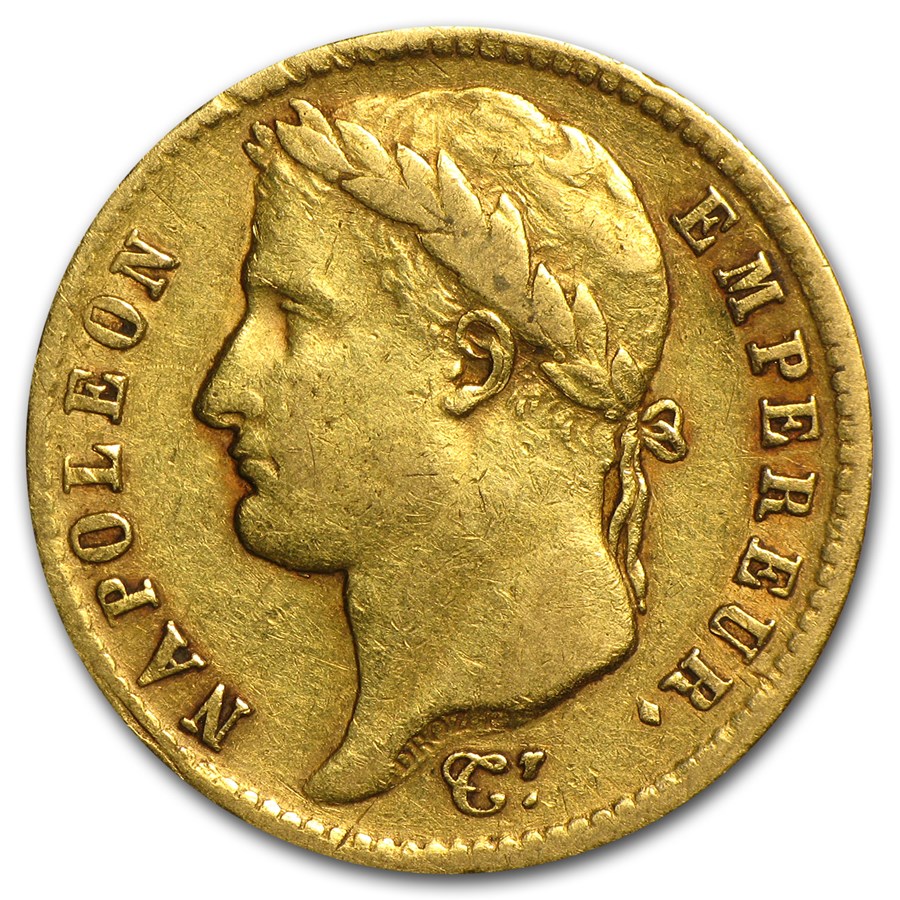
The coin that started it all. Napoleon Bonaparte introduced the 20 franc gold piece in 1803 as part of his sweeping monetary reforms, and the denomination would carry his name — Napoléon — long after his empire fell. Three distinct portrait styles span the series: Napoleon I as First Consul and Emperor (1803–1815), the brief restorations of Louis XVIII and Charles X (1816–1830), and Napoleon III’s Second Empire (1852–1870).
What collectors look for:
- Early Napoleon I dates (1803–1807): These “An XI” through “An 14” pieces use the Revolutionary calendar and command significant premiums. A nice AU example can sell for several multiples of melt.
- Mint marks: Paris (A) is most common, but pieces from provincial mints — Lille (W), Toulouse (M), Marseille (MA), and especially Perpignan (Q) — are scarcer and prized by specialists.
- Napoleon III laureate vs. bare head: The bare-head type (1852–1860) preceded the laureate portrait (1861–1870). Both are widely available, but the bare-head in high grade is less common.
- Condition: Most surviving Napoleons saw heavy circulation. An AU-58 or better stands out sharply from the typical VF–XF survivor.
2. Angel / Genius (France, 1871–1898)
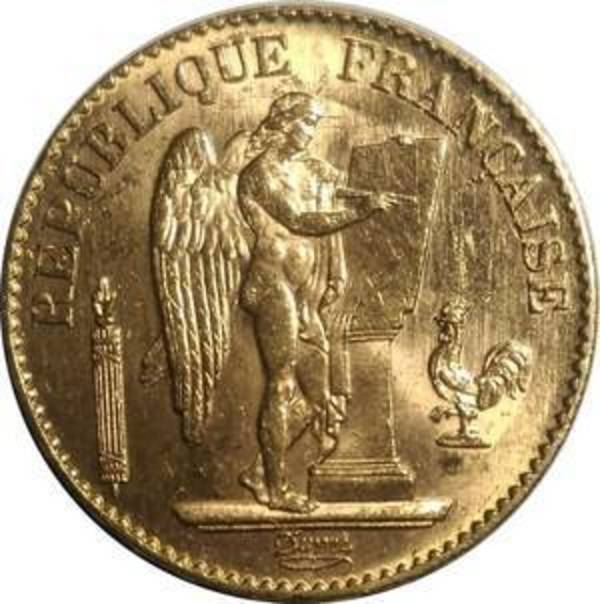
After the fall of Napoleon III, the Third Republic introduced one of the most artistic designs in the series: the Génie (Guardian Angel or Genius of Liberty). The obverse depicts a winged figure inscribing the French constitution on a tablet, with a Gallic rooster at her feet. The reverse features a wreath surrounding the denomination.
What collectors look for:
- Design appeal: The Angel is widely considered the most beautiful of the four types. Its artistic detail makes it popular even among collectors who don’t specialize in French numismatics.
- Date range: Coins from 1871–1898 are generally available, with earlier dates (1871–1878) being somewhat scarcer in high grade because they saw more years of circulation.
- Condition sensitivity: The Angel’s high-relief design means the wing feathers and constitutional tablet show wear quickly. A sharp, lustrous example with full feather detail is worth a meaningful premium.
- Paris mint only: All Angels were struck at the Paris mint (mint mark A), so there’s no mint-mark rarity to chase — condition is everything.
3. Rooster / Marianne (France, 1898–1914)
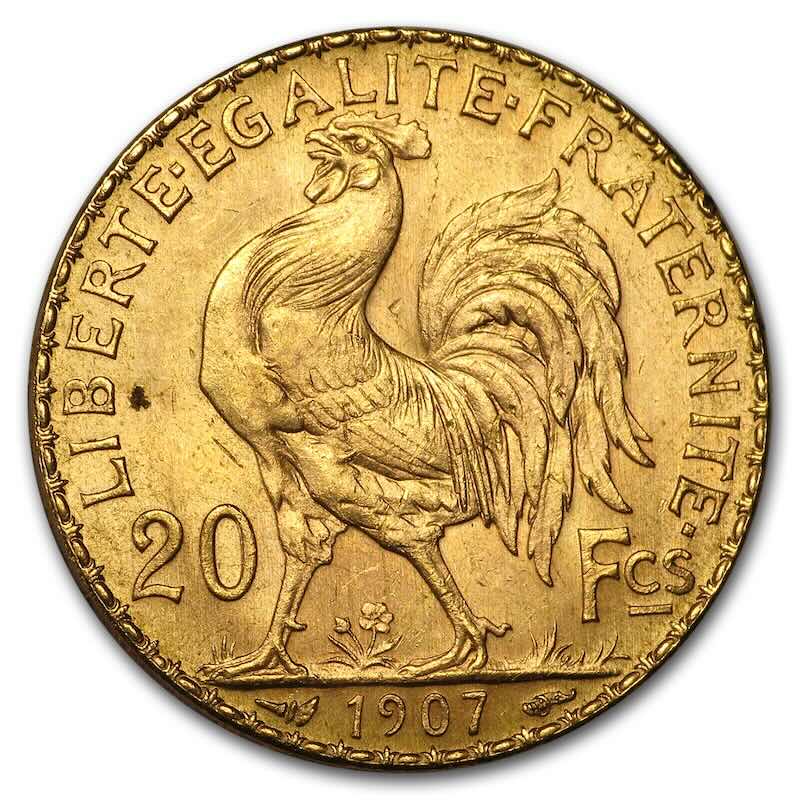
The most recognizable 20 franc coin and the one most commonly available on the secondary market. The obverse features Marianne — the personification of the French Republic — wearing a Phrygian cap. The reverse showcases the iconic coq gaulois (Gallic Rooster), a symbol of French national identity since the Middle Ages.
What collectors look for:
- Original strikes vs. restrikes: This is the single most important distinction for Rooster collectors. The Paris Mint restruck over 37.4 million Roosters between 1951 and 1960, dated 1907–1914, to sell on the reopened gold market. See the restrike identification section below.
- Pre-1907 dates are safe: Coins dated 1898–1906 cannot be restrikes, since only 1907–1914 dates were used for the restrike program. If you want a guaranteed original, stick to these years.
- The 1899 date: The first year with the finalized design. Some collectors consider this the “type coin” for the series.
- 1914 — the last year: Production stopped when World War I began. The 1914 is the scarcest regular date for original strikes, though restrikes with this date are abundant.
| The restrike question matters for value: A genuine original-strike 1907 Rooster in MS-63 can sell for a noticeable premium over a restrike of the same date and grade. For collectors building a date set, originals are the goal. For investors focused on gold content, the distinction is irrelevant — both contain exactly the same amount of gold. |
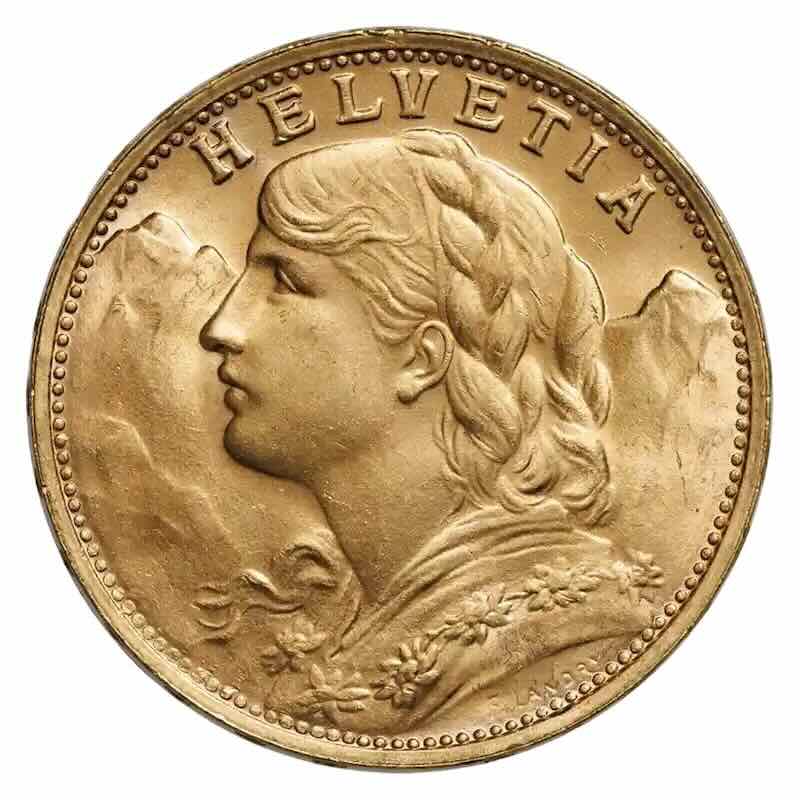
4. Helvetia / Vreneli (Switzerland, 1897–1949)
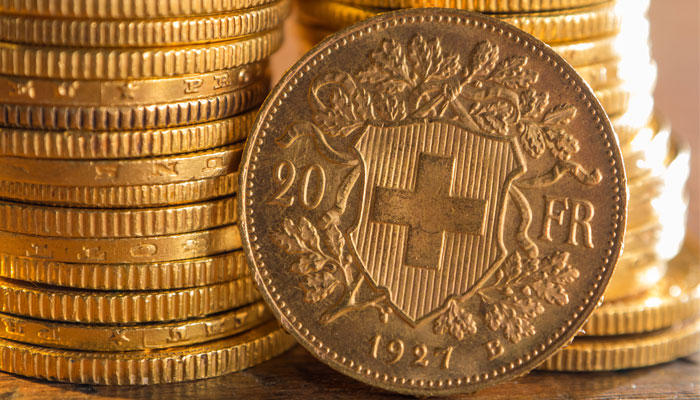
Switzerland’s entry in the 20 franc series features Helvetia, the female personification of the Swiss Confederation, on the obverse, with an Alpine cross and shield on the reverse. Collectors affectionately call these coins “Vreneli” (a Swiss-German diminutive of Verena).
What collectors look for:
- Early dates (1897–1916): These saw actual circulation and surviving high-grade examples are genuinely scarce. The 1897 first-year issue carries a collector premium.
- Late dates (1922, 1925–1930, 1935, 1947, 1949): Later issues were struck more as bullion or reserve coins and tend to survive in higher grades. They trade closer to melt.
- The Bern mint mark (B): All Swiss 20 francs bear the B mint mark for Bern. There’s no mint-mark variety, so date and condition drive the premium.
- Cross-border appeal: The Vreneli is popular in both the numismatic and bullion markets across Europe, particularly in Germany, Austria, and of course Switzerland, giving it strong liquidity.
Type-by-Type Comparison
| Napoleon | Angel | Rooster | Helvetia | |
| Country | France | France | France | Switzerland |
| Years | 1803–1870 | 1871–1898 | 1898–1914 | 1897–1949 |
| Restrikes? | No | No | Yes (37.4M) | No |
| Design Appeal | High (historic) | Highest | Iconic | Classic |
| Typical Premium | Moderate–High | Moderate | Low | Low–Moderate |
| Best For | History buffs | Art collectors | New collectors | European focus |
How to Tell an Original Rooster from a Restrike
Between 1951 and 1960, the Paris Mint restruck over 37.4 million Rooster 20 francs — all dated 1907 through 1914 — to meet demand when France reopened its gold market after World War II. These restrikes are genuine government-produced coins with the correct gold content, but they are not original period pieces. Here’s how to distinguish them:
Edge Inscription (Most Reliable Method)
This is the quickest and most definitive test:
- Original strikes: Edge reads “DIEU PROTEGE LA FRANCE” (God Protect France).
- Restrikes: Edge reads “LIBERTÉ ÉGALITÉ FRATERNITÉ” (Liberty Equality Fraternity).
This edge inscription difference applies specifically to the 1907–1914 dates. If a coin dated in this range has the “Dieu Protège la France” edge, it’s an original. If it reads “Liberté Égalité Fraternité,” it was restruck in the 1950s.
Gold Color and Strike Quality
- Original gold color: More yellow, with a warmer tone. The alloy used in original production had a slightly different copper-to-gold ratio.
- Restrike gold color: Noticeably redder due to a higher proportion of copper in the alloy.
- Strike quality: Restrikes were produced on more powerful modern presses and tend to have sharper, crisper details with virtually no die polish lines. Originals show finer “velvet” texture and sometimes visible corner-polishing streaks under magnification.
The Easy Rule
| Want a guaranteed original? Buy a Rooster dated 1898–1906. These dates predate the restrike program entirely. No guesswork, no edge-reading required. For 1907–1914 dates, check the edge inscription or buy NGC/PCGS graded coins where the holder will note if the coin is a restrike. |
Spotting Counterfeits
20 franc gold coins are counterfeited frequently enough that every buyer should know the basics. Most fakes are crude, but the best ones can fool casual inspection.
- Weigh it. A genuine 20 franc weighs 6.4516g (±0.03g). Even a small deviation is a red flag. Use a precision scale accurate to 0.01g.
- Measure the diameter. It should be 21mm. Counterfeits are often slightly off because replica dies don’t match original specifications exactly.
- Magnet test. Gold is not magnetic. If the coin responds to a strong neodymium magnet, it’s fake. Note: this won’t catch non-magnetic base-metal fakes.
- Examine the details under magnification. Genuine coins have crisp lettering and clean field surfaces. Counterfeits often show grainy or pitted surfaces, mushy lettering, and raised lines in the fields.
- Check the edge. The edge lettering on genuine coins is cleanly struck and evenly spaced. Fakes frequently have sloppy or unevenly spaced edge text.
- Buy graded when possible. For coins above melt value, NGC or PCGS certification provides professional authentication. The cost of grading is trivial compared to the cost of a high-grade fake.
Approaches to Building a 20 Franc Collection
There’s no single “right” way to collect 20 francs. Here are the most popular strategies:
Type Set
Acquire one example of each major design: Napoleon (pick your favorite era), Angel, Rooster, and Helvetia. This gives you a representative survey of 150 years of European gold coinage in just four coins. Many collectors add a Belgian 20 franc (Leopold I or II) and an Italian 20 lire to round out the Latin Monetary Union.
Date Set (Single Type)
Pick one type and collect every date. The Rooster (1898–1914) is the most popular for date sets because the series is short and every date is obtainable. The Helvetia (1897–1949) offers more dates but includes some gaps where no coins were struck.
Condition Census
Focus on the highest-grade examples available. This approach works best with Angels and early Napoleons, where high-grade survivors are meaningfully scarcer. MS-64 and above are genuinely rare for circulated types and command strong premiums at auction.
Bullion Accumulation with Upside
Buy common-date Roosters and Helvetias near melt value and hold for gold exposure with collector upside. This is the most popular approach among investors who appreciate history but are primarily motivated by gold’s value. The low premiums on common dates mean you’re paying very little above the metal’s intrinsic worth, and these coins have deep liquidity for resale.
Grading Basics for 20 Francs
Most 20 franc coins on the secondary market fall in the VF to AU range. Here’s what to expect at each grade level:
| Grade | What You’ll See | Premium Impact |
| VF (25–35) | Moderate wear on high points; major details clear but softened | At or near melt. The workhorse grade for bullion buyers. |
| XF (40–45) | Light wear on highest points only; most original detail intact | Slight premium. Good balance of appearance and cost. |
| AU (50–58) | Trace wear on the very highest points; much original luster remains | Moderate premium. This is where collector interest really begins. |
| MS (60–65+) | No wear. May have bag marks or contact marks but no circulation wear. | Strong premium, escalating sharply above MS-63. Rare for pre-1900 types. |
For Roosters and Helvetias, BU/MS examples are readily available because so many survived uncirculated (or were restruck). For Angels and early Napoleons, anything above AU-55 starts to become meaningfully scarce.
Where to Start
If you’re new to 20 francs, a practical first step is to compare current dealer pricing across multiple retailers to understand the typical spread between spot gold and what these coins actually trade for. Premiums vary significantly between types, dates, and conditions — and between dealers.
Compare live 20 franc gold coin prices across dealers to see which types and dates are available near melt and which carry collector premiums.
For deeper background on the denomination’s origins and the historical events that shaped it, our earlier coverage traces the 20 franc from Napoleon’s monetary reforms through the collapse of the Latin Monetary Union:
• The Origin of the 20 Francs Gold Coin — How Napoleon’s monetary reforms created one of history’s most enduring gold coins.
• 20 Francs: A Fractional Gold Coin Ideal for Investing — Why the 20 franc denomination hits a sweet spot for gold investors.
Collectors looking for a trusted source specializing in European gold coins — particularly French 20 franc varieties including Roosters, Angels, and Napoleons — can explore dedicated inventory from established European gold specialists to find graded and raw examples across the full date range.
Browse French 20 Franc gold coin selections from a specialist dealer for Roosters, Angels, and Napoleon III varieties