The British Gold Sovereign is one of the oldest and most widely traded gold coins in the world. First struck in 1489 under Henry VII and revived in its modern form in 1817, the Sovereign has been minted almost continuously for over two centuries. It circulated as currency across the British Empire, served as the backbone of the international gold standard, and remains a staple of the global bullion market today.
This guide covers everything a buyer or collector needs to know: physical specifications, the monarch timeline, what drives Sovereign values, and practical advice for purchasing.
Gold Sovereign Specifications
| Denomination | One Pound Sterling (legal tender in the UK) |
| Gross weight | 7.988 grams (0.2568 troy oz) |
| Pure gold content | 7.322 grams (0.2354 troy oz) |
| Fineness | .9167 (22 karat — 91.67% gold, 8.33% copper alloy) |
| Diameter | 22.05 mm |
| Thickness | 1.52 mm |
| Edge | Reeded (milled) |
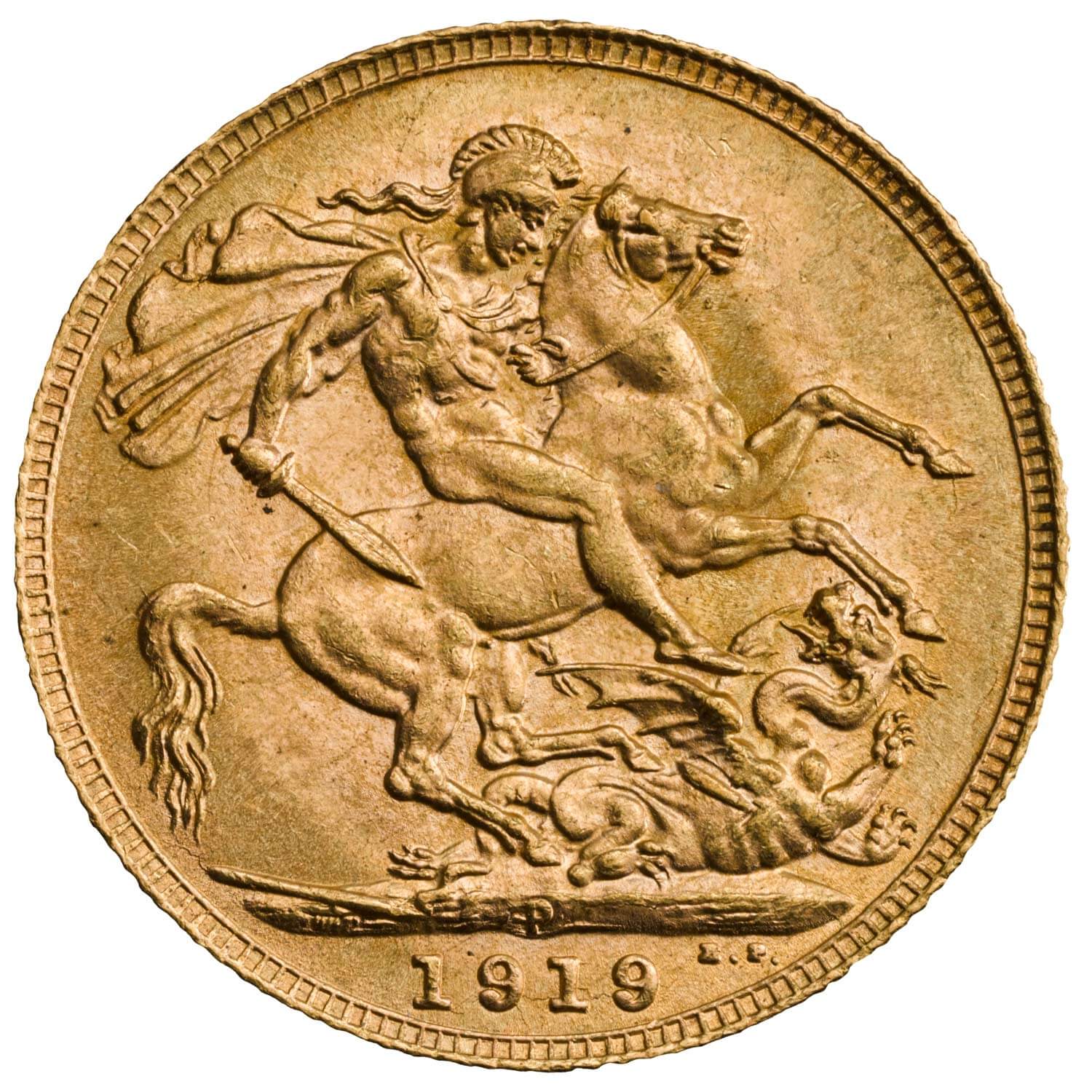
| Reverse design | St. George slaying the dragon (Benedetto Pistrucci, 1817) |
| Mint | The Royal Mint (Llantrisant, Wales) |
The Sovereign’s 22-karat alloy is a defining characteristic. The copper content makes the coin harder and more resistant to wear than pure gold coins like the Canadian Maple Leaf (.9999 fine). This durability is one reason Sovereigns from the 1800s often survive in better condition than their age would suggest.
At current gold prices near $4,338.66 per troy ounce, the gold melt value of a Sovereign is approximately $1,021.32. Most Sovereigns trade above melt due to collector demand, historical significance, and the Royal Mint’s continued production of new issues.
History of the Gold Sovereign
The Tudor Sovereign (1489-1604)
Henry VII introduced the first Sovereign in 1489 as a prestige coin — the largest gold denomination in English currency at the time. These early Sovereigns were much larger than the modern version, weighing approximately 15.6 grams of 23-karat gold (compared to today’s 7.988 grams at 22 karat). The Tudor Sovereign featured the monarch enthroned on the obverse and the royal coat of arms on the reverse. These coins were produced intermittently through the reigns of Henry VIII, Edward VI, Mary I, and Elizabeth I before production ceased under James I, who replaced the Sovereign with the Unite.
The Modern Sovereign (1817-Present)
The Sovereign was revived in 1817 as part of the Great Recoinage following the Napoleonic Wars. The new coin was redesigned at its current specifications: 7.988 grams of 22-karat gold, 22.05 mm in diameter. Italian engraver Benedetto Pistrucci created the now-iconic St. George and the Dragon reverse, which has appeared on most Sovereigns ever since.
From 1817 through 1914, the Sovereign served as the primary gold coin of the British Empire and was struck not only in London but at branch mints across the world — in Sydney, Melbourne, Perth (Australia), Ottawa (Canada), Bombay and Calcutta (India), and Pretoria (South Africa). These branch mint Sovereigns carry their own mint marks and are often collected separately from London issues.
Production for circulation ended with World War I when Britain abandoned the gold standard. Sovereigns were struck sporadically between 1925 and 1932, then resumed as bullion coins in 1957. Since 1979, the Royal Mint has produced Sovereigns annually as bullion and proof issues, and they remain one of the most actively traded gold coins in the world.
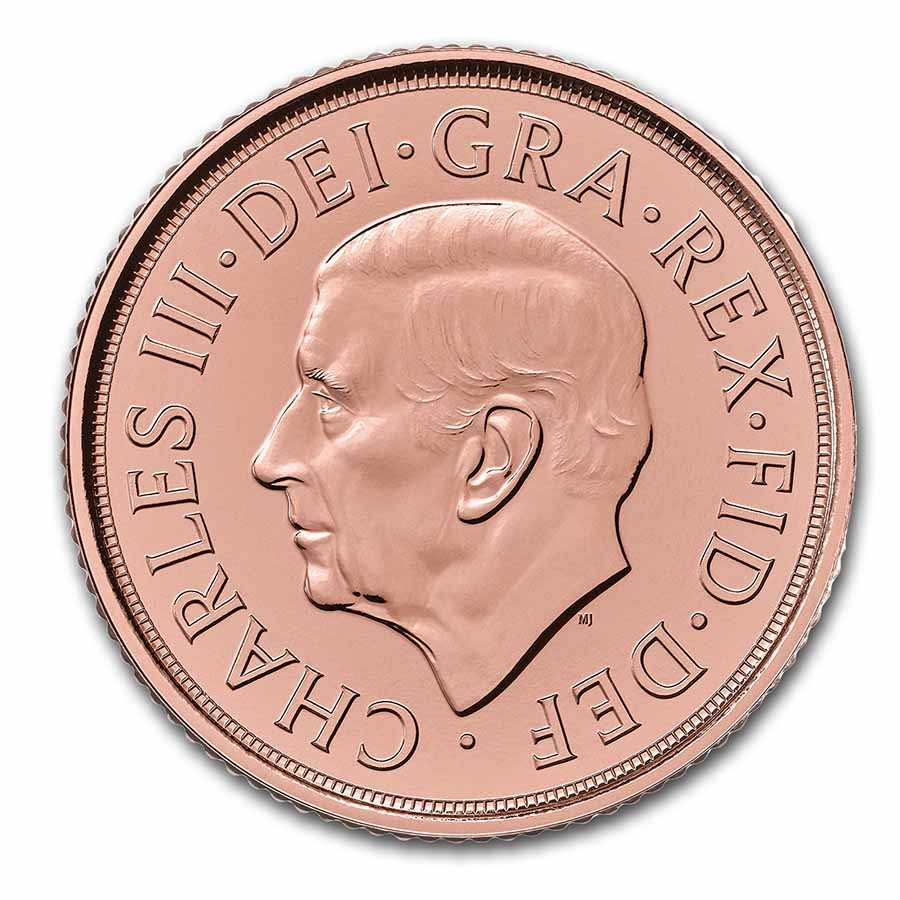
Monarchs on the Gold Sovereign
The obverse of every modern Sovereign bears the portrait of the reigning monarch at the time of minting. Seven monarchs have appeared on the modern Sovereign since its 1817 revival:
| Monarch | Years on Sovereign | Notable Varieties |
|---|---|---|
| George III | 1817-1820 | Pistrucci’s original design. “Garter” reverse also used. |
| George IV | 1821-1830 | Two portrait types. Shield reverse used 1825-1830. |
| William IV | 1831-1837 | Shield reverse only. Relatively scarce. |
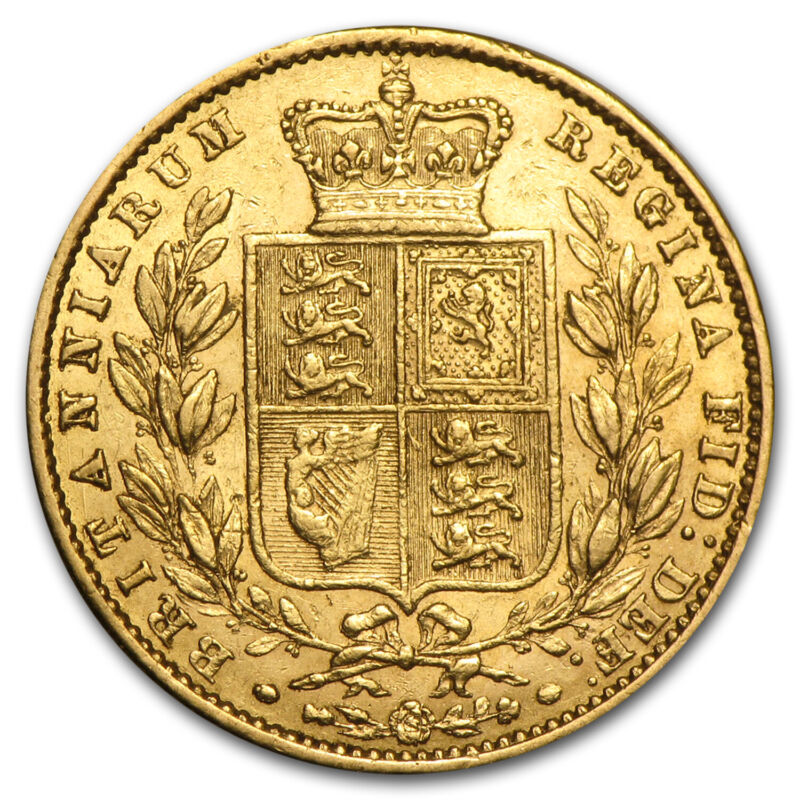
| Victoria | 1838-1901 | Three portrait types: Young Head, Jubilee Head, Old (Veiled) Head. Shield and St. George reverses. |
| Edward VII | 1902-1910 | Bare head portrait. St. George reverse returned permanently. |
| George V | 1911-1932 | Includes branch mint issues (Perth, Melbourne, Sydney, Ottawa, Bombay, Pretoria, South Africa). |
| Elizabeth II | 1957-2022 | Five portrait types over 65 years. Mary Gillick, Arnold Machin, Raphael Maklouf, Ian Rank-Broadley, Jody Clark designs. |
| Charles III | 2023-present | Martin Jennings portrait. 2026 marks return to traditional yellow gold alloy. |
Victoria-era Sovereigns are among the most collected. The Young Head (1838-1887) Sovereigns with the shield reverse — known as Victoria Shield Sovereigns — are popular for their elegant design and wide availability from the peak of the British Empire. The Jubilee Head (1887-1893) and Old/Veiled Head (1893-1901) varieties complete the Victorian set.
Gold Sovereign Values
Sovereign values fall into three broad categories:
Bullion Sovereigns
Common-date Sovereigns from the late Victorian era through George V, plus all modern issues from 1957 onward, trade primarily on their gold content. These typically sell for $1,041.28 to $1,128.05 — a 3% to 8% premium over the roughly $1,021.32 melt value. Random-year bullion Sovereigns are the most cost-effective way to buy into the series.
Semi-Numismatic Sovereigns
Certain dates, mint marks, and varieties command premiums of 10% to 50% above bullion value. Examples include specific branch mint issues (Pretoria, Ottawa, and Bombay Sovereigns are scarcer than London or Australian issues), early George III dates, and William IV Sovereigns (1831-1837), which had relatively low mintages. These typically sell for $1,041.28 to $1,301.60 depending on condition.
Rare and Key Date Sovereigns
A handful of dates are exceptionally rare. The 1819 George III Sovereign is one of the scarcest, with very few known examples — prices at auction have exceeded $100,000. The 1841 Victoria Sovereign (no known circulation strikes, only proofs) and certain low-mintage branch mint issues from the early 1900s can reach five or six figures. For most collectors and investors, these are museum pieces rather than practical purchases.
The 2026 Sovereign: Return to Yellow Gold
The 2026 Gold Sovereign marks a notable change. The Royal Mint has returned to the traditional yellow gold alloy used in historic Sovereigns, replacing the slightly redder alloy that had been used in recent years. The visual difference is subtle but noticeable when comparing a 2026 issue side by side with a 2023 or 2024 coin.
The 2026 issue also introduces new anti-counterfeiting features: microtext around the portrait and a latent image visible only at specific viewing angles. These security enhancements bring the Sovereign in line with other modern sovereign mint products like the Britannia, which has featured multiple security layers since 2021. The specifications — weight, diameter, fineness, and gold content — remain unchanged.
Tax Advantages for UK Buyers
Gold Sovereigns carry a significant tax advantage in the United Kingdom. As legal tender coins produced by the Royal Mint, Sovereigns are exempt from Capital Gains Tax (CGT) in the UK. This means any profit from selling Sovereigns is entirely tax-free, regardless of the amount. No other major gold bullion product offers this benefit in the UK market.
All investment-grade gold (including Sovereigns) is also exempt from Value Added Tax (VAT) in the UK. These two exemptions together make the Sovereign one of the most tax-efficient ways to hold physical gold for UK residents.
For U.S. investors, Sovereigns do not carry special tax advantages. They are taxed as collectibles at up to 28% on long-term capital gains, the same as other gold coins and bars.
Buying Guide: What to Look For
Whether you are buying for bullion value or beginning a Sovereign collection, a few considerations help you get the best value:
Start with bullion-grade Sovereigns. Random-year or common-date Sovereigns offer the lowest premiums and are the most liquid. They are the best entry point for investors who want exposure to gold in a historic and widely recognized format. Browse the current selection on our British Gold Sovereigns collection page.
Check the alloy color. Authentic Sovereigns should have a warm yellow-gold tone. Coins that appear too bright, too red, or too pale may warrant closer inspection. The 22-karat alloy produces a distinctive color that experienced dealers recognize immediately.
Verify weight and dimensions. A genuine Sovereign weighs exactly 7.988 grams and measures 22.05 mm in diameter. Counterfeits often fail on one or both measurements. A precision scale accurate to 0.01 grams is the single most useful tool for authenticating Sovereigns.
Know the mint marks. Branch mint Sovereigns carry a small letter on the reverse — “M” for Melbourne, “S” for Sydney, “P” for Perth, “C” for Ottawa (Canada), “I” for British India, “SA” for South Africa. London-minted coins from 1871 onward sometimes carry no mint mark, or display a small St. George’s cross. Mint marks affect both rarity and value.
Consider graded coins for key dates. If you are purchasing a Sovereign for its numismatic value rather than its gold content, third-party grading from PCGS or NGC provides authentication and a standardized condition assessment. For bullion-grade Sovereigns, grading is unnecessary — the gold content is the same regardless of grade.
Sovereigns vs. Other Gold Coins
The Sovereign’s 0.2354 troy ounces of gold makes it smaller than the standard 1 oz coins (Gold Eagles, Maple Leafs, Krugerrands). This is both an advantage and a limitation. The lower gold content means a lower price per coin — roughly $1,050 to $1,100 for a bullion Sovereign compared to $4,400+ for a 1 oz coin — making Sovereigns accessible to investors who prefer to accumulate gradually at lower individual purchase prices.
The trade-off is a slightly higher per-ounce premium compared to 1 oz products. A bullion Sovereign at $1,075 works out to about $4,567 per troy ounce of gold content, versus $4,400 to $4,500 for a 1 oz Gold Eagle. The premium gap is modest but real. Investors focused purely on minimizing premium-per-ounce are better served by 1 oz coins or bars. Investors who value the Sovereign’s history, recognition, and (for UK buyers) tax advantages may find the slightly higher per-ounce cost worthwhile.
Related Guides
- British Gold Sovereigns Collection — compare current bullion dealer pricing
- Gold Melt Value Calculator
- Pre-1933 Gold Coins
- Gold Hub — the complete gold bullion resource
- Gold Value Hub — track gold spot price and historical data
This article is for informational purposes only and does not constitute financial or investment advice. Precious metals carry market risk, and past performance does not guarantee future results. Always conduct your own research and consult with a qualified financial advisor before making investment decisions.