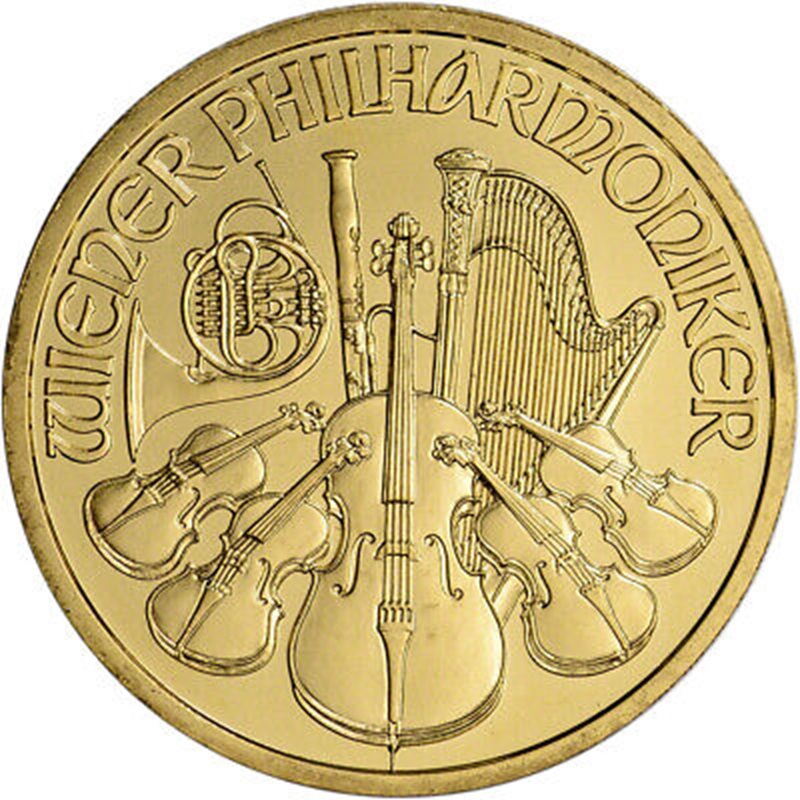
The Austrian Philharmonic series is among the most recognized bullion coin programs in the world. Issued annually by the Austrian Mint — an institution that has been striking coins for more than 800 years — the Philharmonic debuted in gold in 1989 and has since grown into one of the best-selling bullion coins on the planet. In multiple years, the Gold Philharmonic has ranked as the top-selling gold coin in Europe and has placed among the top three globally.
For 2026, the Austrian Mint continues the Philharmonic tradition with both gold and silver editions carrying the same iconic design that has made the series a staple in investor portfolios. With consistently competitive premiums, recognized legal tender status across the Eurozone, and high purity standards, the Philharmonic remains one of the most practical choices for cost-conscious precious metals buyers.
Design and Heritage
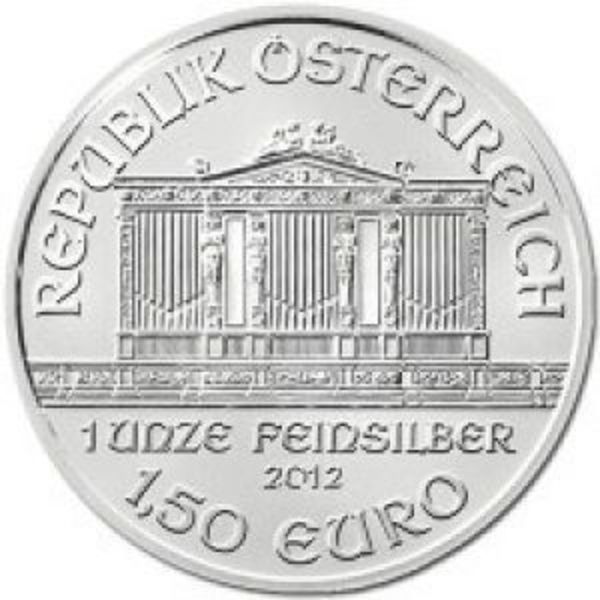
The Philharmonic’s design has remained essentially unchanged since its introduction, which has helped build instant worldwide recognition. The obverse features an arrangement of orchestral instruments associated with the Vienna Philharmonic Orchestra — a cello, four violins, a Viennese horn, a bassoon, and a harp. The reverse displays the Great Organ of the Musikverein’s Golden Hall, one of the most famous concert venues in the world and the site of the celebrated Vienna New Year’s Concert.
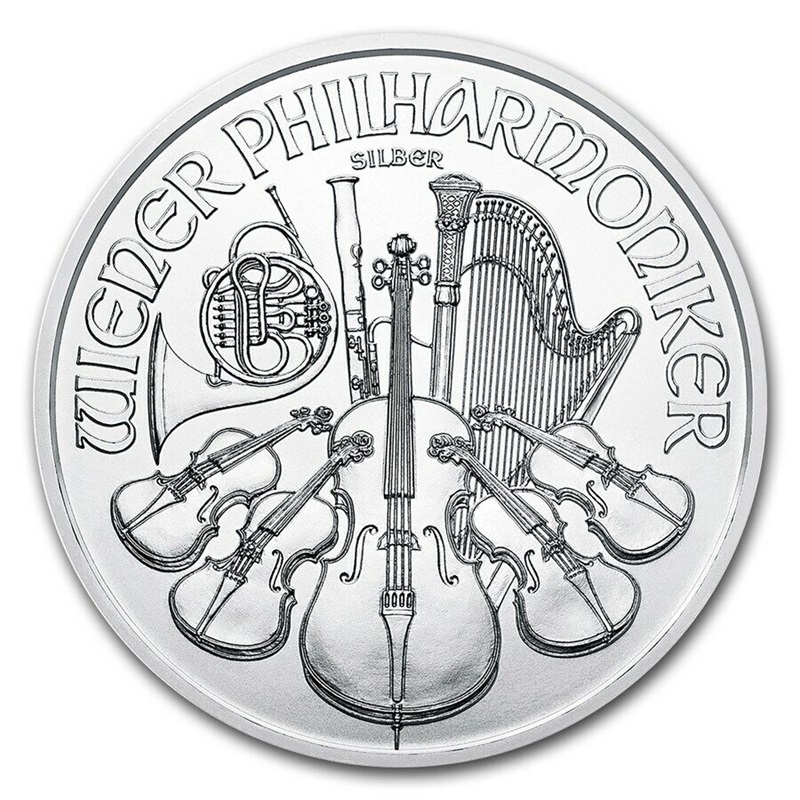
Unlike the British Britannia or the Chinese Panda — which undergo periodic or annual design changes — the Philharmonic’s visual consistency is part of its appeal. Dealers, investors, and assayers worldwide recognize it immediately, which contributes to the coin’s strong liquidity in secondary markets.
Each coin carries a face value denominated in euros (€100 for the 1 oz gold, €1.50 for the 1 oz silver), making it legal tender across all Eurozone countries. While the face value is largely symbolic relative to the metal content, the legal tender status provides an added layer of legitimacy and government backing that generic rounds and bars do not offer.
2026 Philharmonic Specifications
The 2026 mintage year continues the established specifications that have defined the series. Here’s how the gold and silver versions compare:
| Specification | Gold Philharmonic | Silver Philharmonic |
|---|---|---|
| Metal Content | 1 troy oz .9999 fine gold | 1 troy oz .999 fine silver |
| Gross Weight | 31.1035 g | 31.1035 g |
| Diameter | 37 mm | 37 mm |
| Thickness | 2 mm | 3.2 mm |
| Face Value | €100 | €1.50 |
| Mint | Austrian Mint, Vienna | Austrian Mint, Vienna |
| First Year of Issue | 1989 | 2008 |
| Edge | Reeded | Reeded |
The Gold Philharmonic is also available in fractional sizes — 1/25 oz, 1/10 oz, 1/4 oz, and 1/2 oz — for buyers who want gold exposure at a lower per-unit cost, though premiums per ounce are higher on fractional sizes. The 1 oz gold coin remains the most cost-efficient option for investors focused on minimizing their premium over spot price.
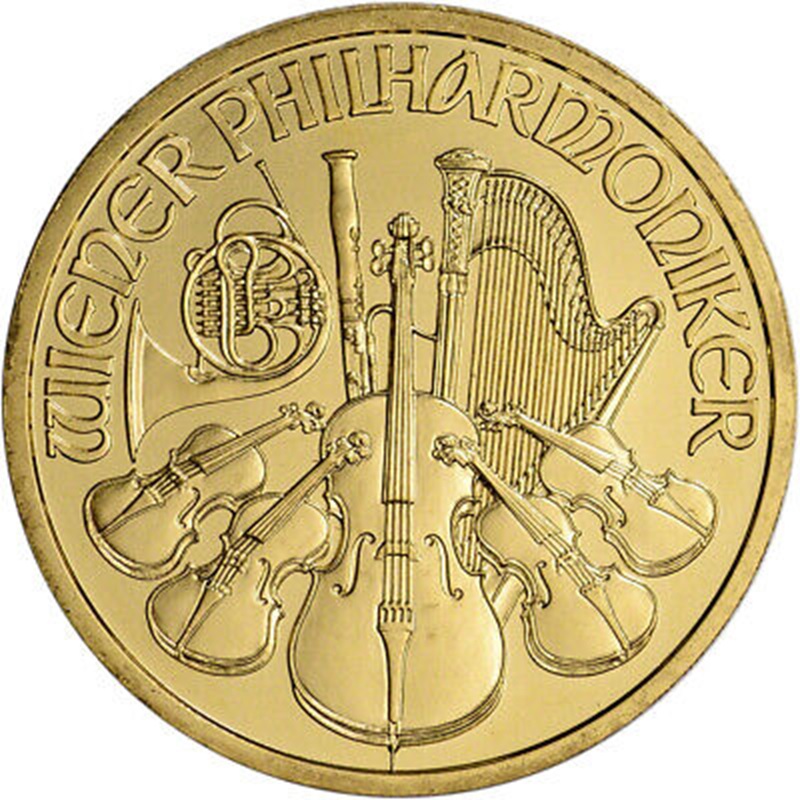
The Philharmonic is one of the lowest-premium .9999 fine sovereign coins. See how it ranks in our guide to comparing government gold coins.
Why Premiums Are Typically Lower
One of the Philharmonic’s most significant advantages for bullion investors is its consistently competitive pricing. Among the world’s major sovereign gold coins — the American Gold Eagle, Canadian Maple Leaf, South African Krugerrand, and the British Britannia — the Philharmonic frequently carries one of the lowest premiums over the spot price of gold.
Several factors contribute to this pricing advantage. The Austrian Mint operates with high production efficiency, and the Philharmonic does not carry the same level of collector-driven demand that inflates premiums on coins like the American Gold Eagle. The result is that stackers and long-term investors can acquire more gold for the same outlay. Buyers focused on minimizing their cost per ounce should compare current Philharmonic prices across dealers against other sovereign options to verify which offers the best value on any given day.
The Silver Philharmonic follows a similar pattern. In the silver market, it competes directly with the Silver Maple Leaf and the other major sovereign silver coins covered in our 2026 silver bullion buyer’s guide, and it typically prices at or near the lower end of the premium range for government-issued silver.
Purity and Authenticity
The Gold Philharmonic is struck from .9999 fine gold (24 karat), placing it in the highest purity tier alongside the Canadian Maple Leaf and the Australian Kangaroo. This contrasts with the American Gold Eagle and the South African Krugerrand, which use .9167 fine (22 karat) gold alloyed with copper for added durability. For investors buying strictly for metal content, the .9999 purity means a 1 oz Gold Philharmonic contains exactly one troy ounce of pure gold with no alloy.
The Silver Philharmonic is .999 fine silver, which is the standard purity for sovereign silver bullion coins worldwide.
It is worth noting that the Philharmonic does not incorporate the advanced anti-counterfeiting security features found on some newer competing coins. The Canadian Maple Leaf has micro-engraved laser marks and radial line patterns, and the Britannia includes surface animation technology. The Philharmonic relies instead on the Austrian Mint’s precise die work, edge reeding, and weight/dimension consistency. For most investors purchasing from reputable dealers, this level of authenticity assurance is sufficient, though buyers in secondary markets should consider basic verification tools such as a precision scale and calipers.
The Austrian Mint: 800+ Years of Minting
The Austrian Mint (Münze Österreich) has one of the longest continuous operating histories of any mint in the world. Established in 1194 when Duke Leopold V used part of the ransom paid for King Richard the Lionheart of England to begin minting silver coins in Vienna, the institution has been producing coinage for over eight centuries. Today, the Mint operates as a subsidiary of the Austrian National Bank and combines traditional craftsmanship with modern minting technology.
This institutional depth matters for bullion investors because it underpins the coin’s credibility and global acceptance. The Austrian Mint’s reputation ensures that Philharmonics are recognized and readily traded at precious metals dealers, banks, and exchanges worldwide.
IRA Eligibility and Tax Considerations
Both the Gold and Silver Philharmonic meet the purity requirements for inclusion in a self-directed precious metals IRA in the United States. The gold version’s .9999 fineness exceeds the IRS minimum of .995, and the silver version’s .999 fineness meets the .999 threshold for silver. This makes the Philharmonic a practical option for retirement account holders who want exposure to physical precious metals with the tax advantages of an IRA structure.
For European buyers, the Philharmonic’s legal tender status as a euro-denominated coin may provide certain tax advantages depending on the jurisdiction. In several EU countries, investment-grade gold coins with legal tender status are exempt from value-added tax (VAT). Buyers should consult local tax regulations for specifics.
How the Philharmonic Fits a Bullion Portfolio
The Philharmonic occupies a specific niche in the bullion coin market: it is a high-purity, low-premium, globally recognized sovereign coin from a mint with centuries of institutional credibility. It may not carry the collector premiums or advanced security features of some competitors, but for buyers whose primary goal is acquiring the most metal per dollar, it consistently ranks among the best options available.
For a broader comparison of how the Philharmonic stacks up against other major sovereign coins, see our guide to the top 10 most popular gold coins for investors. If you’re focused on the silver side, the Philharmonic is also featured in our 2026 silver bullion buyer’s guide.
Compare 2026 Philharmonic Prices
Premiums on Philharmonic coins vary from dealer to dealer and shift with market conditions. The best way to ensure you’re getting a competitive price is to compare current offerings across multiple dealers before buying.
Compare 2026 Gold Philharmonic prices across dealers →
Compare 2026 Silver Philharmonic prices across dealers →
This article is for informational purposes only and does not constitute financial or investment advice. Precious metals carry market risk, and past performance does not guarantee future results. Always conduct your own research and consult with a qualified financial advisor before making investment decisions.