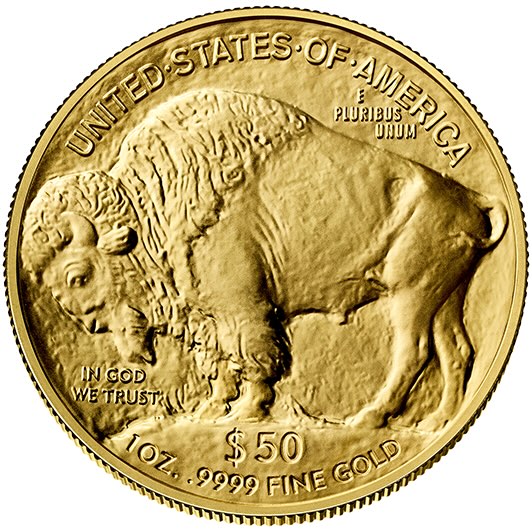
The American Gold Buffalo is the purest gold coin the United States Mint has ever produced. Struck in one troy ounce of .9999 fine (24-karat) gold, it has been the Mint’s flagship pure gold offering since its debut in 2006 and remains one of the most sought-after gold bullion coins in the world.
History and Design
The Gold Buffalo’s design comes from one of the most iconic coins in U.S. numismatic history: the Buffalo nickel, designed by sculptor James Earle Fraser and first struck in 1913.
Fraser’s obverse features a composite portrait of a Native American. In 1938, Fraser identified three chiefs who sat as models: Iron Tail (Oglala Lakota), Two Moons (Northern Cheyenne), and Big Tree (Kiowa). His stated intent was not to create a portrait of any individual, but a type, a representative image drawn from multiple sittings. The reverse depicts an American bison, traditionally identified as Black Diamond, a bison that lived at the Bronx Zoo in New York in the early 1900s, though Fraser himself never confirmed the specific animal.
The Buffalo nickel circulated from 1913 to 1938. When Congress passed the Presidential $1 Coin Act of 2005 (Public Law 109-145), Title II of the legislation authorized the American Buffalo Bullion Coin Program, selecting Fraser’s century-old artwork as the design. The first American Gold Buffalo coins were struck at the West Point Mint in 2006.
The Gold Buffalo was the first .9999 fine (24-karat) gold coin produced by the United States Mint. Before its launch, the American Gold Eagle, struck in 22-karat gold, had been the Mint’s only gold bullion coin since 1986. The Buffalo filled a gap for investors who wanted U.S. Mint gold at the same purity level as the Canadian Gold Maple Leaf and Austrian Philharmonic (both .9999 fine).
Specifications
The American Gold Buffalo is produced in a single size: one troy ounce. Unlike the Gold Eagle, which comes in 1 oz, 1/2 oz, 1/4 oz, and 1/10 oz sizes, the Buffalo is a one-ounce-only coin.
The Mint briefly offered fractional sizes in 2008 only. The fractional Gold Buffalo coins typically carry numismatic premium and are sought by collectors.
| Specification | Detail |
|---|---|
| Metal content | 1.0000 troy ounce of gold |
| Purity | .9999 fine (24-karat) |
| Weight | 31.108 grams |
| Diameter | 32.70 mm (1.287 inches) |
| Thickness | 2.95 mm (0.116 inches) |
| Face value | $50 |
| Edge | Reeded |
| Designer | James Earle Fraser (original 1913 design) |
The coin’s $50 face value is nominal; its market value tracks the gold spot price plus a dealer premium. Like all U.S. legal tender bullion coins, the Gold Buffalo is backed by the U.S. government for weight and purity. Bullion versions do not carry a mint mark; only proof editions bear the “W” for the West Point Mint.
2026 Gold Buffalo: The Semiquincentennial Edition
The 2026 Gold Buffalo carries special significance. As part of the United States Semiquincentennial (250th anniversary) celebration, the 2026-W Proof Gold Buffalo features a dual date (1776 ~ 2026) and a Liberty Bell privy mark bearing the numeral “250.” This is the first time the U.S. Mint has placed a privy mark on a 24-karat gold coin. The privy mark sits near the usual location of the W mint mark, which has been moved between the headdress feathers. The dual date appears along the lower right rim rather than on the portrait’s shoulder.
The 2026 Proof Gold Buffalo launched on May 7, 2026, with a product limit of 15,000 units and an issue price of $3,540. It sold out quickly. For full details on the 2026 Proof release, see 2026-W Proof Gold Buffalo: First Dual Date, First Privy Mark.
The 2026 bullion (BU) version, the investment-grade coin sold through authorized dealers and retailers including Costco, carries the standard Fraser design without the dual date or privy mark.
For details on all 2026 U.S. Mint bullion releases, including the Gold Eagle, Silver Eagle, and Semiquincentennial commemoratives, see our guide to 2026 US Mint Bullion Coins: What to Know Before Buying.
Mintage by Year
The Gold Buffalo’s annual mintage has varied significantly based on gold demand and market conditions. Complete bullion mintage history:
| Year | Bullion Mintage |
|---|---|
| 2006 | 337,012 |
| 2007 | 136,503 |
| 2008 | 189,500 |
| 2009 | 200,000 |
| 2010 | 209,000 |
| 2011 | 250,000 |
| 2012 | 100,000 |
| 2013 | 198,500 |
| 2014 | 180,500 |
| 2015 | 220,500 |
| 2016 | 219,500 |
| 2017 | 99,500 |
| 2018 | 121,500 |
| 2019 | 61,500 |
| 2020 | 242,000 |
| 2021 | 350,500 |
| 2022 | 410,000 |
| 2023 | 387,000 |
| 2024 | 186,500 |
| 2025 | 160,000 |
The 2006 debut year saw the highest initial demand at 337,012 coins. In September 2008, the Mint temporarily suspended sales; demand during the financial crisis outstripped production capacity. The lowest mintage year was 2019 at 61,500 coins, a period of relatively low gold investment demand before the pandemic. The 2020 to 2023 period saw a sharp increase driven by pandemic uncertainty, inflation, and rising gold prices, peaking at 410,000 coins in 2022.
Total bullion mintage since 2006 exceeds 4 million coins. For the complete mintage history including proof coins, fractional sizes, and the 2013 Reverse Proof, see our American Buffalo Gold Coin Mintage Charts and History.
Bullion vs. Proof
The U.S. Mint produces the Gold Buffalo in two finishes each year:
Bullion (BU): The investment-grade version, sold through the Mint’s Authorized Purchaser network to dealers like JM Bullion, SD Bullion, APMEX, and others, and through retailers like Costco. Bullion Buffalos have a satin finish and no mint mark. These trade at a modest premium over the gold spot price.
Proof: The collector version, sold directly by the U.S. Mint at a significant premium. Proof Buffalos feature a mirror-like background with frosted design elements (cameo finish), come in presentation packaging with a Certificate of Authenticity, and carry the W mint mark. Proof mintages are much lower, typically 10,000 to 20,000 coins per year versus 100,000 to 400,000 for bullion.
For investors focused on gold content, the bullion version is the better buy. The proof carries a collector premium that does not track the gold price; it is driven by collector demand and mintage scarcity.
Where to Buy
The Gold Buffalo is widely available from online bullion dealers and is one of the gold coins Costco sells through its precious metals program.
Online dealers offer the broadest selection and most competitive pricing. The difference between the highest and lowest price for the same coin on the same day can be $50 to $100 or more. Our gold coin price comparison tools show real-time pricing from online dealers. You can also browse current availability on our American Gold Buffalo collection page.
Costco sells the 2026 1 oz American Gold Buffalo through Costco.com at a price that updates daily with the spot market. Purchase limits are 1 transaction per membership, 4 units per 24 hours. Shipping is included via FedEx insured, and bullion purchases are non-refundable. Executive members with a Costco Visa can earn 2 to 4% cash back (2% Executive reward + 2% Visa reward), which can make Costco’s net price competitive with online dealers, though Costco’s selection is limited and their pricing does not always beat the lowest dealer premium.
For a full breakdown of Costco’s precious metals program, including purchase limits and pricing comparisons, see our Costco gold, silver, and platinum guide.
Gold Buffalo vs. Gold Eagle
We have written a detailed comparison: Comparing the American Gold Eagle vs American Gold Buffalo. The key differences:
Purity: The Gold Buffalo is .9999 fine (24K). The Gold Eagle is .9167 fine (22K) with copper and silver alloys for durability. Both contain exactly one troy ounce of pure gold. The Eagle weighs more total (33.93g vs. 31.108g) because of the alloy.
Sizes: The Gold Eagle comes in four sizes (1 oz, 1/2 oz, 1/4 oz, 1/10 oz). The Buffalo is 1 oz only. For fractional gold from the U.S. Mint, the Eagle is the only option. For a broader look at fractional options, see our fractional gold coin comparison.
Premiums: Gold Eagles typically carry slightly lower premiums than Buffalos. The Buffalo’s higher purity and generally lower mintage contribute to its slightly higher premium over spot.
Durability: The Eagle’s 22-karat alloy is harder and more scratch-resistant. For coins stored in capsules or tubes, which is how most investors store bullion, this difference is negligible.
Liquidity: Both are instantly recognized and highly liquid in U.S. and global markets. The Eagle has been around longer (since 1986 vs. 2006) and has greater worldwide recognition, but the Buffalo has no liquidity issues.
Most experienced gold investors own both: Eagles for flexibility and fractional sizes, Buffalos for maximum purity. For a broader look at gold coin options, see our guide to the best gold coins to buy.
The Buffalo is the only US-minted .9999 fine gold coin, but several foreign sovereign coins match that purity. See the full breakdown in comparing government-backed gold coins.
Gold Buffalo in an IRA
The Gold Buffalo qualifies for a self-directed precious metals IRA. Its .9999 fineness exceeds the IRS minimum purity requirement of .995 for gold held in an IRA. The Gold Eagle is also IRA-eligible through a specific exemption despite being 22-karat.
The deciding factors for a gold IRA are custodian fees, storage costs, and the premium paid on coins, not which of these two coins you choose. Both work equally well.
Compare Gold Prices Before You Buy
At current prices, the premium you pay on a Gold Buffalo matters. A 1% difference in dealer premium is $40 to $50+ per coin, and on a five-coin purchase, that adds up fast.
FindBullionPrices tracks pricing from online dealers:
- 1 oz Gold Coins: Compare Eagles, Maple Leafs, Buffalos, Britannias, Krugerrands, and similar coins
- Gold Bullion: Coins, bars, and rounds sorted by premium
- Gold Bar Price: 1 oz to kilo bars from PAMP, Valcambi, and other refiners
- Buy Gold at Spot Price: Zero-premium offers for new customers
Frequently Asked Questions
What is the American Gold Buffalo coin? A 1 oz .9999 fine (24-karat) gold bullion coin produced by the U.S. Mint since 2006. It features James Earle Fraser’s Buffalo nickel design and carries a $50 face value.
Is the Gold Buffalo pure gold? Yes. It is .9999 fine, or 99.99% pure. It is the purest gold coin the U.S. Mint has produced.
How much does a Gold Buffalo cost? The price tracks the gold spot price plus a dealer premium typically ranging from 3 to 5% over spot. Use our gold coin comparison tools to see current pricing from multiple dealers.
Does Costco sell Gold Buffalo coins? Yes. Costco sells the 2026 1 oz Gold Buffalo through Costco.com with a limit of 1 transaction per membership, 4 units per 24 hours. Executive members with a Costco Visa can earn up to 4% cash back.
What is the difference between a Gold Buffalo and a Gold Eagle? The Buffalo is .9999 fine (24K); the Eagle is .9167 fine (22K with alloys). Both contain one troy ounce of pure gold. The Eagle comes in four sizes; the Buffalo in one. See our full Gold Eagle vs Gold Buffalo comparison.
Is the Gold Buffalo good for an IRA? Yes. Its .9999 fineness exceeds the IRS minimum (.995) for gold in a self-directed precious metals IRA.
What is the Gold Buffalo mintage? Annual bullion mintage has ranged from 61,500 (2019) to 410,000 (2022). Total bullion mintage since 2006 exceeds 4 million coins. See our Gold Buffalo mintage charts for year-by-year figures.
What makes the 2026 Gold Buffalo special? The 2026-W Proof features a dual date (1776 ~ 2026) and a Liberty Bell privy mark with the numeral “250” for the U.S. Semiquincentennial, the first privy mark ever placed on a U.S. Mint 24-karat gold coin. The bullion version maintains the standard design.