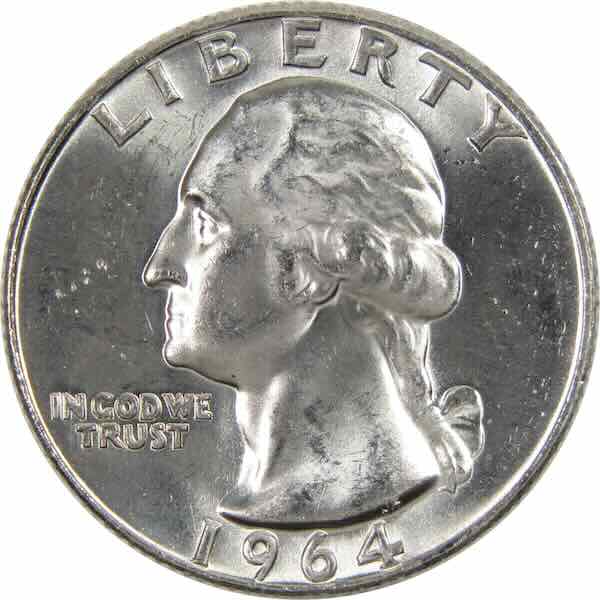
The 1964 Washington Quarter holds a unique place in American numismatics as the last quarter struck for circulation containing 90% silver. Produced in record quantities at both the Philadelphia and Denver Mints, these coins marked the end of an era before the United States transitioned to copper-nickel clad coinage in 1965. In 2026, the 1964 quarter is valued by both silver investors for its precious metal content and by collectors for its many proof, error, and high-grade varieties.
Due to rising silver spot prices and economic changes in the mid-1960s, the U.S. government enacted the Coinage Act of 1965, eliminating silver from dimes and quarters. This makes the 1964 quarter a transitional coin with both numismatic and intrinsic metal value. Whether you found one in a roll of junk silver quarters or inherited a collection, understanding what your 1964 quarter is worth requires knowing the mint mark, condition, and whether it has any error characteristics.
1964 Quarter Silver Content and Melt Value
Every 1964 Washington Quarter contains 0.18084 troy ounces of pure silver in a 90% silver, 10% copper composition. The coin weighs 6.25 grams with a diameter of 24.3 mm. Based on the current spot price of silver, the melt value of a 1964 quarter is approximately $11.10. You can verify this using our silver coin melt value calculator. Most circulated 1964 quarters trade at or slightly above their silver melt value, making them a popular way to acquire physical silver at low premiums.
| Specification | Detail |
|---|---|
| Composition | 90% Silver, 10% Copper |
| Weight | 6.25 grams |
| Silver Weight | 0.18084 troy oz |
| Diameter | 24.3 mm |
| Designer | John Flanagan |
| Mintage (Philadelphia) | 560,390,585 |
| Mintage (Denver) | 704,135,528 |
1964 No Mint Mark Quarter Value (Philadelphia)
The 1964 Philadelphia quarter carries no mint mark, as was standard practice for the Philadelphia Mint at this time. With a mintage of over 560 million coins, these are common in circulated grades and typically trade at melt value. However, high-grade uncirculated examples and coins with exceptional eye appeal can command significant premiums.
| Grade | Estimated Value |
|---|---|
| Good (G-4) to Fine (F-12) | $11.10 |
| Extremely Fine (EF-40) | $11.10 – $11.72 |
| Mint State (MS-60) | $12.33 – $12.95 |
| Mint State (MS-63) | $20 – $30 |
| Mint State (MS-65) | $35 – $50 |
| Mint State (MS-67+) | $500 – $12,000+ |
The highest known auction record for a 1964 Philadelphia quarter is $12,000 for a coin graded PCGS MS-67+. Coins in the MS-66 to MS-67 range regularly trade between $100 and $500, making gem-quality examples worthwhile to identify and have professionally graded.
1964-D Quarter Value (Denver)
The 1964-D quarter features a small “D” mint mark on the reverse, located just below the olive branches near the eagle’s tail feathers. Denver produced over 704 million quarters in 1964, making it the highest single-year mintage for any 90% silver quarter. Despite the enormous mintage, high-grade survivors are scarce because so many entered circulation.
| Grade | Estimated Value |
|---|---|
| Good (G-4) to Fine (F-12) | $11.10 |
| Extremely Fine (EF-40) | $11.10 – $11.72 |
| Mint State (MS-60) | $12.33 – $12.95 |
| Mint State (MS-63) | $20 – $25 |
| Mint State (MS-65) | $25 – $40 |
| Mint State (MS-67) | $1,000 – $5,000 |
| Mint State (MS-68) | $20,000 – $38,400 |
The record auction sale for a 1964-D quarter is $38,400 for a coin graded PCGS MS-68. This makes the 1964-D in top condition one of the most valuable common-date Washington quarters, as the jump from MS-67 to MS-68 represents extreme rarity in this series.
1964 Proof Quarter Value
The Philadelphia Mint produced proof 1964 quarters as part of the 1964 Proof Set. These coins were struck using specially polished dies and planchets, producing a mirror-like finish on the fields with frosted design elements. Proof 1964 quarters are designated as either standard proof, cameo, or deep cameo based on the contrast between frosted devices and mirrored fields.
| Grade | Estimated Value |
|---|---|
| Proof (PR-60) | $11.10 – $11.72 |
| Proof (PR-65) | $25 – $35 |
| Proof Cameo (PR-65 CAM) | $30 – $50 |
| Proof Deep Cameo (PR-65 DCAM) | $75 – $125 |
| Proof Deep Cameo (PR-69 DCAM) | $150 – $300 |
Deep cameo and ultra cameo proof quarters from 1964 are more desirable than standard proofs because of the striking visual contrast between frosted and mirrored surfaces. While most proof 1964 quarters are worth $10 to $20, high-grade deep cameo examples in PR-67 DCAM and above can bring $100 to $300 or more at auction.
1964 Quarter Error Coins and Varieties
Given the massive production of 1964 quarters across two mints, a number of die errors and striking varieties have been documented. Error coins from this year range from minor die cracks worth a small premium to major varieties that can be worth hundreds or thousands of dollars. Here are the most significant error types to look for.
Double Die Obverse (DDO)
Several double die obverse varieties exist for the 1964 quarter, with doubling visible in the lettering of “IN GOD WE TRUST” and “LIBERTY.” The most prominent DDO varieties are cataloged in the Cherrypickers’ Guide and can be identified under magnification. Strong DDO examples typically sell for $50 to $500 depending on the strength of doubling and the coin’s overall grade.
Double Die Reverse (DDR)
Double die reverse varieties (cataloged as FS-801 through FS-804 in the Cherrypickers’ Guide) show doubling on the reverse lettering, particularly in “UNITED STATES OF AMERICA” and “QUARTER DOLLAR.” These varieties are less common than DDO errors and can be worth $100 to $1,920 depending on the specific variety and grade. The FS-801 is considered the most desirable.
1964-D/D Repunched Mint Mark
Several repunched mint mark varieties exist on 1964-D quarters where the “D” mint mark was punched into the die more than once, creating a visible doubling or shifting of the mint mark. These are designated as RPM varieties and typically add $15 to $75 to the coin’s value, depending on the prominence of the repunching.
Off-Center Strikes
Off-center strikes occur when the planchet is not properly aligned with the dies during striking. A 1964 quarter struck 5% to 10% off-center may be worth $20 to $50, while dramatically off-center examples (25% or more) with a visible date can bring $100 to $300. The more off-center the strike while still showing the date, the more valuable the error.
Clipped Planchets
Clipped planchet errors occur when the blank coin is cut from an area of the metal strip that overlaps with a previously punched hole, resulting in a curved clip on the edge of the coin. Straight clips and curved clips on 1964 quarters are worth $25 to $100 depending on the size and type of clip.
Die Cracks and Cuds
Die cracks appear as raised lines on the surface of the coin where the die has begun to fracture. Minor die cracks add $5 to $15 to a coin’s value. Major die breaks that create a “cud” (a raised blob of metal at the rim where a piece of the die has broken away) can be worth $50 to $200 depending on the size and location of the cud.
1964 Quarter Error Value Summary
| Error Type | Estimated Value Range |
|---|---|
| Double Die Obverse (DDO) | $50 – $500 |
| Double Die Reverse (DDR) | $100 – $1,920 |
| Repunched Mint Mark (RPM) | $25- $75 |
| Off-Center Strike (5-10%) | $20 – $50 |
| Off-Center Strike (25%+) | $100 – $300 |
| Clipped Planchet | $25 – $100 |
| Minor Die Crack | $11.10 – $11.72 |
| Major Die Cud | $50 – $200 |
Key Factors That Affect 1964 Quarter Value
Condition and Grading
Condition is the single most important factor in determining a 1964 quarter’s value above melt. Coins are graded on the Sheldon scale from 1 (barely identifiable) to 70 (perfect). For 1964 quarters, the value difference between an MS-65 ($25) and an MS-67+ ($5,000+) is enormous. Original mint luster, absence of contact marks, and a strong strike all contribute to a higher grade. If you believe you have a high-grade example, professional grading from PCGS or NGC is recommended.
Silver Content
The silver content provides a floor value for every 1964 quarter. With 0.18084 troy ounces of silver, the current melt value is $11.10, which fluctuates with the spot price of silver. Even heavily worn 1964 quarters will always be worth at least their silver content, which provides downside protection that post-1964 quarters do not have.
Collector Demand and Market Trends
The 1964 quarter benefits from collector interest across multiple areas: silver investors, Washington quarter series collectors, error coin specialists, and proof set collectors. This broad demand base helps maintain liquidity and stable pricing. Registry set competition at PCGS and NGC for top-graded examples can drive prices significantly higher for coins graded MS-67 and above.
How to Sell Your 1964 Quarters
If you have 1964 quarters to sell, your options depend on the coins’ condition and quantity. Circulated 1964 quarters in average condition are best sold as junk silver to bullion dealers, where they will be priced based on silver content. Use FindBullionPrices.com to compare dealer buy-back prices and find the best offer. For high-grade uncirculated coins or error varieties, consider having them professionally graded before selling through a coin dealer or auction house, as graded coins typically realize higher prices than raw coins.
Related Coin Value Guides
Explore our other coin value and numismatic guides:
- 1965 Quarter Value Guide
- 1967 Quarter Value Guide
- 1966 Quarter Value Guide
- 1999 Georgia Quarter Errors
- Bicentennial Quarters Worth Money
- Silver Quarters Guide
- 90% Silver Quarter Prices
- 1922 Silver Dollar Value
- Silver Bullion Coin Buyer’s Guide
- Top 10 Gold Coins for Investors
Disclaimer: This article is for informational and educational purposes only and should not be considered financial or investment advice. Coin values are estimates based on recent market data and auction results and may vary based on condition, market demand, and other factors. Prices fluctuate with the precious metals market. Always consult with a qualified numismatic professional or financial advisor before making significant purchasing or selling decisions. FindBullionPrices.com is a price comparison platform and does not buy or sell coins directly.