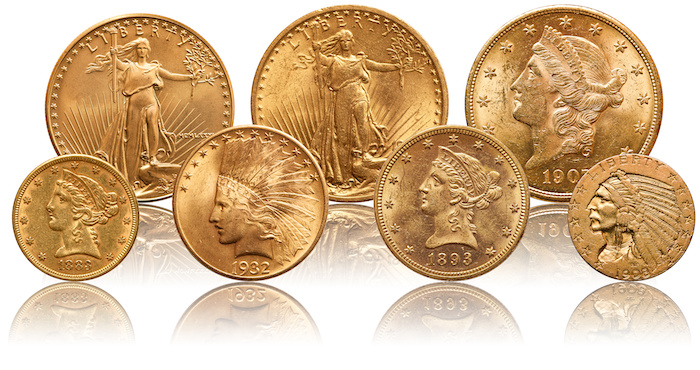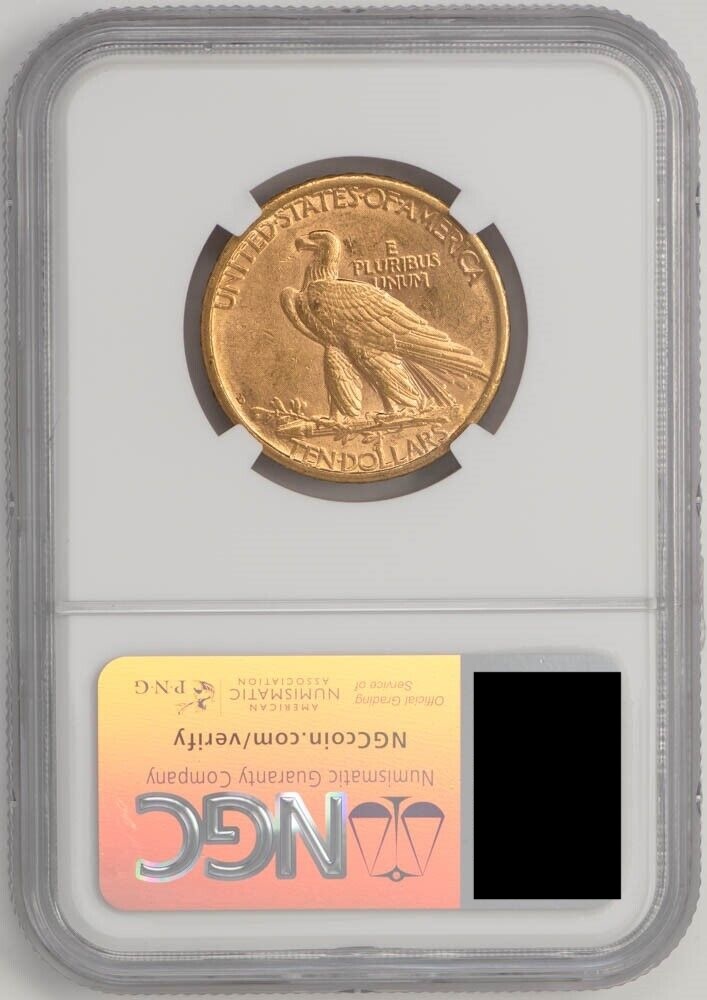
The classic $10 Gold Coin, particularly the Liberty Head and Indian Head Eagles, sits right in the overlap between bullion and numismatics. Owning gold is pretty simple. Picking the right gold is not. With the $10 Gold Coin, you’re buying almost a half ounce of gold, but you’re also buying a finite pre-1933 U.S. coin series that collectors care about and that the market has traded actively for more than a century.
What is the $10 Gold Coin?
The U.S. $10 Gold Coin, declared the Eagle in the Coinage Act of 1792 was a workhorse denomination of the gold standard era. First issued in 1795, it continued (with gaps and design changes) until 1933, when private gold ownership was heavily restricted under Executive Order 6102.
For modern buyers, two series dominate the market:
- Liberty Head $10 Gold Coin (1838–1907)
- Indian Head $10 Gold Coin (1907–1933)
Both:
- Contain 0.48375 troy ounces of gold in a 90% gold / 10% copper alloy
- Are widely recognized and actively traded by major dealers
- Have enough surviving common dates that they function as quasi-bullion
- Have scarcer dates and grades that are firmly numismatic plays
That combination — bullion floor + numismatic potential — is why these coins show up in both investment portfolios and serious collections.
Liberty Head $10 Gold Coin (1838–1907)
Design and Specifications
The Liberty Head $10 Gold Coin (often called the Coronet Head Eagle) was designed by Christian Gobrecht, the third Chief Engraver of the U.S. Mint.
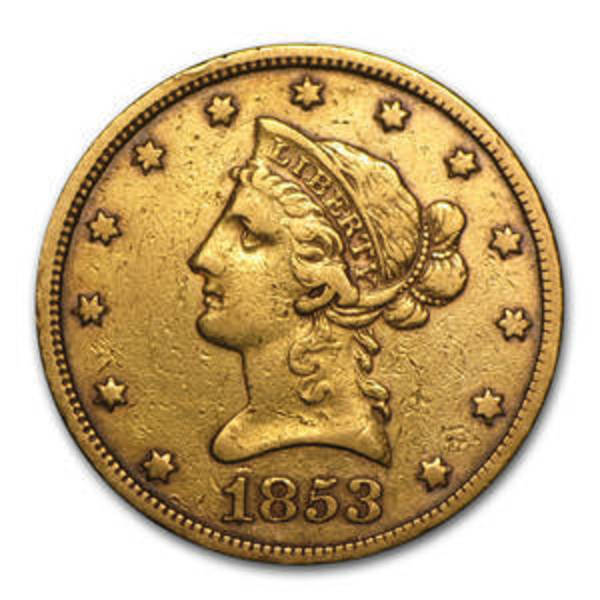
Key points:
- Obverse: Left-facing Liberty wearing a coronet inscribed LIBERTY, surrounded by 13 stars and the date below.
- Reverse: Heraldic eagle with shield, holding arrows and olive branch, surrounded by UNITED STATES OF AMERICA and TEN D.; mintmark below eagle.
- Composition: 90% gold, 10% copper
- Gold content: 0.48375 troy oz
- Years struck: 1838–1907 (with subtype changes such as the addition of IN GOD WE TRUST in 1866) (PCGS)
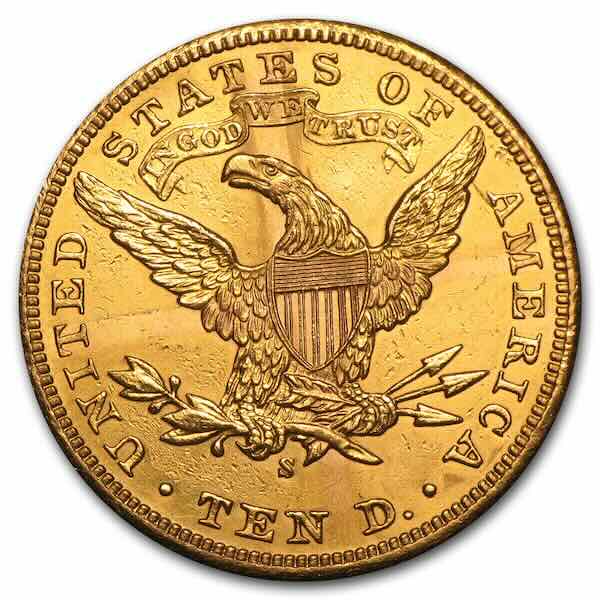
Numismatically, certain dates and mintmarks are tough; but for most bullion-oriented buyers, “common date, random year” Liberty $10s are essentially a semi-numismatic gold vehicle with a strong collector following. PCGS and other price guides show deep collector markets but very modest premiums for generic, circulated common dates.
Premiums over spot for Liberty $10 Gold Coins
Based on current price comparisons and recent listings from large, reputable bullion dealers, we can map out realistic premium bands for common-date Liberty $10 Gold Coins (not key dates, not condition rarities).
Spot gold: $4,338.66 / oz
Typical Premiums – Liberty Head $10 Gold Coin (Common Dates)
| Grade band / Market bucket | Typical % premium over spot* | How that translates in practice |
|---|---|---|
| VF–XF Circulated (“generic common”) | ~1.2% – 2.0% | Often sold as “Random Year” or specified XF; treated as semi-bullion by many dealers. |
| AU (Choice Circulated / AU50–AU58) | ~2.0% – 3.0% (est.) | Thin data point spread; usually prices fill the gap between XF and lower-MS coins. |
| BU / MS60–MS61 (uncertified or slabbed) | ~3.0% – 3.5% | Generic uncirculated commons; often marketed to both stackers and entry-level collectors. |
| Retail BU/MS62+ (branded “premium BU”) | ~3.5% – 5.5% | Higher eye-appeal offerings from big retailers; brand and marketing push premiums to top of band. |
*Premiums are relative to melt value of the gold content. Markets move; these ranges can and will change. In the current market, common-date pre-1933 U.S. gold is currently trading at multi-decade low premiums relative to spot.
3. Indian Head $10 Gold Coin (1907–1933)
Design and Specifications
The Indian Head $10 Gold Coin (Indian Head Eagle) was part of Theodore Roosevelt’s push to elevate U.S. coinage into true “national art.” Sculptor Augustus Saint-Gaudens created the design, which the Mint modified for mass production.
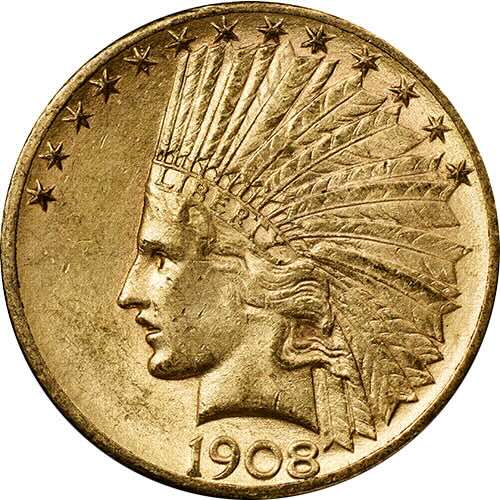
Key points:
- Obverse: Liberty wearing a Native American feathered headdress, LIBERTY across the band, with 13 stars and date.
- Reverse: Bald eagle standing on a bundle of arrows and an olive branch; UNITED STATES OF AMERICA, E PLURIBUS UNUM and IN GOD WE TRUST (added in 1908 after public pushback).
- Composition: 90% gold, 10% copper
- Gold content: 0.48375 troy oz (same as Liberty)
- Years struck: 1907–1933
NGC and PCGS both emphasize that truly high-grade Indian $10s (MS-65 and up) are legitimately scarce, while VF–AU commons are far more available and tend to trade with bullion-like behavior.
Premiums over spot for Indian $10 Gold Coins
Spot gold: $4,338.66 / oz
| Grade band / Market bucket | Typical % premium over spot* | How that translates in practice |
|---|---|---|
| VF–XF / Circulated / Cleaned (generic common) | ~3.3% – 4.0% | Often listed as “VF” or “Circulated/Cleaned”; still very liquid but carries a modest numis bump. |
| About Uncirculated (problem-free, decent eye appeal) | ~4.0% – 5.5% | Appeals to crossover buyer: investor + collector; more sensitive to small grade differences. |
| BU / Choice Unc (raw or low-MS) | ~4.0% – 6.0% | Indian design is popular; even generic BU usually sells above Liberty at equivalent grades. |
*Again: premiums are relative to melt value of the gold content, based on current dealer quotes and the spot gold figure from your table. Future market levels may differ significantly.
Counterfeits and altered coins
Pre-1933 $10s are heavily counterfeited, including real-gold fakes and altered coins.
To manage that risk:
- Favor coins certified by PCGS or NGC for anything beyond low-grade generic.
- Buy from established dealers with strong reputations in both bullion and numismatics (not random online Facebook sellers).
Liquidity, Spreads and Condition
Even when premiums are low, spreads exist:
- You might pay +3–5% over melt and sell back at +0–2%, depending on market stress and dealer appetite.
- Local coin shops and online dealers sometimes pay closer to melt on generic material, especially in forced-selling environments.
- Grade drives value. Paying numismatic premiums for a coin that turns out to be over-graded, cleaned, or damaged is an easy way to lose money.
- If you’re paying serious numismatic money, stick to slabbed coins from top-tier services.
You should not assume you can instantly recover the full premium you paid.
5.4 Market and price risk
Gold prices can fall. Numismatic premiums can also shrink if:
- Demand shifts to other series
- A wave of supply hits (estate liquidations, meltbacks reversing)
- Economic conditions change and buyers prioritize tight-spread bullion
None of these coins guarantee profit. They’re tools for wealth preservation, diversification, and collecting, not a quick flip.
7. Bottom Line
Right now, common-date $10 Gold Coins — especially Liberty Head and Indian Head Eagles — are priced in a way that blurs the line between bullion and collectible:
- Liberty $10s often sit in the +1–3% over melt band for VF–AU
- Indian $10s typically run +3–5% for VF–AU
- Choice BU and low-MS coins push into the mid-single-digit premium range
That’s historically low for pre-1933 U.S. gold and creates a window for bullion investors to add historic coins without paying old-school numismatic markups.
Still, you should treat them as part of a broader strategy, not your entire plan. Double-check pricing, confirm authenticity, and consider speaking with a qualified financial or tax professional if you’re making large allocations.
Related Guides
For deeper information on specific denominations and topics within the pre-1933 gold series, explore these guides:
- Pre-1933 Gold Coins: The Complete Collector & Investor Guide
- Saint-Gaudens Double Eagle: Value, Premiums, Key Dates, and How to Buy Smart
- Common-Date $20 Liberty Double Eagle Values and Conditions
- Collecting Liberty Head Half Eagle $5 Gold Coins
- The Joys of Collecting $2.50 Quarter Eagle Gold Coins
- Coin Grading: The Sheldon Scale & NGCX
- Top 10 Vintage Gold Coins for Investors
This article is for informational and educational purposes only. It is not financial, investment, or tax advice. Gold coin values fluctuate with precious metals markets and numismatic demand. Past performance does not guarantee future results. Consult a qualified financial advisor before making investment decisions. FindBullionPrices.com is a price comparison platform and does not sell coins directly.